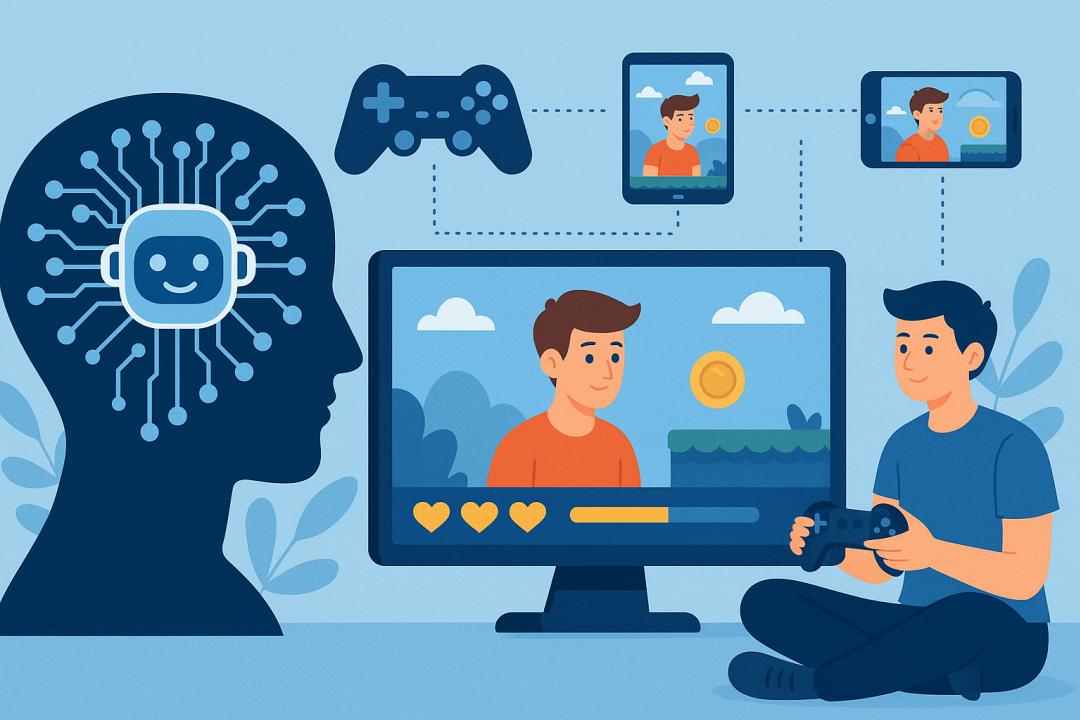
It is a competitive world today; every gaming industry is focusing on two major things: player retention and player acquisition. What is making their task even harder is cross-platform games. Players demand for seamless gaming experience, adaptive gameplay, and consistent performance on platforms like PC, mobile, and console.
Here, artificial intelligence plays a vital role; an AI game development company helps experienced as well as new developers to fine-tune every aspect of gaming so that players get engaged in games. In this article, we will explore insights about how AI is contributing to increasing the player retention rate in games.
What are AI Games?
These games often include artificial intelligence to develop smarter, adaptive games that provide a personalised gameplay experience. AI introduces elements like enemy behavior, dynamic difficulty, customized missions, real-time decision-making, and engaging gameplay, making them more immersive and interactive for players.
How AI is Helping to Improve Player Retention Rate?
Various reasons like providing personalized gaming, seamless cross-platform optimization, predictive churn analysis, and more. Below, let’s understand in detail how AI helps in cross-platform games.
Personalized Gameplay and Adaptive Difficulty
AI allows games to adapt to the player's behavior, how they play, and by analyzing the player's difficulty level, it sets the game accordingly in cross-platform games and in other games as well.
Key Benefits:
- Modifies game difficulty according to the player's skill
- Suggests quests, weapons, or game modes based on user preferences.
- Creates custom challenges to encourage players’ mastery and progression.
Some Real Examples
Call of Duty and Fortnite use skill-based matchmaking systems and adaptive gaming powered by AI to group players of similar capabilities, creating fairer, more engaging sessions.
Seamless Cross-Platform Optimization
Cross-platform players expect a smooth gaming experience on every device, whether it's a mobile with limited processing power or a high-end PC. AI solves this problem by detecting the device’s strengths and limitations, like graphics power, internet speed, or device control type.
Key Benefits:
- Dynamic control adjustments
- Automated graphics scaling for smoother performance
- Input prediction and latency correction across platforms.
Some Real World Examples
Genshin Impact and Roblox optimize graphics and controls automatically across iOS, Android, PC, and consoles using AI-assisted rendering engines.
Predictive Churn Analysis and Retention Campaigns
To maintain player retention, AI automatically predicts when the game will stop playing the game by spotting the early signs of boredom or frustration while playing in the game. To minimize this, the AI arranges the rewards, offers, and reminders to the players so that they can continue the game without any boredom.
Key Benefits:
- After analyzing disengagement, it automatically sends notifications and emails
- Offers incentives within the game, like coins, power-ups, or exclusive content
- Makes the game easier or more fun when needed.
Smarter Onboarding and AI-Based Tutorials
In a cross-platform AI game, these are the key factors which has been observed by the game development companies. The players experienced a major drop-off point as they couldn’t figure out how to play or survive in the game. AI helps customize tutorials and onboarding by learning from each new user’s performance and interactions.
Key Benefits:
- Shortens the learning curve by adapting the tutorial pace and hints.
- Prevents players from getting overwhelmed with too much information.
- Builds confidence, increasing early-game satisfaction.
Procedural Content Generation for Continuous Engagement
AI helps in automatic content creation, like generating new missions, levels, apps, or challenges without needing a developer to manually design each one. With this AI personalization in the gameplay becomes fresh and interactive.
Key Benefits:
- Keeps the game world dynamic and surprising.
- Reduces content burnout in long-term players.
- Supports scalability in open-world or sandbox games.
AI in Community Engagement and Toxicity Control
More than playing, in multiplayer online games, interacting with people and socializing has a big impact on whether the player will stay or leave. A toxic environment, full of abuse, cheating, or bullying, can hurt the players, and it can drive them away. Here, AI is used to monitor and manage these interactions in real time. It can detect abusive language, flag inappropriate behavior, and even take automatic action like muting or banning players when necessary.
Key Benefits:
- Catches and blocks bad words and behavior instantly.
- Suggests friends, teams, or guilds based on compatibility.
- Promotes healthier, more welcoming in-game communities.
Final Words
Undoubtedly, AI is conquering the gaming industry by introducing new trends and technologies. It has become a goldmine for the startups. In a world where players are confused between devices and expect flawless, rewarding experiences, various AI game development company helps developers keep users happy, challenged, and engaged. From personalized gameplay to predictive strategies and AI-generated content, the possibilities are enormous and growing every day.