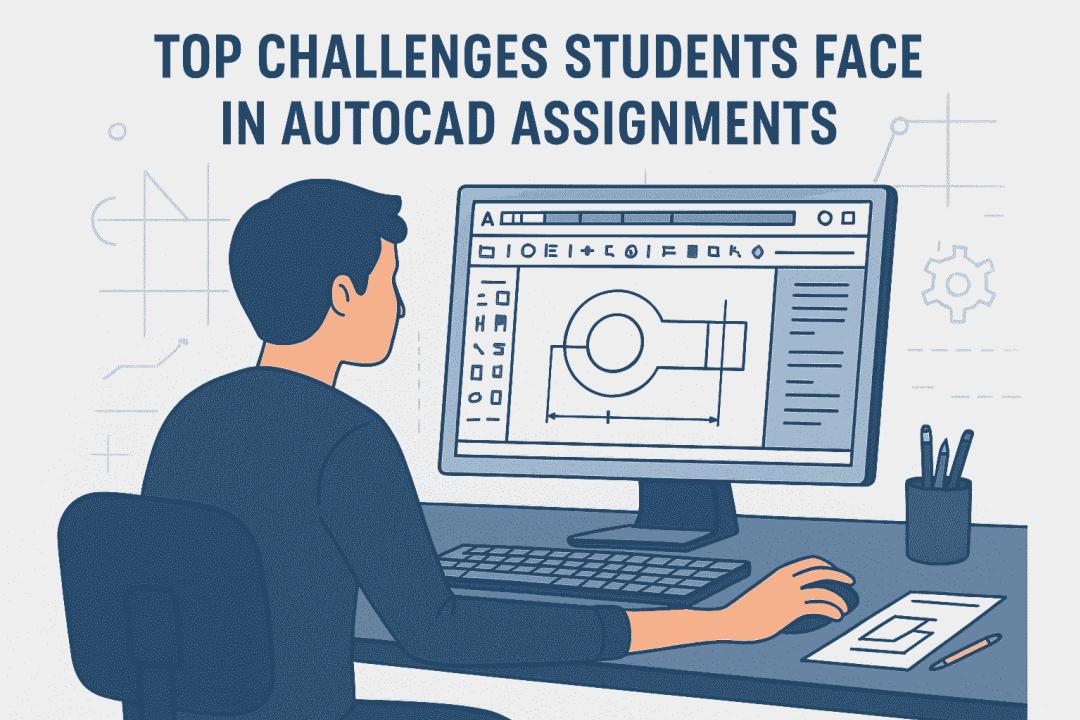
AutoCAD has become an essential software tool in universities across engineering, architecture, interior design, computer-aided manufacturing, and several technical disciplines. Whether students are drafting a mechanical part, creating architectural layouts, or preparing 3D models, AutoCAD plays a vital role in helping them understand real-world design processes. However, as powerful as the software is, learning and mastering AutoCAD comes with a unique set of challenges—especially when it comes to completing academic assignments.
Students often struggle with complex commands, time-consuming tasks, multi-layer drawings, and the pressure of submitting accurate and professional designs. This is one reason many learners seek AutoCAD assignment help online to guide them through demanding coursework.
In this detailed guide, we’ll explore the top challenges students face in AutoCAD assignments and how they can effectively overcome them. Whether you’re a beginner or advancing through your university modules, this article will help you understand common problems and learn practical solutions.
1. Understanding the Interface and Tools
AutoCAD’s interface is powerful—but also overwhelming for new users. The toolbar is filled with dozens of commands, functions, shortcuts, and features that can confuse beginners.
Why it’s challenging:
- Too many command tools to remember
- Difficulty understanding the ribbon, command line, and layout tabs
- Switching between 2D and 3D modes
- Confusion between model space and paper space
How to overcome it:
- Start by learning core commands such as LINE, TRIM, OFFSET, EXTRUDE, and DIMENSION
- Spend time personalizing the interface to hide unnecessary tools
- Practice using the command line for faster workflow
- Follow beginner-friendly tutorials to get comfortable with navigation
Mastering the interface early can significantly increase your productivity and reduce assignment errors.
2. Mastering Command Shortcuts
AutoCAD is a shortcut-driven tool, and students quickly realize that using the mouse alone is inefficient. But memorizing dozens of keyboard shortcuts can be intimidating.
Why it’s challenging:
- Students try to remember too many shortcuts at once
- Some shortcuts differ in 2D vs. 3D modes
- Wrong shortcut use can distort a drawing
How to overcome it:
- Learn shortcuts in small batches (5–10 per week)
- Print a shortcut reference chart for quick access
- Practice in real assignments so shortcuts become second nature
Small improvements in speed lead to significant time savings in large university projects.
3. Difficulty Creating Accurate Dimensions
Universities expect students to submit dimensionally accurate designs that follow industry standards. However, maintaining precision is one of the most difficult parts of AutoCAD assignments.
Why it’s challenging:
- Incorrect scale settings
- Mismatched units (centimeters vs. millimeters)
- Poor use of dimension >
- Misaligned measurement placement
How to overcome it:
- Set units before starting any drawing
- Use object snaps (OSNAP) for accurate measurement points
- Learn dimensioning tools like DIMLINEAR, DIMANGULAR, and DIMRADIUS
- Use ISO or ANSI standard templates provided by your university
Accurate dimensioning improves grading outcomes and makes your drawing look more professional.
4. Managing Layers Effectively
Layer management is essential in architecture, civil engineering, electronics, and mechanical drafting. Students often struggle to maintain clean, organized multi-layer drawings.
Why it’s challenging:
- Too many layers get created
- Incorrect layer naming
- Wrong line weights and colours
- Difficulty controlling visibility
How to overcome it:
- Learn university-approved layer standards
- Group similar elements under one layer
- Colour-code appropriately for easy navigation
- Lock layers when you’re not working on them
Being disciplined with layers improves readability and reduces assignment mistakes.
5. Handling Complex 3D Models
3D designing in AutoCAD introduces a new level of complexity. Students must understand coordinates, extrusions, constraints, and surface modeling.
Why it’s challenging:
- Understanding the X, Y, Z coordinate system
- Managing 3D viewports
- Difficulty converting ideas into 3D shapes
- Time-consuming rendering
How to overcome it:
- Begin with simple 3D exercises before attempting advanced models
- Use the VIEWCUBE and NAVIGATION BAR to switch perspectives
- Learn essential commands like EXTRUDE, REVOLVE, SWEEP, LOFT, and PRESSPULL
- Break large models into smaller components
3D modeling becomes easier with consistent practice and conceptual clarity.
6. Time Pressure and Assignment Deadlines
AutoCAD assignments are often more time-consuming than theoretical tasks. Students frequently underestimate the amount of time required to create detailed drawings.
Why it’s challenging:
- Long drafting hours
- Frequent revisions
- File crashes due to heavy models
- Balancing AutoCAD with other academic subjects
How to overcome it:
- Start early to avoid last-minute stress
- Break the assignment into phases (sketching → drafting → checking → submission)
- Save multiple versions to avoid losing progress
- Create templates to avoid repetitive work
Time management is one of the biggest keys to scoring well in AutoCAD assignments.
7. Lack of Conceptual Understanding
Sometimes the issue isn’t AutoCAD—it’s the underlying engineering or architectural concept. If a student doesn’t understand structural design, machine parts, or electrical layouts, they will naturally struggle with AutoCAD interpretation.
How to overcome it:
- Revisit lecture notes before starting your drawing
- Understand the principles behind the design
- Talk to your professors or seniors if the concept is unclear
- Use AutoCAD only after you are confident about the technical requirement
Clear concepts lead to accurate designs.
8. Submitting Industry-Standard Drawings
Universities often apply professional standards to AutoCAD assignments, expecting the level of detail used in real projects.
Challenges include:
- Using correct title blocks
- Applying proper line weights
- Maintaining drawing scale
- Exporting drawings in PDF, DWG, or DXF formats
- Meeting rubric guidelines
How to overcome it:
- Download standard title blocks from your university
- Use professional templates
- Set scale in paper space before plotting
- Read assignment instructions carefully
Submitting industry-level work significantly improves academic grades.
9. Software Crashes, System Lag & Compatibility Issues
AutoCAD requires a strong system configuration. Students with older laptops often experience frequent crashing, slow processing, and lag during complex tasks.
How to overcome it:
- Turn off hardware acceleration if it causes issues
- Reduce unnecessary layers
- Save work frequently
- Use cloud storage for backups
- Close other programs while using AutoCAD
This protects your work and ensures smoother performance.
10. Knowing When to Ask for Expert Help
Despite best efforts, some students still find AutoCAD assignments too challenging due to complexity or time constraints. That’s when professional guidance becomes extremely valuable.
Many students turn to expert AutoCAD assignment helper services to ensure their work remains accurate, detailed, and aligned with academic guidelines. Platforms like Native Assignment Help provide expert assistance, allowing students to understand concepts better and meet deadlines without stress.
Conclusion
AutoCAD is one of the most powerful tools used in universities today—but it’s also one of the most challenging. Students face difficulties with complex commands, 3D modeling, layer management, accuracy, and time pressure. However, most of these challenges can be overcome with consistent practice, proper guidance, and the right learning strategy.
When the workload becomes overwhelming, many students rely on AutoCAD assignment help online to ensure high-quality submissions and improved learning outcomes. Support from expert tutors and professional drafters can make the entire process smoother, faster, and far more accurate.