
Understanding how modern data centers work can feel complex, especially when trying to learn new technologies like VXLAN and EVPN. Many engineers who start their journey through Cisco ACI Training often find these two concepts confusing at first. But once you understand the basics, everything begins to make sense. VXLAN and EVPN form the backbone of Cisco ACI’s fabric communication, helping networks scale, stay flexible, and support large numbers of devices without breaking traditional networking limitations.
Why VXLAN and EVPN Matter in Cisco ACI
In a traditional data center, networks often rely on VLANs for segmentation. But VLANs have limitations—such as limited numbers and challenges with large-scale mobility. As applications grew and virtualization became more common, networks needed something more flexible.
This is where VXLAN and EVPN come in. Cisco ACI uses these technologies under the hood to create a highly scalable and programmable network fabric. Understanding these technologies is a key part of any Cisco ACI Course, especially for engineers dealing with modern cloud-enabled data centers.
What Is VXLAN?
VXLAN stands for Virtual Extensible LAN. It helps expand Layer 2 networks over a Layer 3 infrastructure. In simple words:
VXLAN allows you to stretch a network across multiple locations, even across long distances.
Here’s why VXLAN is helpful:
It supports up to 16 million network segments, compared to only 4,094 in VLANs.
It uses UDP encapsulation, allowing Layer 2 frames to travel over Layer 3 networks.
It enhances flexibility and scalability in virtualized environments.
In Cisco ACI, you don’t configure VXLAN directly. Instead, the fabric automatically assigns VXLAN IDs (called VNIDs) to bridge domains and EPGs. This means the complexity is hidden from the engineer, but the power remains fully available.
What Is EVPN?
EVPN stands for Ethernet VPN. It works alongside VXLAN to provide control-plane intelligence. While VXLAN handles how packets move, EVPN helps devices learn where endpoints are located.
Think of EVPN as the “directory service” for the ACI fabric.
EVPN helps with:
Endpoint learning
Mobility across the fabric
Reducing flooding and broadcast traffic
More efficient routing information distribution
Without EVPN, devices would depend heavily on broadcasting, which becomes inefficient as networks grow. EVPN allows the ACI fabric to scale smoothly while providing faster and more accurate endpoint tracking.
How VXLAN and EVPN Work Together in Cisco ACI
VXLAN and EVPN complement each other. Here’s a simple way to understand their relationship:
VXLAN = the tunnel that carries traffic across the fabric
EVPN = the control system that tells fabric devices where to send traffic
Cisco ACI uses both to create an overlay network on top of the physical underlay. The underlay is built on a spine–leaf architecture using standard routing protocols, while the overlay handles segmentation and mobility.
This design gives ACI its main strengths: scalability, automation, and centralized control.
Spine–Leaf Architecture and VXLAN
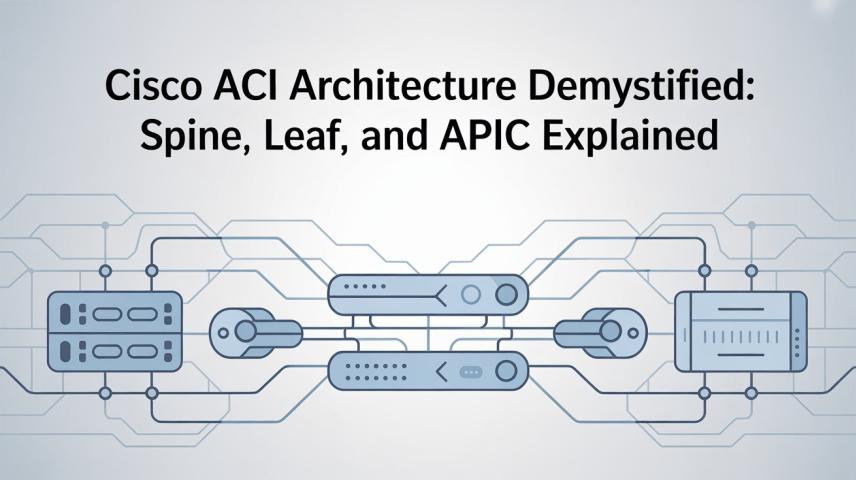
Cisco ACI uses a spine–leaf topology instead of traditional three-tier designs. Every leaf switch connects to every spine switch. VXLAN tunnels form between these leaves, creating a fully meshed fabric.
Why this matters:
Traffic always takes the shortest path
No spanning tree issues
High bandwidth and low latency
Better performance for virtualized workloads
The VXLAN tunnels are built automatically by the APIC controller, so engineers do not need to manually configure tunnels or routing.
EVPN in the ACI Fabric
EVPN enables the fabric to learn endpoints based on MAC and IP information. When a new device joins the network, EVPN informs the rest of the fabric without relying on large floods of unknown traffic.
Key benefits of EVPN in ACI:
Efficient endpoint learning
Faster convergence
Reduced broadcast traffic
Better visibility and control
This automation is one of the reasons Cisco ACI is widely used in modern data centers.
Conclusion
VXLAN and EVPN are two essential technologies that make Cisco ACI powerful, scalable, and suitable for modern data centers. For beginners, understanding them at a high level makes the entire ACI fabric easier to work with. As networks continue to grow in size and complexity, these technologies will remain at the core of Cisco ACI’s architecture. For those planning to build their skills further, exploring Cisco ACI Training Online and pursuing Cisco ACI Certification can help deepen understanding and open new career opportunities in this area.