Digital transformation is no longer a buzzword—it has become a strategic necessity for businesses aiming to stay competitive in rapidly evolving markets. Organizations across healthcare, finance, manufacturing, logistics, retail, and other sectors are adopting digital technologies to streamline operations, enhance customer experiences, and improve decision-making. One of the most powerful drivers of this transformation is industry-specific software—customized solutions designed to address the unique needs, regulations, and workflows of particular sectors.
A Software development agency plays a crucial role in this shift by designing tailored solutions that align with industry requirements rather than forcing companies to adapt their processes to generic software. Instead of relying solely on off-the-shelf platforms, organizations increasingly invest in specialized applications that integrate with their systems, automate complex processes, and deliver actionable insights. Industry-specific software enables companies to digitize operations efficiently, making digital transformation more practical, scalable, and impactful.
Understanding Industry-Specific Software
Industry-specific software refers to applications designed to meet the particular needs of a specific sector. Unlike general-purpose tools that serve a broad audience, these solutions are built with industry workflows, compliance standards, and operational challenges in mind.
For example:
- Healthcare software may include electronic health record (EHR) systems, telemedicine platforms, and patient management tools.
- Manufacturing software may focus on supply chain management, predictive maintenance, and production planning.
- Financial software often includes fraud detection systems, risk analysis tools, and digital banking platforms.
- Retail software may involve inventory management, personalized marketing tools, and omnichannel customer experience systems.
Because these tools are designed for specific industries, they offer deeper functionality and higher efficiency compared to generic platforms.
The Role of Industry-Specific Software in Digital Transformation
Digital transformation involves integrating digital technologies into all areas of a business. This process changes how organizations operate and deliver value to customers. Industry-specific software accelerates this transformation by providing targeted solutions that address sector-specific challenges.
Here are several ways it drives digital transformation.
1. Automating Complex Industry Workflows
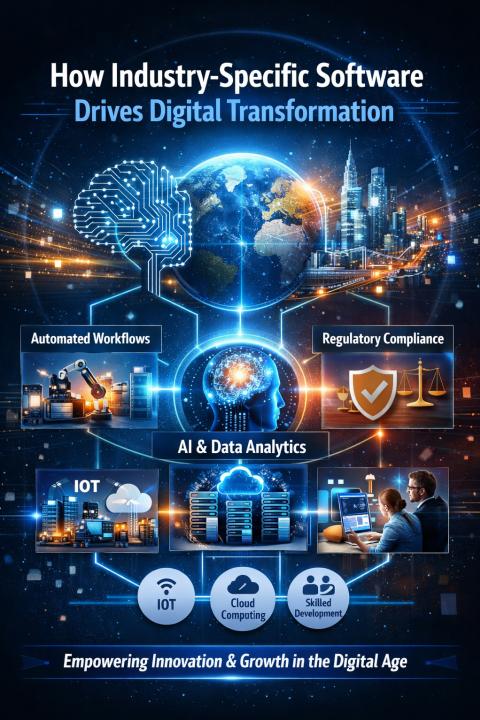
Many industries rely on complex workflows that involve multiple departments, compliance steps, and manual processes. Industry-specific software automates these processes, reducing errors and saving time.
For instance:
In healthcare, automated appointment scheduling and patient records reduce administrative workload.
In logistics, route optimization software helps companies manage deliveries more efficiently.
In manufacturing, automated production monitoring improves productivity and reduces downtime.
Automation not only increases efficiency but also allows employees to focus on strategic and creative tasks instead of repetitive administrative work.
2. Enhancing Data-Driven Decision Making
Data is one of the most valuable assets in the digital economy. However, raw data alone is not useful unless it can be analyzed and transformed into actionable insights.
Industry-specific software collects and analyzes data relevant to a particular sector. This enables organizations to make informed decisions quickly.
Examples include:
Healthcare analytics systems that track patient outcomes and treatment effectiveness.
Financial platforms that analyze market trends and investment risks.
Retail software that evaluates customer purchasing behavior to personalize marketing campaigns.
By providing real-time insights, these solutions empower businesses to respond quickly to market changes and customer demands.
3. Improving Customer Experience
Customer expectations have evolved dramatically in the digital era. People now expect seamless, fast, and personalized experiences across all channels.
Industry-specific software helps businesses meet these expectations by enabling:
Personalized recommendations
Faster service delivery
Omnichannel customer engagement
Real-time communication and support
For example, a banking app that provides instant transaction alerts and personalized financial insights significantly enhances customer satisfaction. Similarly, retail platforms that track customer preferences can offer tailored promotions and recommendations.
By improving the customer experience, businesses strengthen loyalty and increase long-term profitability.
4. Supporting Regulatory Compliance
Many industries operate under strict regulatory requirements. Healthcare organizations must comply with patient privacy regulations, financial institutions must follow strict security and reporting standards, and manufacturing companies must meet safety and quality guidelines.
Industry-specific software is designed with these regulations in mind, making compliance easier to manage.
Key compliance features often include:
Secure data storage and encryption
Audit trails and reporting tools
Automated compliance checks
Risk management dashboards
This reduces the likelihood of costly regulatory violations and ensures organizations maintain high standards of governance and accountability.
5. Enabling Scalability and Business Growth
As companies grow, their operational complexity increases. Generic software often struggles to scale effectively, especially when it needs to accommodate specialized workflows or regulatory requirements.
Industry-specific software is designed to scale with the business. It can support increasing data volumes, expanding teams, and new service offerings.
For example:
A logistics company can expand its route management system to handle more deliveries.
A healthcare provider can integrate additional clinics into a centralized patient management system.
A retail brand can scale its inventory and order management platform to support international markets.
Scalability ensures that technology remains a growth enabler rather than a limitation.
Integration with Emerging Technologies
Industry-specific software becomes even more powerful when integrated with emerging technologies such as artificial intelligence, machine learning, the Internet of Things (IoT), and cloud computing.
Artificial Intelligence and Machine Learning
AI-powered solutions can analyze large datasets, detect patterns, and make predictions. For example:
Predictive maintenance in manufacturing
Fraud detection in banking
Disease prediction and diagnosis support in healthcare
Internet of Things (IoT)
IoT devices collect real-time data from physical environments. When integrated with industry software, this data enables organizations to monitor equipment, track shipments, and manage energy usage.
Cloud Computing
Cloud-based industry software provides scalability, remote access, and reduced infrastructure costs. Businesses can deploy solutions faster and update them more easily.
Together, these technologies significantly amplify the impact of industry-specific digital transformation initiatives.
The Importance of Skilled Development Teams
Building effective industry-specific software requires deep technical expertise combined with strong knowledge of the target sector. This is where enterprise application developers become essential.
These professionals specialize in creating robust, scalable applications that integrate with complex enterprise systems. They design solutions capable of handling large datasets, supporting multiple users, and maintaining high levels of security and reliability.
Their responsibilities often include:
Designing scalable system architectures
Ensuring data security and compliance
Integrating software with existing enterprise systems
Optimizing performance for large-scale operations
With the help of experienced development teams, organizations can implement digital solutions that align closely with their strategic objectives and operational needs.
Real-World Industry Examples
Healthcare
Healthcare organizations use specialized software to manage patient records, schedule appointments, track treatment plans, and enable telemedicine services. These solutions reduce administrative overhead while improving patient care and accessibility.
Manufacturing
Manufacturers rely on industry-specific systems to manage production processes, monitor equipment performance, and optimize supply chains. Predictive maintenance tools can identify equipment issues before failures occur, preventing costly downtime.
Finance
Financial institutions use specialized platforms for digital banking, fraud detection, risk management, and regulatory reporting. These systems improve security and enable faster, more efficient financial services.
Retail and E-Commerce
Retailers use customized software to manage inventory, analyze customer behavior, and deliver personalized shopping experiences. Advanced analytics tools help businesses forecast demand and optimize pricing strategies.
Overcoming Challenges in Implementation
Despite its benefits, implementing industry-specific software can present challenges.
High Initial Investment
Custom solutions may require significant upfront investment. However, the long-term benefits—such as increased efficiency and reduced operational costs—often outweigh the initial expense.
Integration with Legacy Systems
Many organizations rely on legacy infrastructure that may not easily integrate with modern software. Careful planning and experienced development teams are essential to ensure smooth integration.
Change Management
Digital transformation often requires employees to adapt to new tools and workflows. Providing training and support is critical for successful adoption.
By addressing these challenges strategically, organizations can maximize the value of their digital transformation efforts.
The Future of Industry-Specific Software
The demand for industry-specific software is expected to grow as businesses seek more specialized solutions. Future developments may include:
Greater use of AI-driven automation
Advanced predictive analytics
More seamless integration with IoT devices
Increased adoption of cloud-native architectures
Enhanced cybersecurity features
As technology continues to evolve, industry-focused digital solutions will become even more sophisticated and powerful.
Conclusion
Digital transformation is reshaping the global business landscape, and industry-specific software is at the center of this evolution. By addressing unique operational challenges, regulatory requirements, and customer expectations, these tailored solutions provide organizations with the tools they need to innovate and grow. From automating workflows and improving decision-making to enhancing customer experiences and ensuring regulatory compliance, industry-specific software offers significant advantages over generic platforms. A key factor accelerating this shift is AI in digital transformation, which enables businesses to analyze large volumes of data, automate complex processes, and generate actionable insights for smarter decision-making. When supported by skilled development teams and modern technologies such as AI, IoT, and cloud computing, these solutions become powerful drivers of business transformation. As organizations continue to invest in digital innovation, industry-specific software will remain a critical component of their success, enabling them to adapt quickly, operate efficiently, and deliver greater value in an increasingly digital world.