The rapid rise of cryptocurrency trading platforms has transformed how people buy and sell digital assets. Behind every successful exchange lies a powerful technology that ensures trades happen quickly, fairly, and accurately—the matching engine. In platforms built using a Binance Clone Script, the matching engine plays a crucial role in managing trade execution and maintaining the efficiency of the entire exchange ecosystem.
Understanding how matching engines function can provide valuable insights for entrepreneurs, developers, and blockchain enthusiasts looking to launch or analyze modern crypto trading platforms.
What Is a Matching Engine in a Crypto Exchange?
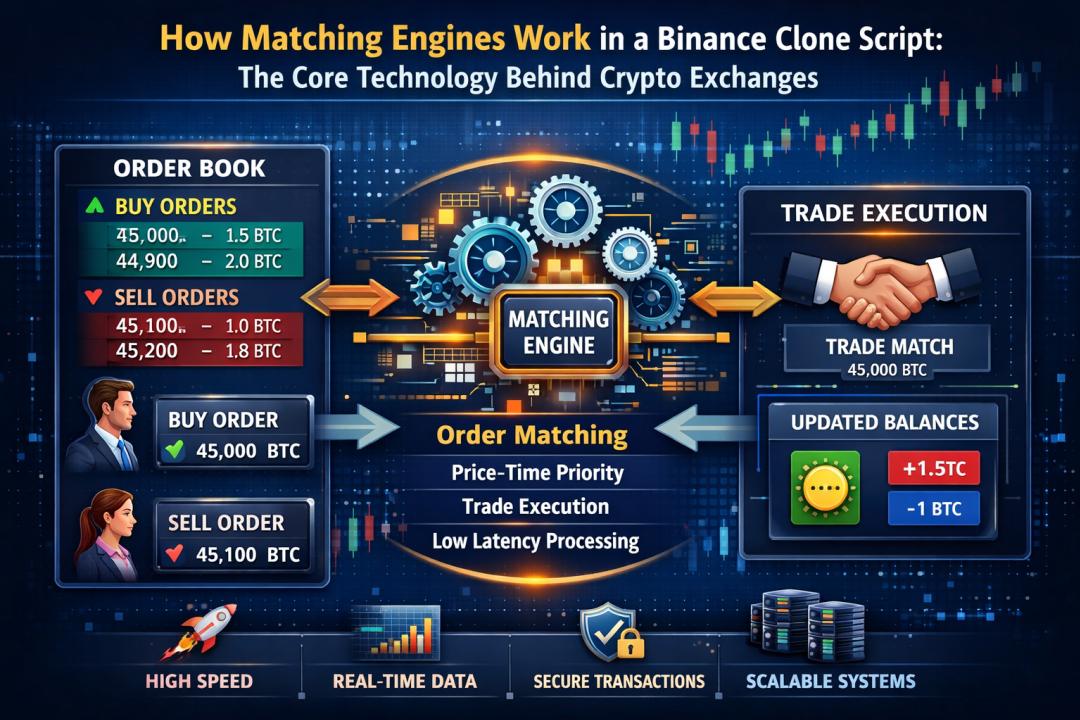
A matching engine is the central component of a cryptocurrency exchange responsible for pairing buy and sell orders submitted by traders. Its main job is to ensure that trades are executed whenever compatible orders are found.
When a trader places a buy order for a cryptocurrency and another trader places a sell order for the same asset at the same price, the matching engine instantly connects the two orders and completes the transaction.
Without this technology, exchanges would struggle to process trades efficiently, leading to delays, pricing inconsistencies, and poor user experiences.
Why Matching Engines Are Critical for Crypto Exchanges
The success of any digital asset exchange depends heavily on its trade execution speed and accuracy. The matching engine ensures that the platform operates smoothly by handling thousands—or even millions—of transactions every second.
Key benefits of an efficient matching engine include:
-
Fast trade execution
-
Accurate order matching
-
Low latency trading
-
Improved liquidity management
-
Enhanced user experience
For platforms built using a Binance Clone Script, a high-performance matching engine helps replicate the fast trading environment users expect from leading global exchanges.
Understanding the Order Book System
Before the matching engine can execute trades, it relies on an order book.
An order book is a real-time list of all active buy and sell orders on the exchange. It displays:
-
Buy orders (bids)
-
Sell orders (asks)
-
Prices offered by traders
-
Quantity of assets available
The matching engine constantly scans the order book to identify compatible orders that can be executed.
This process happens in milliseconds, ensuring traders experience minimal delays.
Types of Orders Processed by Matching Engines
Modern crypto exchanges support multiple order types, all of which are handled by the matching engine.
Market Orders
A market order executes immediately at the best available price in the order book.
Limit Orders
A limit order allows traders to specify the price at which they want to buy or sell an asset.
Stop Orders
These orders are triggered once the asset reaches a specified price level.
The matching engine processes each order type differently while maintaining fairness and speed.
Price-Time Priority Mechanism
Most crypto exchanges use a price-time priority algorithm.
This means orders are matched based on:
-
Best price first
-
Earliest order submission
For example:
-
If two traders place buy orders at the same price,
-
the order submitted earlier receives priority.
This method ensures transparency and fairness in trade execution.
How Matching Engines Execute Trades
The trade execution process follows several steps:
-
A trader submits a buy or sell order.
-
The order enters the exchange's order book.
-
The matching engine scans for compatible orders.
-
When matching criteria are met, the trade executes instantly.
-
Account balances update automatically.
This entire process occurs within fractions of a second, enabling high-speed trading environments.
Low Latency and High-Speed Performance
In cryptocurrency trading, latency—the delay between order submission and execution—can significantly impact profits.
Advanced matching engines used in Binance Clone Script exchanges are optimized for:
-
Ultra-low latency
-
High transaction throughput
-
Real-time data processing
These capabilities allow exchanges to handle thousands of trades per second while maintaining stability and reliability.
Scalability in High-Volume Trading Platforms
As an exchange grows, the number of users and trading activity increases dramatically. The matching engine must scale accordingly.
Scalable systems often rely on:
-
Distributed server infrastructure
-
High-performance databases
-
Microservices architecture
-
Load balancing systems
These technologies help maintain consistent performance even during peak trading periods.
Security Measures in Matching Engine Systems
Security is another critical aspect of exchange technology. Matching engines must operate within a secure environment to prevent manipulation or system abuse.
Common security practices include:
-
Encrypted data communication
-
Anti–market manipulation algorithms
-
DDoS protection systems
-
Secure wallet integration
These safeguards protect both the exchange infrastructure and user funds.
Real-Time Market Data Processing
Modern trading platforms depend heavily on real-time market updates.
Matching engines constantly broadcast:
-
Order book updates
-
Trade confirmations
-
Price changes
-
Liquidity levels
This information is delivered through APIs and WebSocket connections, allowing traders to monitor market conditions instantly.
The Role of APIs in Matching Engine Integration
Application Programming Interfaces (APIs) allow external systems and trading bots to interact with the exchange.
Through APIs, users can:
-
Place automated trades
-
Access market data
-
Manage portfolios
-
Integrate third-party trading tools
The matching engine processes API-generated orders just as it does manually placed trades.
Future Innovations in Matching Engine Technology
As cryptocurrency markets continue evolving, matching engine technology is also advancing.
Emerging developments include:
-
AI-driven order execution optimization
-
Cross-chain trading capabilities
-
Hybrid centralized and decentralized exchange models
-
Advanced liquidity aggregation systems
These innovations aim to further improve trading speed, efficiency, and security.
Conclusion
The matching engine is the technological backbone of every cryptocurrency exchange. It ensures that buy and sell orders are processed quickly, accurately, and fairly. Within platforms built using a Binance Clone Script, this system enables high-speed trade execution, efficient order management, and real-time market interaction.
By combining powerful algorithms, low-latency infrastructure, and secure architecture, matching engines make it possible for modern crypto exchanges to handle massive trading volumes while delivering a seamless user experience. As blockchain technology and digital asset markets continue to grow, the role of advanced matching engine systems will remain central to the future of cryptocurrency trading.