Have you ever wondered why your phone sometimes shows 4G LTE and other times 5G, and whether it actually makes a difference?
Mobile carriers constantly promote faster speeds and better connectivity, which can make it confusing to understand what these technologies really mean. Many people have questions like:
Is 5G really faster than 4G LTE? Do I need a 5G phone? Will it improve streaming, gaming, or work-from-home tasks?
The truth is that both 4G LTE and 5G networks support most of the modern mobile internet experience. However, they differ significantly in speed, latency, capacity, and future capabilities.
In this guide, we’ll break down the difference between 5G and 4G LTE, explain how each technology works, and help you decide which one is best for your needs.
Understanding 4G LTE
4G LTE (Fourth Generation Long-Term Evolution) is the mobile network technology that has powered smartphones and mobile internet since the early 2010s.
It replaced 3G networks and dramatically improved mobile browsing, video streaming, and app performance.
Key Features of 4G LTE
1. Fast Mobile Speeds
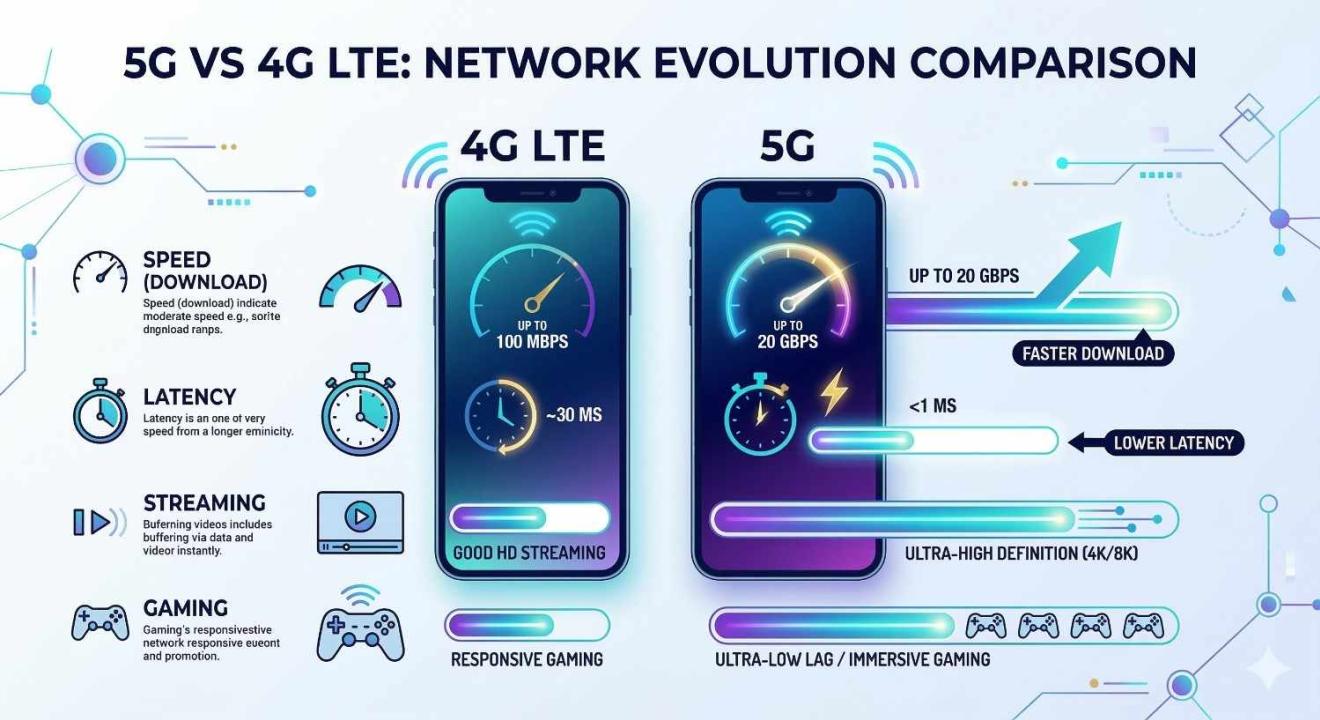
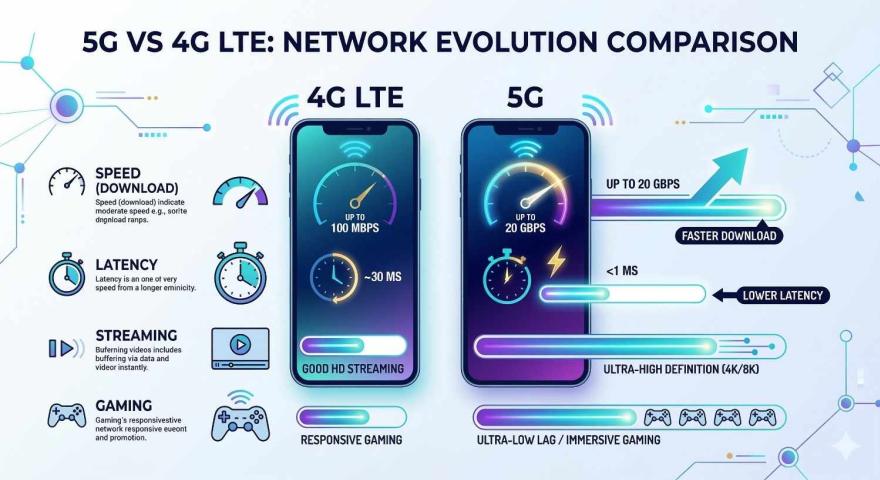
4G LTE typically offers download speeds between 10 Mbps and 100 Mbps, though it can reach higher speeds under ideal conditions.
2. Reliable Coverage
One of the biggest advantages of 4G LTE is its wide availability. Most regions around the world, including rural areas, still rely on LTE networks.
3. Good for Everyday Internet Use
4G LTE handles most online tasks comfortably, including:
HD video streaming
Social media browsing
Online gaming
Video calls
Mobile hotspot usage
Because of its maturity and infrastructure, 4G LTE remains one of the most stable mobile network technologies available today.
What Is 5G?
5G (Fifth Generation Mobile Network) is the newest version of wireless technology. It aims to provide ultra-fast speeds, very low latency, and support for many devices.
While 4G mainly focused on improving mobile internet speeds, 5G is meant to support the future of digital connectivity. This includes smart cities, autonomous vehicles, and IoT devices.
Key Features of 5G
1. Ultra-Fast Speeds
5G can deliver speeds ranging from 100 Mbps to over 1 Gbps, making it significantly faster than most LTE connections.
2. Extremely Low Latency
Latency is the delay between sending and receiving data. 5G cuts latency to as low as 1 millisecond, compared to 20 to 40 ms for LTE.
3. Higher Network Capacity
5G can support millions of connected devices simultaneously, which is essential for smart homes, IoT, and smart city technology.
4. Better Performance in Crowded Areas
Large events, busy city centers, and airports often overwhelm LTE networks. 5G helps reduce congestion by handling more connections at the same time.
Key Differences Between 5G and 4G LTE
While both networks provide wireless internet access, 5G and 4G LTE differ in several important ways.
1. Speed
Speed is the most noticeable difference.
Network | Average Speed | Maximum Speed |
4G LTE | 10–100 Mbps | ~1 Gbps |
5G | 100 Mbps – 1 Gbps | Up to 10 Gbps |
This means downloading a 4K movie that takes minutes on LTE could take seconds on 5G.
2. Latency
Latency affects real-time activities like gaming and video calls.
4G LTE latency: 20–40 milliseconds
5G latency: 1–10 milliseconds
Lower latency allows for instant communication between devices. This is vital for technologies such as autonomous vehicles and remote surgery.
3. Network Capacity
As the number of connected devices grows, networks need to support more data traffic.
4G LTE: Supports thousands of devices per square kilometer.
5G: Can support up to one million devices per square kilometer.
This makes 5G ideal for IoT ecosystems and smart infrastructure.
4. Technology and Spectrum
5G uses advanced radio technologies and new spectrum bands.
4G LTE Uses
Sub-6 GHz spectrum
Traditional cellular infrastructure
5G Uses
Sub-6 GHz spectrum
Millimeter wave (mmWave) frequencies
Advanced beamforming technology
These innovations allow faster data transfer and better network efficiency.
5. Coverage Availability
Coverage is currently where 4G LTE still leads.
4G LTE Coverage
Available almost everywhere
Strong rural and suburban coverage
5G Coverage
Expanding rapidly
Stronger in major cities
Still limited in some rural areas
Because of this, most smartphones switch automatically between 5G and LTE depending on signal strength.
Types of 5G Networks
Not all 5G networks are the same. There are actually three types:
1. Low-Band 5G
Wide coverage
Speeds slightly faster than LTE
Best for nationwide availability
2. Mid-Band 5G
Balance of speed and coverage
Speeds up to 1 Gbps
Considered the best everyday 5G experience
3. High-Band 5G (mmWave)
Extremely fast speeds
Limited coverage area
Mostly used in dense urban locations
Each type contributes to expanding next-generation wireless connectivity.
Benefits of 5G Over 4G LTE
5G introduces new possibilities beyond faster smartphone speeds.
1. Improved Streaming
5G enables 4K and even 8K video streaming with minimal buffering.
2. Better Online Gaming
Low latency allows smooth real-time multiplayer gaming.
3. Smart Cities
5G helps power technologies like:
Smart traffic systems
Connected infrastructure
Autonomous vehicles
4. Internet of Things (IoT)
From smart homes to industrial automation, 5G supports large networks of connected devices.
Do You Need a 5G Phone?
Whether you need a 5G phone depends on your usage.
You Should Consider 5G If:
You stream large amounts of video
You download large files often
You live in an area with strong 5G coverage
You want the latest mobile technology
4G LTE Is Still Enough If:
You mainly browse social media
You watch HD videos occasionally
Your area has limited 5G availability
For many users, LTE still provides reliable and fast connectivity.
The Future of Mobile Networks
5G is expected to transform the global internet infrastructure over the next decade.
As networks expand, we will see improvements in:
Smart healthcare
Remote work technologies
Connected vehicles
Augmented and virtual reality
Industrial automation
However, 4G LTE will continue to coexist with 5G for many years, ensuring reliable coverage worldwide.
Conclusion
The difference between 5G and 4G LTE lies in speed, latency, capacity, and future potential.
4G LTE is a dependable and widely available network that supports most daily mobile activities. In contrast, 5G offers much faster speeds, lower latency, and the ability to connect millions of devices at the same time.
As 5G coverage grows, it will enable new technologies and experiences that extend well beyond smartphones. This includes smart cities, self-driving cars, and advanced IoT networks.
For now, both networks are crucial for keeping the world connected. 5G marks the next significant step in wireless technology.
Frequently Asked Questions (FAQs)
1. Is 5G faster than 4G LTE?
Yes. 5G can be up to 10 times faster than 4G LTE, with speeds reaching over 1 Gbps in optimal conditions.
2. Does 5G work everywhere?
No. While coverage is expanding rapidly, 5G is still not available in all areas, especially in some rural locations.
3. Will 5G replace 4G LTE?
Not immediately. 4G LTE will continue to operate alongside 5G for many years to provide widespread coverage.
4. Do I need a special phone for 5G?
Yes. To access 5G networks, you need a 5G-compatible smartphone and a carrier plan that supports 5G.
5. Does 5G use more battery?
Early 5G phones consumed more battery power, but modern devices now use optimized chips that improve battery efficiency.
6. Is 5G worth upgrading to?
If you want faster downloads, better streaming, and future-ready connectivity, upgrading to 5G can be worthwhile—especially in areas with strong coverage.