Introduction
Tattoos are a popular form of self-expression, but personal stories, identities, and tastes can change over time. For the millions seeking to remove unwanted ink, the journey has historically been long, painful, and uncertain. The shift in societal trends is significant, as reflected in market data. According to a 2023 report by the American Society of Plastic Surgeons (ASPS), over 100,000 tattoo removal procedures were performed by their member surgeons in 2022 alone, indicating a substantial and sustained clinical demand for this service. (Source:https://www.plasticsurgery.org/). Traditional methods, which often left behind faded tattoos, scars, or troublesome skin discoloration, are no longer meeting modern patient expectations for safety and efficiency. The aesthetic industry’s sustained quest for a better solution has now arrived: the picosecond laser tattoo removal machine.
This technology isn’t just an incremental upgrade; it’s a paradigm shift that is fundamentally changing clinical practice and patient outcomes. For clinic owners and dermatologists, investing in the right pico laser for sale is a significant strategic decision that can directly define practice growth and competitive advantage. This comprehensive guide explores the underlying science, the essential technical specifications, and the day-to-day clinical realities to empower you to make a thoroughly informed choice for your practice.
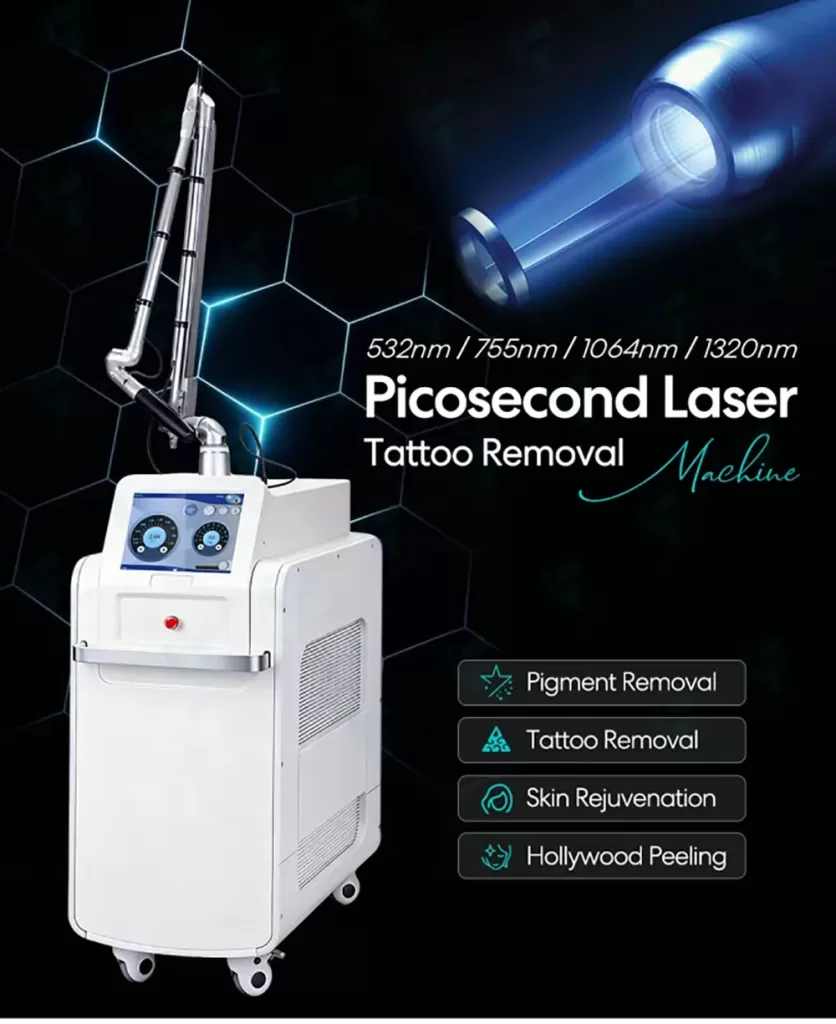
Understanding the “Pico” Advantage
At the heart of this clinical and commercial revolution is the definition of a “picosecond” itself. A picosecond is one trillionth of a second (10-12s). This is 1,000 times shorter than a nanosecond, the unit used to measure the pulse width of traditional Q-switched lasers, which were the previous industry standard for decades. This is not a minor technical specification; it is the fundamental difference that enables a superior mechanism of action, directly translating to the faster, safer results that are driving patient demand and practitioner adoption.
Pico Tattoo Removal Machine: The Core Science of the Photomechanical Shockwave Effect
The core principle of a modern pico tattoo removal machine is fundamentally different from its predecessors. Instead of relying primarily on a thermal mechanism (the photothermal effect), it generates a powerful photomechanical or photoacoustic shockwave. The physics are critical: the ultra-short pulse duration allows a high peak power of energy to be delivered to the target pigment—be it tattoo ink or melanin particles—faster than the thermal relaxation time of the surrounding tissue. In simpler terms, the energy hits and acts on the target before heat can “leak out” and damage the skin around it.
This innovative approach to pigment removal, enabled by the picosecond laser’s ultra-short pulse width and photomechanical shockwave effect, has opened up new possibilities in the field of aesthetic treatments. It has not only improved the efficiency and safety of tattoo removal but also expanded the range of pigment-related issues that can be effectively addressed. And when it comes to putting this advanced technology into practice, the LuFenbeauty PC04 pico tattoo removal machine stands out as a prime example.
Picosecond Laser Core Applications and Wavelength Selection Guide
Main Clinical Applications
- Acquired Pigmentation: Such as sunspots, freckles, age spots, melasma, etc., which can brighten skin tone and improve skin texture.
- Congenital Pigmentation: Such as nevus of Ota, blue nevus, black nevus, café-au-lait spots, etc., which can significantly lighten their color.
- Tattoo Removal: Effectively removes tattoos of various colors (such as black, red, green, and blue) as well as pigmentation of eyeliner and lip liner, minimizing the risk of scarring.
- Brightening and Whitening: By stimulating collagen regeneration, it effectively improves dull skin and rough texture, achieving a clear and radiant complexion.
Commonly Used Wavelengths and Their Characteristics
Different wavelengths of laser light target different depths of tissue for precise treatment:
- 1064nm Wavelength: Penetrates deeply, a classic choice for treating black tattoos and deep dermal pigmentation (such as nevus of Ota).
- 532nm Wavelength: Primarily acts on the epidermis, commonly used to treat superficial pigmentation problems such as freckles, sunspots, and red tattoo ink.
- 755nm wavelength: Medium penetration depth, precisely targets melanin, stimulates collagen regeneration, improves pigmentation and dullness, and brightens skin tone.
- 1320nm Wavelength: Primarily used for non-ablative skin rejuvenation treatments, such as carbon peels, pore tightening, and skin texture improvement; effectively stimulates collagen regeneration.
Picosecond Laser vs. Q-Switched Laser
To better understand the advantages of picosecond lasers, let’s compare them with traditional Q-switched lasers across several key dimensions:
| Dimension | Picosecond Laser | Q-Switched Laser |
| Pulse Width | Ultra-short (picoseconds) | Longer (nanoseconds) |
| Treatment Sessions | Fewer (2-4 sessions) | More (5-10 sessions) |
| Pigment Fragmentation | More efficient (micro-particles) | Less efficient (larger particles) |
| Skin Damage Risk | Lower (minimal thermal damage) | Higher (risk of thermal damage) |
| Recovery Time | Shorter (faster healing) | Longer (slower healing) |
- Pulse Width: Q-switched lasers typically operate with pulse widths of 5 nanoseconds (ns) or more. A picosecond is 100 to 1000 times shorter.
- Mechanism of Action: The longer pulse of a Q-switch laser relies more on photothermal effects, heating and fracturing pigment into larger fragments. This process can lead to scatter of thermal energy, increasing the risk of hypopigmentation, textural changes, and thermal damage to surrounding skin.
- Efficacy & Safety: The pico tattoo removal machine, with its ultra-short pulse, generates a more intense photomechanical stress. This results in a more complete breakup of pigment into finer particles, which are cleared more efficiently. Consequently, treatments are often more effective, require fewer sessions, and present a lower risk of thermal side effects.
Key Considerations for Choosing a Picosecond Laser Equipment Supplier
1. Equipment Qualifications and Performance
- Complete Certifications: Prioritize equipment certified by the China National Medical Products Administration (NMPA). Request relevant certification documents from the supplier; this is essential for the legal and safe use of the equipment in the Chinese market.
- Wavelength and Platform Suitable for Business Needs: Based on your core business (e.g., tattoo removal, pigmentation treatment, or anti-aging), assess whether the equipment possesses the required key wavelengths (e.g., 1064nm, 532nm, 755nm) and whether it is a multi-wavelength integrated platform. This consideration is to meet diverse treatment needs. For example, for comprehensive aesthetic medical institutions, a multi-wavelength platform can address different types of skin problems, reducing equipment procurement costs and space requirements.
- Pulse Width and Energy: True “picosecond” pulse width (1 picosecond equals 10-12 seconds) is its core advantage. Therefore, inquire in detail about key parameters such as the equipment’s pulse width range, peak power, and energy stability.
2. Supplier Strength and Service
Understand the supplier’s brand history, market reputation, and industry experience. Well-known brands are generally more reliable in terms of technology research and development, manufacturing processes, and quality control. At the same time, it’s crucial to remember that the supplier’s provision of comprehensive and systematic training services is essential. A robust training system is a prerequisite for ensuring treatment safety and effectiveness. A comprehensive training system should cover equipment operation training, clinical application guidance, and regular advanced training, among other things. Finally, confirm whether the supplier has a stable after-sales service team in your area. Response speed, spare parts supply, and regular maintenance services are key factors, directly impacting the long-term stable operation of the equipment.
3.Summary and Recommendations
We recommend that you prioritize equipment compliance and core performance when selecting a supplier. Strictly review the equipment’s certifications and key parameters such as wavelength configuration. Based on this, focus on evaluating the supplier’s localized service capabilities and clinical support system to ensure the long-term stable development of your medical aesthetics business.
Frequently Asked Questions (FAQs)
Q 1: Is the treatment painful? How long does each session take?
A: Treatment process there will be CICI hot feeling, the pigment distribution in more places will be more obvious sense, according to the indications and therapeutic dose, the doctor will recommend the use of appropriate local anesthetic ointment and the air cooler to reduce discomfort, usually the treatment time is about 5-15 minutes, depending on the size of the treatment area and skin problems.
Q 2: Is picosecond laser tattoo removal effective?
A: The current effect is particularly significant is the use of picosecond laser tattoo, it does not produce heat damage to the surrounding tissue, so it will not leave a scar.
Q 3: Is the equipment complicated to operate? How long does it take for medical staff to be trained and put to work?
A: The user interface is user-friendly, but professional training is required. Reputable suppliers (such as LuFenbeauty) provide systematic training, including equipment operation, parameter settings, and clinical case practice. Medical staff can usually master the basic operations in 1-2 days.
Conclusion: The Future of Tattoo and Pigment Removal
The evolution from nanosecond to picosecond technology marks one of the most significant leaps forward in aesthetic laser medicine. The multi-wavelength pico tattoo removal machine is not merely a new device; it is the new benchmark. It successfully addresses the historical tattoo removal challenges of color selectivity, treatment discomfort, and skin safety. By combining the physics of ultra-short pulses with the biological specificity of multiple wavelengths, it delivers precision that was previously unimaginable.
For medical and aesthetic practices, this represents more than clinical superiority—it embodies a substantial commercial opportunity. Investing in what is widely considered the best tattoo removal laser machine available today future-proofs a practice, aligns it with evidence-based technological progress, and most importantly, delivers superior outcomes that meet the heightened expectations of modern patients. The future of clear skin is not just about removal; it’s about intelligent, selective, and respectful treatment, and that future is firmly in the picosecond domain.