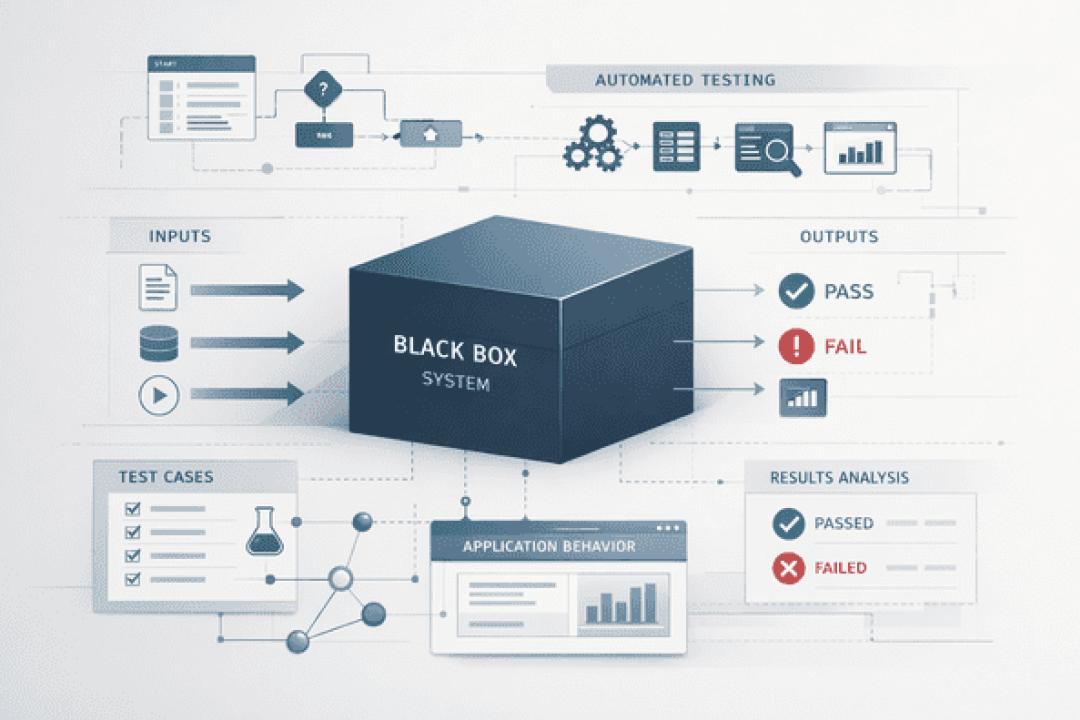
APIs are the backbone of modern applications, enabling communication between services, systems, and third-party integrations. Ensuring their reliability is critical for delivering seamless user experiences. This is where black box testing becomes highly effective. By validating APIs from an external perspective, it helps teams ensure that endpoints behave correctly without needing to understand the internal implementation.
What Is Black Box Testing in API Context?
Black box testing focuses on validating the functionality of an API by sending requests and analyzing responses. Testers do not need access to the source code. Instead, they rely on API specifications such as endpoints, request formats, and expected outputs.
This approach is particularly valuable for API testing because it mirrors how real clients interact with the system. Whether it is a frontend application or an external service, all interactions happen through requests and responses, making black box testing a natural fit.
Why Black Box Testing Is Important for APIs
APIs often serve as critical integration points. Even a small failure can disrupt entire workflows. Black box testing helps ensure:
- Correct response data for valid requests
- Proper error handling for invalid inputs
- Stability under different conditions
- Compatibility with various clients and systems
By focusing on expected behavior rather than internal logic, teams can validate APIs in a way that aligns with real-world usage.
Key Techniques for API Black Box Testing
1. Equivalence Partitioning
This technique divides input data into valid and invalid groups. Instead of testing every possible input, testers select representative values from each group. For example, if an API accepts age values between 18 and 60, inputs can be grouped into valid and invalid ranges to optimize test coverage.
2. Boundary Value Analysis
Errors often occur at the edges of input ranges. Boundary value analysis focuses on testing values at, just below, and just above these limits. Using the same age example, test cases would include values like 17, 18, 60, and 61.
3. Error Guessing
Based on experience, testers anticipate where issues might occur. This could include testing missing parameters, invalid data formats, or unexpected request sequences.
4. State Transition Testing
Some APIs depend on specific sequences of operations. For example, a user must log in before accessing protected endpoints. State transition testing ensures that APIs behave correctly across different states and workflows.
5. Data-Driven Testing
This approach uses multiple sets of input data to validate API behavior under various scenarios. It is especially useful for testing large datasets or validating multiple combinations of inputs.
Best Practices for Effective API Testing
Focus on Real-World Scenarios
Design test cases that reflect actual usage patterns. Consider how different clients will interact with the API and test those workflows thoroughly.
Validate Both Positive and Negative Cases
Do not limit testing to expected inputs. Ensure that the API handles invalid requests gracefully and returns meaningful error messages.
Automate Repetitive Tests
Automation helps execute test cases consistently across builds. Modern tools can record and replay API calls, making it easier to maintain test suites. For example, tools like Keploy can capture real API traffic and convert it into test cases, improving test accuracy and reducing manual effort.
Monitor Performance Alongside Functionality
While black box testing focuses on functionality, it can also help identify performance issues such as slow response times or timeouts when combined with load testing tools.
Keep Test Data Independent
Avoid dependencies between test cases. Each test should be able to run independently to ensure reliability and easier debugging.
Black Box Testing and Broader QA Strategy
Understanding the relationship between black box testing and white box testing helps teams build a balanced testing strategy. While black box testing ensures APIs behave correctly from an external perspective, white box testing validates internal logic and code paths. Together, they provide comprehensive coverage and improve overall software quality.
Common Challenges and How to Overcome Them
One challenge in black box testing is limited visibility into internal processes. This can make it harder to identify the root cause of failures. To address this, teams can use logging and monitoring tools to gain better insights.
Another challenge is maintaining test coverage as APIs evolve. Regularly updating test cases and leveraging automation can help keep tests aligned with changes.
Conclusion
Black box testing is essential for ensuring the reliability and functionality of APIs. By focusing on inputs, outputs, and real-world usage scenarios, it allows teams to validate systems from a user perspective.
When combined with structured techniques and best practices, black box testing helps deliver robust, scalable, and high-performing APIs. Integrating it with automation and complementary testing approaches ensures that applications remain stable even as they grow in complexity.