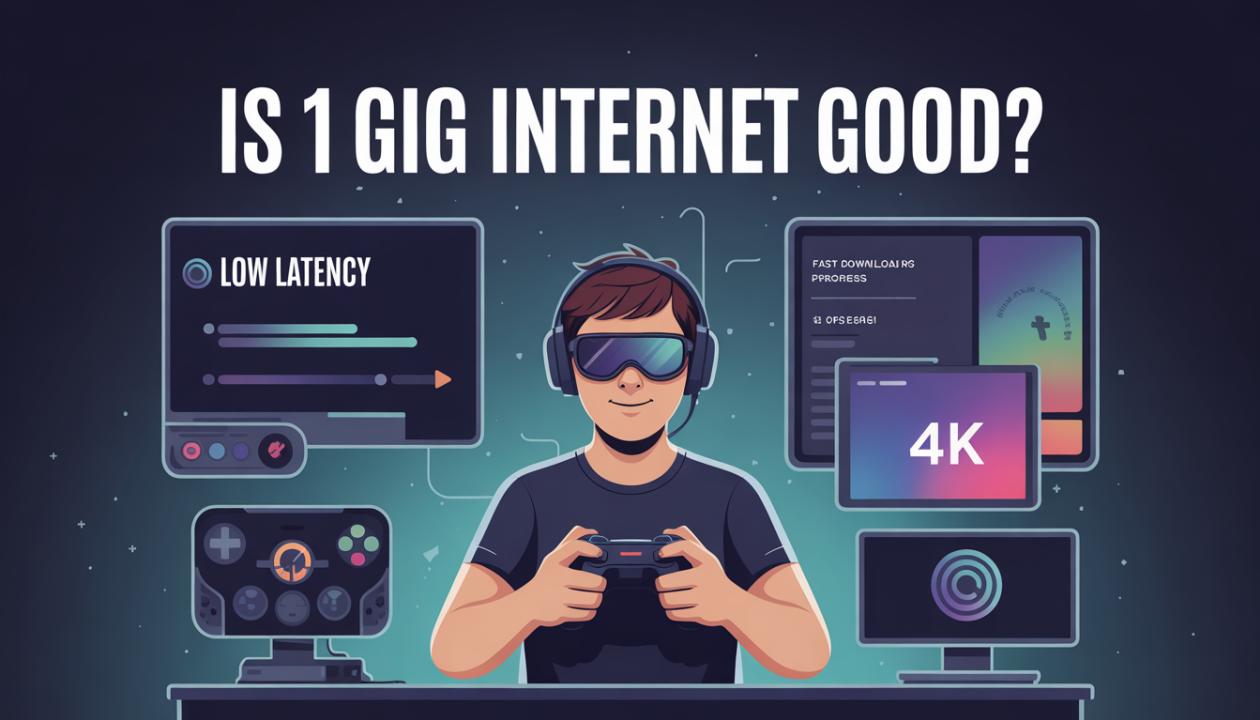
Your streaming keeps buffering. Your video call just froze again. You're paying for what seems like a decent internet plan. So, you start Googling: do I need gigabit internet? Is 1 gig internet good, or is it too much?
You're not alone. With more people working from home, gaming, streaming 4K, and running smart devices all at once, many are considering whether to upgrade to a 1 Gbps plan. Let's break it down without the tech jargon.
What Does "1 Gig Internet" Actually Mean?
A 1 gig (short for gigabit) internet connection offers speeds of up to 1,000 Mbps for both downloading and uploading.
To put that in perspective:
| Activity | Time / Capability |
| Download a full HD movie | ~5 seconds |
| Download a large video game (50GB) | ~30 seconds |
| Speed comparison | 10–20× faster than the average US home plan |
| Simultaneous usage | 100+ HD streams supported |
So, is 1 gig internet good?
The short answer is yes, 1 gig internet is genuinely good, but it's not the right choice for everyone. It depends on how many people share your connection and what they're doing at the same time.
Think about your household on a busy evening. Maybe someone's on a Zoom call, another is watching Netflix in 4K, a kid is gaming online, and a few smart home devices are running in the background. That kind of load is exactly where a gigabit connection shines.
For a single person who mostly browses, streams, and makes video calls, a 100–300 Mbps plan is probably sufficient. But for larger households, remote workers who handle big files, or anyone who has noticed slow speeds during busy hours, the upgrade makes sense.
Who Actually Needs 1 Gig Internet?
Worth It
Large households (4+ people): Multiple streams, video calls, and devices all running at once need high bandwidth.
Remote workers & freelancers: Great for uploading large files, making frequent video calls, and running cloud backups.
Online gamers: Helps with faster game downloads and smoother performance, especially during busy hours.
4K & 8K streamers: Multiple high-resolution streams require extra capacity, 1 Gig provides consistent performance.
Maybe Skip It
Solo users, light browsing: A 200–300 Mbps plan is usually enough for everyday tasks like browsing, streaming, and social media.
Budget-conscious households: Gigabit plans are more expensive, and the speed difference may not be noticeable for moderate use.
The benefits go beyond raw speed.
When people ask if 1 gig internet is good, they're often only considering download speeds. But a few other benefits are worth mentioning:
Symmetric upload speeds
Many gigabit fiber plans offer the same upload and download speeds. This is important if you regularly video conference, upload content to the cloud, or back up large files. Standard cable plans often limit upload speeds compared to download speeds.
Future-proofing
Smart home devices, AR/VR headsets, and 8K video are becoming more common. Getting a gigabit plan now means your connection won't feel slow in two or three years when your household's data needs increase.
Lower congestion at peak hours
Even if you don't "use" 1 Gbps in a single session, having that capacity gives you extra room during busy hours when your ISP's network is more crowded. Your speeds remain stable instead of dropping.
What to watch out for before upgrading
Your internet speed is only as fast as your slowest link. A gigabit plan works well at the modem. However, your Wi-Fi router, ethernet cables, and even your device's network card can create bottlenecks before that speed reaches your screen.
Before upgrading, check:
Your router: Older routers can’t handle speeds above 1 Gbps. You may need a Wi-Fi 6 or Wi-Fi 6E router to enjoy gigabit wireless speeds.
Fiber vs. cable availability: True symmetric gigabit is most reliable over fiber. Cable-based gigabit plans are available, but they often have uneven speeds and can vary more under heavy use.
Plan pricing in your area: In India and the US, gigabit fiber plans have become more affordable. They often cost ₹500–₹999 per month or $60–$90 per month, depending on the provider and city.
The verdict
1 gig internet is good. genuinely impressive, even, for the right household. It's the internet equivalent of a wide, open highway: no bottlenecks, no slowdowns, and plenty of room for everyone to do their thing simultaneously.
If your household regularly has 4+ people online at once, you work from home, or you're just tired of your connection feeling sluggish at 8 PM, gigabit internet is absolutely worth considering. If you live alone and mostly stream and browse, you can probably save some money with a 200–300 Mbps plan and not notice the difference.
The smartest move is to look at what your household actually does, not just what sounds impressive on a spec sheet.
Frequently asked questions
Is 1 gig internet overkill for a family of four?
Not really. A family of four with multiple devices streaming, gaming, and working from home can easily saturate a 200–300 Mbps plan during peak hours. A gigabit connection gives everyone enough bandwidth without anyone slowing each other down.
Does 1 gig internet reduce lag while gaming?
Speed alone doesn't reduce lag/latency (ping) does. However, a gigabit plan can indirectly help by reducing congestion on your home network, meaning other household activities won't spike your ping mid-game. Look for fiber connections, which typically have lower latency than cable.
Do I need a special router for 1 gig internet?
Yes. Most older routers cap out below gigabit speeds over Wi-Fi. For full-speed wireless, you'll want a Wi-Fi 6 or Wi-Fi 6E router. For wired connections, a standard Cat 6 Ethernet cable easily handles up to 1 Gbps.
What's the difference between 1 gig cable and 1 gig fiber internet?
Both offer 1 Gbps download speeds, but fiber typically provides symmetric upload speeds (matching download) and more consistent performance. Cable gigabit plans often have slower uploads (20–50 Mbps) and can slow down during peak neighborhood usage.
How many devices can connect to 1 gig internet at once?
Comfortably 20–30+ active devices. A 4K Netflix stream uses about 25 Mbps, a Zoom video call uses 3–5 Mbps, and smart home devices use under 1 Mbps each. With 1,000 Mbps of capacity, you have enormous headroom before performance degrades.