Market Overview
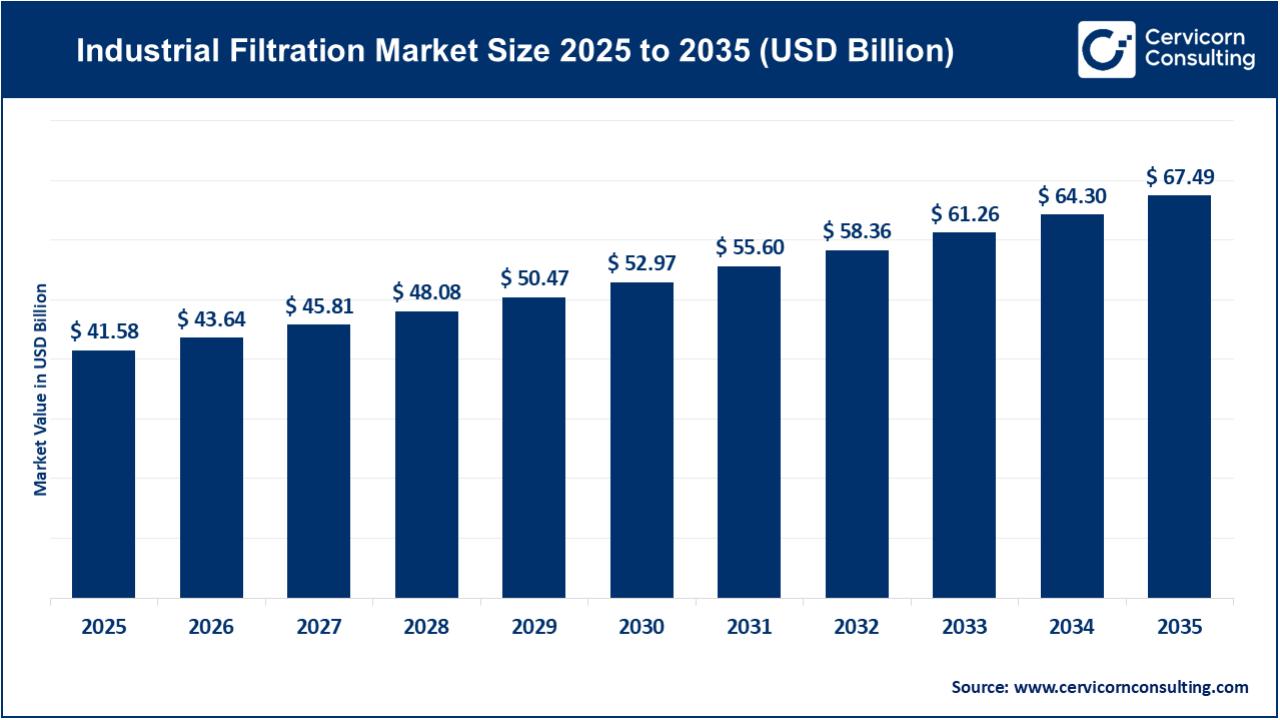
The global industrial filtration market is experiencing consistent growth, supported by rapid industrialization, tightening environmental regulations, and rising demand for clean air and water across key industries.
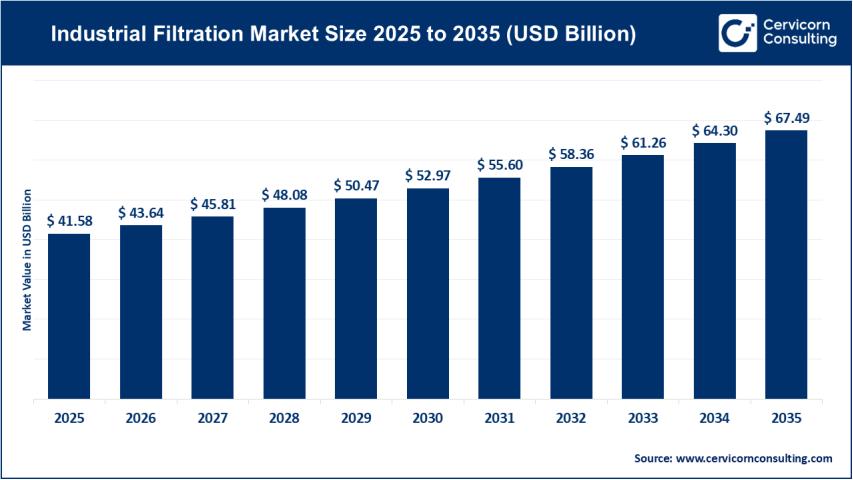
The market was valued at approximately USD 41.58 billion in 2025 and is projected to reach around USD 67.49 billion by 2035, expanding at a CAGR of 4.96% during the forecast period.
This growth is being driven by strong adoption across chemicals, pharmaceuticals, food & beverages, oil & gas, and power generation, where filtration systems are essential for maintaining process efficiency, safety, and regulatory compliance.
What is Industrial Filtration?
Industrial filtration refers to the process of separating and removing suspended solids, contaminants, and impurities from liquids and gases using specialized filtration systems and media.
It plays a vital role in:
- Ensuring product purity
- Protecting industrial equipment
- Meeting environmental regulations
- Enhancing operational efficiency
Depending on the system and application, filtration efficiency can reach 95–99.9% contaminant removal, making it critical for high-precision industrial processes.
📄 Get a Free Sample: https://www.cervicornconsulting.com/sample/2945
Market Drivers
The market is being shaped by several strong growth factors:
- Increasingly strict environmental regulations on emissions and wastewater
- Rising global demand for clean water and air
- Rapid industrial expansion in emerging economies
- Growing emphasis on sustainability and energy efficiency
- Expansion of key end-use industries such as manufacturing, pharma, and food processing
Liquid filtration remains the dominant segment, accounting for over 55% of total market demand, reflecting its broad industrial applicability.
Key Filtration Technologies
Industrial filtration is advancing with a range of technologies, including:
- Mechanical filtration (screens, meshes, barriers)
- Membrane filtration (microfiltration to reverse osmosis)
- Depth filtration (high dirt-holding capacity systems)
- Surface filtration (particle retention on surfaces)
- Centrifugal filtration (high-speed separation)
- Adsorption & electrostatic systems (VOC and gas removal)
Among these, membrane and smart filtration technologies are gaining rapid adoption due to their high precision and efficiency in complex applications.
Major Applications
Industrial filtration is widely used across multiple sectors:
- Manufacturing – coolant purification and dust control
- Water & wastewater treatment – 99%+ contaminant removal
- Oil & gas – refining and impurity separation
- Food & beverage – hygiene and quality assurance
- Pharmaceuticals – sterile and controlled environments
- Power generation – emission control and cooling systems
The chemicals and petrochemicals industry remains a key end-user due to stringent purity and safety requirements.
Emerging Trends
The market is evolving through strong technological integration:
- IoT-enabled smart monitoring systems
- Predictive maintenance solutions
- Energy-efficient and reusable filtration systems
- Shift toward sustainable filter materials
- AI-driven process optimization
Air filtration is expected to see strong growth, driven by rising concerns over workplace safety and environmental pollution.
Challenges in the Market
Despite strong growth potential, the industry faces several challenges:
- High installation and maintenance costs
- Complex integration with legacy systems
- High energy consumption in advanced filtration processes
- Disposal and environmental concerns related to used filters
Regional Outlook
- North America: Leading market due to strict environmental regulations
- Europe: Focused on sustainability and emission reduction initiatives
- Asia-Pacific: Fastest-growing region, driven by industrialization in China and India
Future Outlook
The future of industrial filtration is closely tied to digital transformation, sustainability, and automation.
Key developments expected include:
- Wider adoption of smart filtration systems
- Growth of water reuse and zero-liquid discharge (ZLD) solutions
- Expansion of eco-friendly filtration technologies
- Increasing demand from pharmaceuticals and advanced manufacturing
Conclusion
Industrial filtration is becoming a core pillar of modern industrial operations. With increasing regulatory pressure and rising efficiency demands, the need for advanced filtration systems will continue to grow steadily.
Organizations investing in smart, sustainable, and energy-efficient filtration solutions will be best positioned to achieve long-term competitive advantage.
👉 To Get a Detailed Overview, Contact Us: https://www.cervicornconsulting.com/contact-u