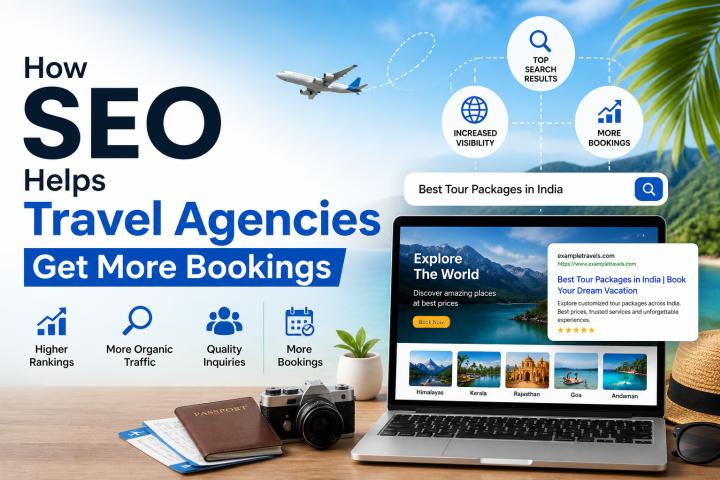
Let
me be honest with you, running a travel agency in 2026 is not easy.
OTAs like MakeMyTrip,
Booking.com, and Cleartrip have deep pockets and massive ad spends. Big hotel
chains have their own loyalty programs. And yet small and mid-sized travel
agencies across India and globally are quietly beating these giants on Google
every single day. How? Through smart, focused SEO.
I have worked closely with travel businesses from Dehradun to Delhi, from Kerala tour operators to Rajasthan heritage travel companies. The one thing they all had in common when they came to us—great packages, but zero online visibility. That’s where our travel SEO services made the difference. Once we fixed their SEO, inquiries started coming in organically every single week without spending a rupee on ads.
This guide is everything you
need to understand how SEO works specifically for travel businesses, what has
changed in 2026 with AI search, and how you can use it to grow bookings
consistently.
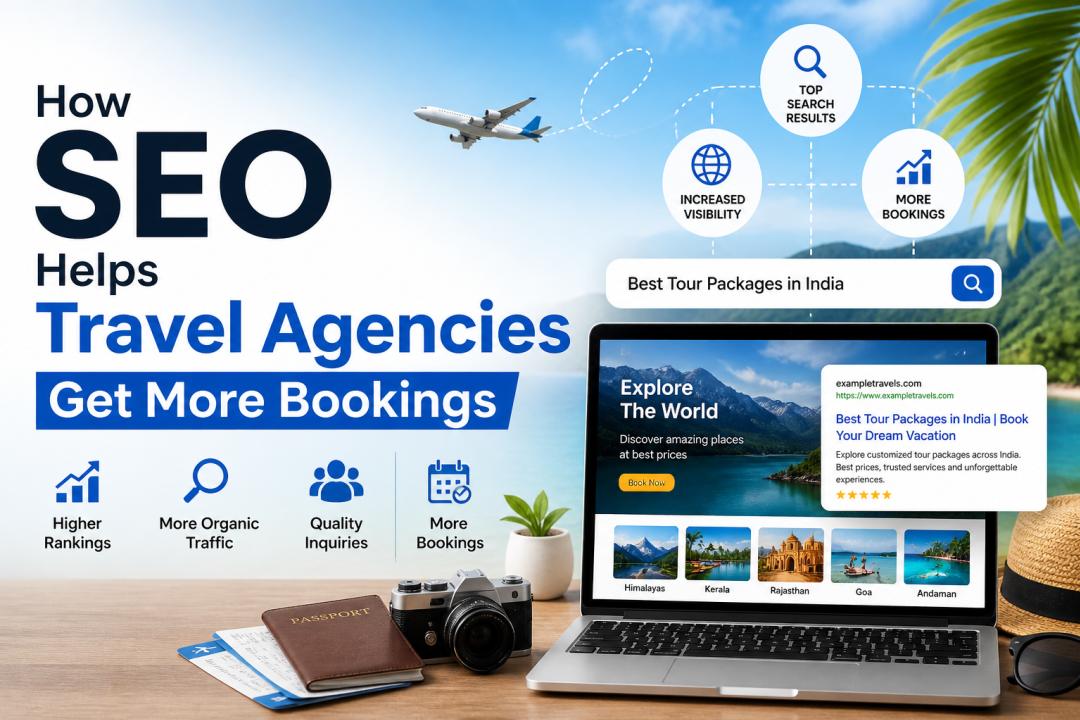
1. Why SEO Matters Specifically for the Travel Industry
Think about the last time you
planned a trip. You probably opened Google and typed something like "best
packages for Manali in winter" or "tour operator for Europe from
Delhi." That is how 87% of travelers begin their trip planning journey with a search.
Here is the uncomfortable
truth: if your travel website does not appear on the first page of Google for
those searches, you simply do not exist for that traveler. They will book with
someone who does rank there.
The travel industry has some
unique SEO characteristics that make it different from other sectors:
•
High purchase intent searches: Someone searching
"Ladakh bike trip package from Delhi" is not window shopping, they
are close to booking. SEO captures this intent at the exact right moment.
•
Long decision journeys: Travelers research for days or
weeks. SEO keeps your brand visible throughout this research process, not just
at one point.
•
Local + global blend: Travel SEO must work for both
"travel agency near me" searches and broader destination-based
searches globally.
•
Seasonal demand spikes: SEO is a long-term game, but
for travel it pays off especially during peak booking seasons — January for
summer holidays, August for winter trips.
•
Competition with OTAs: Big portals dominate broad
keywords. Smart travel agencies win by targeting niche, long-tail, and
destination-specific keywords the OTAs ignore.
Quick
Stat: According to Google's travel
insights data, over 60% of leisure travel searches on mobile are from people
who have not yet decided on a specific brand or agency. This is your
opportunity window — and SEO is the key to stepping into it.
2. Key SEO Strategies for Travel Agencies That Actually Work in 2026
There is a lot of noise online
about SEO. "Do this trick" and "use this hack." Let me skip
all that and share what actually moves the needle for travel businesses right
now.
A. Long-Tail Keyword Targeting — Stop Fighting OTAs Head-On
MakeMyTrip spends crores on ads
to rank for "Goa tour package." You cannot beat that with SEO alone.
But can you rank for "5-night Goa honeymoon package with North and South
Goa included from Pune"? Absolutely yes.
Long-tail keywords have three
big advantages:
•
Lower competition — fewer agencies are targeting them
specifically.
•
Higher intent — someone searching this specifically is
ready to book.
•
Better conversion rates — you attract exactly the right
traveler for your packages.
Pro Tip: Use
Google's autocomplete and "People Also Ask" section to find real
keyword variations your target travelers are using. Tools like Ahrefs or
Semrush help, but Google itself is a goldmine.
B. Destination Pages — Your Biggest SEO Asset
Every destination you offer
needs its own dedicated, well-optimized page. Not a generic "Europe
Tours" page that lists 15 countries in 200 words. I mean real, detailed
pages.
Each destination page should
include:
•
A clear title with the destination and package type
(e.g., "Kerala Backwater Tour Packages from Mumbai")
•
Detailed itinerary — day by day breakdown
•
What is included and not included
•
Best time to visit with seasonal context
•
FAQs that answer the real questions travelers ask
Google
•
Schema markup for travel packages (more on this below)
•
Real customer photos and reviews with structured data
A well-built destination
page is not just an SEO page — it is a sales page that convinces the traveler
to pick up the phone or fill the inquiry form. Both goals together is the
travel SEO sweet spot.
C. Local SEO — The Underused Goldmine for Travel Agencies
Here is something many travel
agencies miss completely — local SEO. Travelers often search for "travel
agency in [city]" or "best tour operator near me" because they
want someone they can meet, trust, and book with in person.
To win locally, your agency
needs:
•
A fully optimized Google Business Profile with real
photos, correct hours, and category set to "Travel Agency"
•
Consistent NAP (Name, Address, Phone) across all online
directories — Justdial, Sulekha, IndiaMART, etc.
•
Regular Google reviews from actual clients — even 10-15
genuine reviews can push you to the top of the local 3-pack
•
Location-specific landing pages if you serve multiple
cities
3. Technical SEO Challenges Travel Websites Face
This is the part that most
travel agency owners do not pay attention to — and it costs them dearly.
Technical SEO is about making sure Google can actually find, crawl, understand,
and rank your pages properly.
Page Speed — Especially on Mobile
Over 70% of travel searches now
happen on mobile devices. If your website takes more than 3 seconds to load on
a 4G connection, travelers bounce. Google knows this and ranks fast websites
higher. Compress your images, use a CDN, and eliminate render-blocking scripts.
Schema Markup for Travel Packages
Schema markup is structured
data code that tells Google exactly what your page is about. For travel
websites, TouristTrip schema, Event schema, and Review schema are your best
friends. Properly implemented schema can get your listings to appear with star
ratings and price ranges directly in Google search results — which massively
improves click-through rates.
URL Structure and Internal Linking
Travel websites often have
complex structures with hundreds of destination pages. A clean URL structure
like /destinations/kerala/backwater-tour-packages/ is far better than
/page?id=4792. And intelligent internal linking between your destination pages,
blog posts, and service pages distributes SEO authority across your whole
website.
Common
Technical Issues Travel Websites Face:
|
Issue |
Impact on SEO |
Fix |
|
Slow loading images |
High bounce rate, lower
rankings |
Compress & use WebP
format |
|
Duplicate destination pages |
Keyword cannibalization |
Use canonical tags or merge
pages |
|
Missing meta descriptions |
Low CTR from search results |
Write unique meta for each
page |
|
Broken links |
Poor crawl efficiency |
Regular broken link audit |
|
No HTTPS |
Trust & ranking penalty |
Install SSL certificate
immediately |
4. How AI Search is Completely Changing Travel Discovery in 2026
This is the most important
section of this entire guide. Read it carefully.
In 2026, search has
fundamentally changed. When someone opens ChatGPT, Perplexity, Gemini, or uses
Google's AI Overviews and asks "What is the best travel agency for Ladakh
trips?" — these AI systems are not showing a list of links. They are directly
recommending specific agencies by name.
Think about what that means for
your business. If your agency is not being cited by AI models, you are
invisible to a fast-growing segment of travelers — especially younger,
tech-savvy ones who use AI assistants as their first stop for travel research.
Why Do LLMs Recommend Some Travel Agencies and Not Others?
AI models learn from content on
the web. They recommend brands that:
•
Appear in multiple high-authority sources — travel
blogs, news sites, review platforms, industry directories
•
Have well-structured, comprehensive content on their
website that clearly explains their services, destinations, and expertise
•
Are frequently mentioned alongside relevant topics — if
15 travel blogs mention your agency as "the best operator for Spiti
Valley," AI models pick that up
•
Have strong E-E-A-T signals — Experience, Expertise,
Authoritativeness, and Trustworthiness in their content
•
Use structured data (schema markup) that makes it easy
for AI to understand what they do
How to Optimize Your Travel Business for AI Search
The good news? AI SEO and
traditional SEO largely overlap. But there are a few specific things to add to
your strategy:
•
Write content that directly answers questions AI
models are asked: Instead of just having a "Manali Tour
Packages" page, also create content like "Is Manali safe to visit in
January?" or "What is the best Manali itinerary for 5 days?"
These are the exact questions people ask AI assistants.
•
Build your brand mentions across the web: Get
featured in travel blogs, be listed in travel directories, get reviews on
Google, TripAdvisor, and Trustpilot. The more places your agency name appears
with positive context, the more likely AI systems are to recommend you.
•
Use FAQ schema extensively: AI models
love structured Q&A content. Every destination page should have an FAQ
section with schema markup. Answer the most common questions travelers have
about that destination and your packages.
•
Publish a knowledge hub: A section of
your website with destination guides, travel tips, visa information, packing
lists — this type of educational content builds topical authority, which both
Google and AI models reward.
2026
Reality Check: We have seen real travel
agencies in India lose significant inquiry volume not because Google rankings
dropped, but because AI platforms started recommending competitors who had
better structured content and more web mentions. AI visibility is no longer optional
— it is now a core part of your digital marketing strategy.
5. How to Measure Travel SEO Success- Bookings, Not Just Traffic
This is where a lot of SEO
agencies get it wrong — and where we at Thrusture take a different approach.
Traffic numbers look great in a monthly report. But if that traffic is not
converting into inquiries and bookings, it means nothing to your business.
The right metrics to track
for travel SEO:
•
Organic inquiry submissions: How many
people filled your contact form or inquiry form through organic search? This is
your primary lead metric.
•
Phone call conversions from organic: Use
call tracking to know exactly how many calls came from people who found you on
Google.
•
Keyword ranking progression: Are your
target keywords moving from positions 20-30 toward the top 10? Track this
monthly.
•
Booking conversion rate from organic traffic: What
percentage of organic visitors ultimately book? This tells you if your pages
are converting, not just attracting.
•
Cost per organic lead: Compare what
each inquiry costs you through SEO versus paid ads. Well-executed SEO is
typically 5-8x more cost-efficient over 12 months.
•
AI citation tracking: Manually test
your target queries on ChatGPT, Perplexity, and Gemini periodically. Is your
agency being mentioned? This is the new frontier metric.
Set
up Google Search Console, Google Analytics 4, and a proper goal tracking system
before you start any SEO campaign. Without measurement, you are flying blind.
6. A Practical 90-Day Travel SEO Action Plan
Theory is great, but you need a
practical starting point. Here is a realistic 90-day roadmap for travel
agencies who are just getting serious about SEO.
Days 1–30: Foundation
1.
Complete a full technical SEO audit — fix speed issues,
broken links, missing meta tags
2.
Set up Google Search Console and Google Analytics 4
properly with conversion tracking
3.
Optimize your Google Business Profile completely — add
all services, real photos, working hours
4.
Identify your top 20 target keywords using a mix of
tools and manual research
5.
Audit all existing destination pages and rewrite the
top 5 based on keyword opportunity
Days 31–60: Content & Authority
6.
Publish 4 new destination or travel guide pages
targeting long-tail keywords
7.
Create a detailed FAQ section on every major
destination page with schema markup
8.
Start a systematic outreach for 3–5 high-quality guest
post backlinks on travel or digital marketing publications
9.
Get your agency listed on 10 high-authority travel
directories
10. Ask
your existing customers for Google reviews — a simple WhatsApp message works
Days 61–90: Scale & Optimise
11.
Review which keywords moved and double down on content
for those topics
12. Build
internal links from newer content to core service and destination pages
13. Begin
testing AI visibility — check if your agency appears in ChatGPT and Perplexity
answers for target queries
14. Publish
2 more editorial-quality blog posts targeting AI-search optimized
question-based keywords
15. Measure
inquiry volume — compare month 3 to baseline and adjust strategy
Final Thoughts -SEO Is the Best Long-Term Investment for Your Travel
Business
Paid ads stop the moment you stop paying. Social media reach is unreliable. But a well-ranked travel website, backed by strong SEO services for travel industry, keeps bringing you inquiries month after month, year after year, without you spending on every single click.
In 2026, with AI search becoming part of everyday traveler behavior, the travel agencies that invest in SEO services for travel industry now — building topical authority, optimizing for AI visibility, and creating genuinely helpful content — will have a massive competitive advantage in the years ahead.
You do not need a massive
budget to start. You need a clear strategy, consistent execution, and patience.
SEO is not a sprint — it is a marathon. But once you are running, it is very
hard for competitors to catch up.
If you run a travel agency and want to understand where your website stands today, what is working, what is holding you back, and what the biggest opportunities are — we are happy to do a free SEO review for you.
This article is written by the SEO team at Thrusture — a digital
marketing agency based in Dehradun, India, specializing in Travel Industry SEO,
Local SEO, and AI-ready search optimization for travel agencies and tour
operators across India and globally.