The front desk phone rings at 9:03 AM. Again at 9:04. By 9:15, there are six calls in the queue and two walk-ins waiting. The receptionist is managing appointment slots, answering the same questions about visiting hours, and trying to confirm a report collection time.
This is not a staffing problem. It is a systems problem.
A WhatsApp chatbot for healthcare handles all of this automatically, around the clock, without a single call reaching the front desk.
The Communication Gap Hospitals Are Still Ignoring
Most hospitals have invested in EMR systems, billing software, and diagnostic equipment. Communication infrastructure, specifically the layer between the hospital and the patient, is almost always the weakest link.
Patients call for appointments and get put on hold. They visit the hospital to collect reports that could have been shared digitally. They miss medication reminders because no one followed up. They wait for a callback that never comes.
WhatsApp for Healthcare changes this entirely. With over 500 million active users in India alone, WhatsApp is already the communication layer patients use in their daily lives. Meeting them there, with an intelligent chatbot, removes every point of friction that creates drop-offs and dissatisfied patients.
Appointment Booking Without the Back-and-Forth
The most immediate win for any clinic or hospital is automating appointment scheduling.
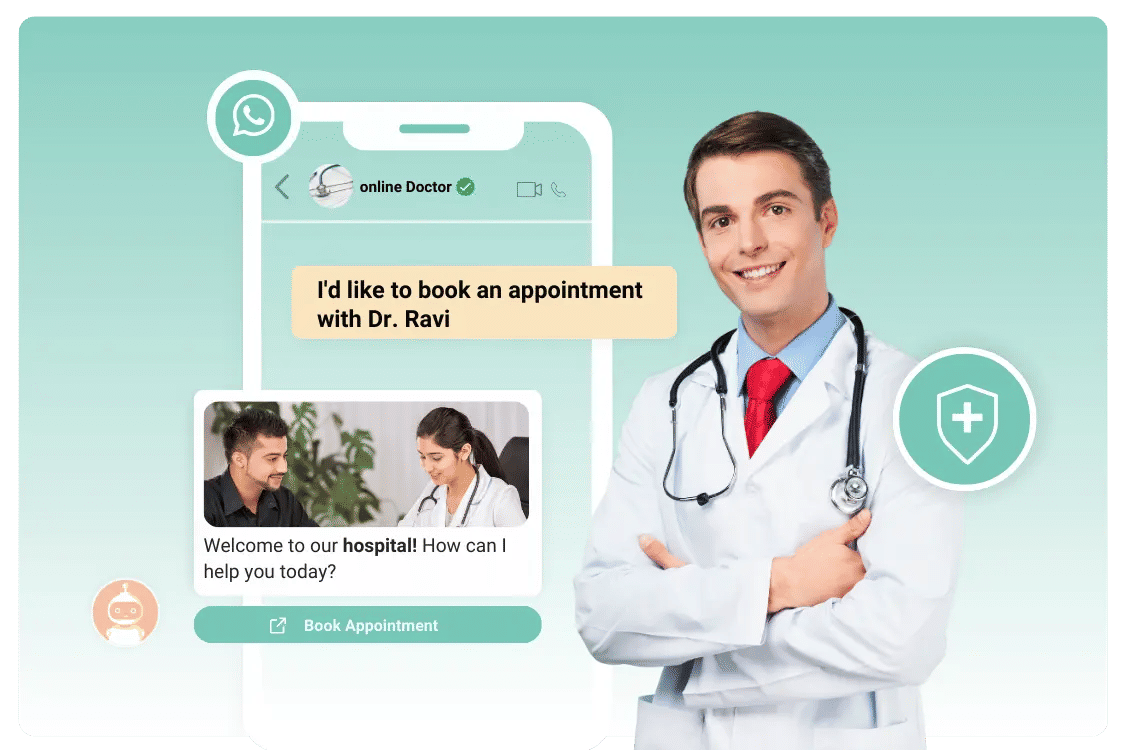
An appointment bot on WhatsApp allows patients to:
Select a department or doctor
View available time slots in real time
Confirm, reschedule, or cancel appointments
Receive instant booking confirmation with all details
No hold music. No call transfers. No "let me check and call you back." The patient books in under two minutes, entirely within WhatsApp.
For hospitals managing multiple specialties and hundreds of daily appointments, this alone reduces front desk load by a significant margin.
Reports, Reminders, and Follow-Ups on Autopilot
A healthcare chatbot does more than book appointments. It manages the entire communication timeline around a patient visit.
Report delivery: Lab results and diagnostic reports can be sent directly to the patient's WhatsApp as a PDF or image, with a message explaining next steps or follow-up requirements.
Medication reminders: Post-discharge patients receive automated reminders for medication schedules, reducing non-compliance and readmission rates.
Appointment reminders: Patients receive reminder messages 24 hours and 2 hours before their appointment, with a one-tap option to confirm or reschedule. No-show rates drop measurably.
Post-visit follow-ups: A simple automated message checking in on recovery or requesting feedback closes the care loop and builds patient trust without adding to staff workload.
This is medical automation working at the communication layer, not replacing clinical care, but removing every administrative gap around it.
Handling Patient Queries at Scale
Walk-in hours, visiting policies, insurance documentation, parking facilities, speciality availability. Every hospital receives hundreds of these queries every week. Most are handled by staff who could be doing higher-value work.
A patient chatbot on WhatsApp handles these queries instantly through a structured FAQ flow. Patients type their question or select from a menu. The bot responds with accurate, pre-approved information in seconds.
For queries that genuinely require human involvement, such as second opinions, billing disputes, or complex medical questions, the bot escalates to a live agent with full conversation context already attached.
The result: patients get fast answers, staff handle only what actually needs human judgement, and the hospital chatbot becomes the first point of contact for the majority of inbound communication.
Why Clinics and Hospitals Choose WhatsApp for Patient Communication
The business case for healthcare communication automation on WhatsApp is straightforward:
24/7 availability without 24/7 staffing costs
Reduced appointment no-shows through automated reminders and easy rescheduling
Faster report access for patients without physical visits
Lower front desk volume for high-frequency, low-complexity queries
Better patient satisfaction scores driven by faster, more responsive communication
HIPAA-aligned data handling when configured through a compliant WhatsApp Business API provider
For multi-speciality hospitals, diagnostic chains, and growing clinic networks, WhatsApp chatbot infrastructure scales with patient volume without proportional increase in staff.
Automate Patient Communication with Anantya.ai
Anantya.ai's WhatsApp chatbot for healthcare is built for clinics and hospitals that want to modernise patient communication without complex integrations or long implementation timelines. From appointment bots to report delivery and follow-up automation, the entire patient communication workflow runs on WhatsApp, under your brand.
Your patients are already on WhatsApp. Your communication system should be too.
[Talk to Anantya.ai about your healthcare chatbot →]
❓ Frequently Asked Questions
Q1. What is a WhatsApp chatbot for healthcare?
A WhatsApp chatbot for healthcare is an automated conversational system that handles patient communication through WhatsApp. It manages appointment bookings, sends reminders, delivers reports, answers common queries, and escalates complex cases to human staff.
Q2. Can a WhatsApp chatbot book hospital appointments automatically?
Yes. A WhatsApp appointment bot can display available slots, confirm bookings, send reminders, and process rescheduling or cancellations, all without staff involvement. Patients complete the entire booking within WhatsApp.
Q3. Is patient data secure on WhatsApp Business API?
WhatsApp Business API messages are end-to-end encrypted. When implemented through a compliant provider and paired with proper data handling policies, the platform can be configured to meet healthcare data privacy requirements.
Q4. How does a healthcare chatbot reduce no-show rates?
By sending automated appointment reminders 24 hours and 2 hours before the scheduled slot, with a simple option to confirm or reschedule. Patients who might forget or need to reschedule take action immediately, reducing last-minute no-shows significantly.
Q5. Can WhatsApp be used to send medical reports to patients?
Yes. Lab results, diagnostic reports, prescriptions, and discharge summaries can be sent as PDFs or images directly to a patient's WhatsApp, with accompanying instructions or follow-up guidance.
Q6. What types of patient queries can a hospital chatbot handle?
A hospital chatbot can handle visiting hours, department information, doctor availability, insurance queries, appointment confirmations, report collection timelines, and general FAQs. Complex or sensitive queries are escalated to human agents with full chat context.
Q7. How is a WhatsApp chatbot different from a hospital mobile app?
A hospital app requires patients to download, register, and learn a new interface. A WhatsApp chatbot works inside an app patients already use daily, with zero setup on their end. Adoption rates are significantly higher as a result.