Choosing the Right Used Fiat Engine for Your
Italian Vehicle
Fiat has maintained a presence in the American market through waves of enthusiasm, retreat, and return each cycle bringing a new generation of American drivers into contact with Italian small-car engineering that has consistently prioritized driving character over absolute reliability statistics. The return of Fiat to the US market in 2011 with the 500 lineup, followed by the 500X, 500L, and the performance-oriented 500 Abarth, created an entirely new generation of Fiat owners who value what these vehicles do differently from their domestic and Japanese competitors. When a used Fiat engine fails whether from the high-mileage wear that eventually affects any small displacement turbocharged unit, a cooling system failure that leads to overheating damage, or a maintenance-related failure that accelerates internal wear the used Fiat engine market provides the financially rational alternative to expensive dealer repair or premature vehicle retirement.
This guide covers the Fiat engine families
most commonly required in the US replacement market, the failure patterns that
drive demand for used units, how to evaluate a replacement engine
intelligently, and where to source a used Fiat engine backed by the warranty
coverage and supplier expertise that a European small-car powertrain investment
demands.
Fiat Engine Families in the US Market
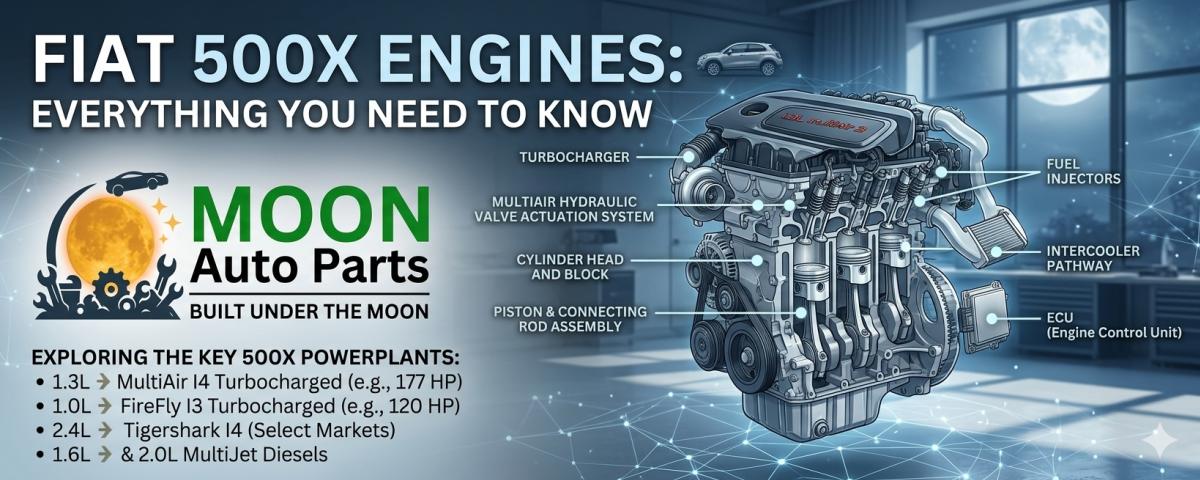
The 1.4L MultiAir turbocharged inline-four
(engine code 312A1000) is the heart of the modern Fiat 500 lineup in the US
market — powering the 500 Pop, Lounge, and Sport in its naturally aspirated
configuration and the 500 Abarth and 500T in its turbocharged variant. The
MultiAir engine is Fiat's award-winning variable valve actuation system, which
uses hydraulic-electro actuators rather than traditional camshaft-follower
valvetrain geometry to manage intake valve timing and lift with a precision
that traditional variable valve timing systems cannot match. In operational
terms, this means exceptional fuel efficiency and low-end torque from an
extremely small displacement — characteristics that make the 1.4L MultiAir feel
considerably larger than its displacement suggests.
The 1.4L Abarth variant of this engine
produces up to 160 horsepower in certain tune states, representing a power
density from a naturally aspirated small-displacement turbocharged unit that is
impressive by any standard. The MultiAir's complexity, however, means that when
it fails — particularly the hydraulic actuator system for the intake valves —
the repair cost through conventional dealer channels can be significant enough
to make a quality used engine the financially preferable solution.
The 2.4L MultiAir inline-four serves the
Fiat 500X and 500L in their higher-specification configurations, providing the
additional torque necessary to move these larger, heavier vehicles with
appropriate responsiveness. The 2.4L MultiAir shares the valvetrain technology
philosophy of the 1.4L but in a larger displacement package better suited to
the crossover segment's demands. This engine appeared in both front-wheel-drive
and all-wheel-drive configurations across the 500X lineup.
The 1.6L E.torQ inline-four served the Fiat
500L in certain configurations, representing a more conventional naturally
aspirated design without the MultiAir variable valve actuation system. The 1.6L
E.torQ is mechanically simpler than the MultiAir family and consequently has a
more conventional failure mode profile — timing belt wear, valve stem seal
degradation at higher mileage, and cooling system failures are the primary
drivers of used engine demand for this configuration.
Common Failure Modes in Fiat Engines
MultiAir actuator failure is the most
consequential and expensive failure mode in the 1.4L and 2.4L MultiAir engine
families. The hydraulic actuator solenoids that control intake valve timing and
lift operate in a high-temperature, high-cycle environment that eventually
leads to solenoid degradation. When a MultiAir actuator fails, the affected
cylinder operates without variable valve control, resulting in rough idle,
power loss, and increased fuel consumption. Dealer repair costs for MultiAir
actuator replacement — which involves partial engine disassembly to access the
actuator assembly — frequently reach a threshold where used engine replacement
becomes the more rational financial decision.
Timing belt failure represents an absolute
engine-ending event in Fiat's interference engines. The 1.4L MultiAir and 1.6L
E.torQ are interference design engines — meaning that if the timing belt fails
at operating speed, valve-to-piston contact occurs immediately, bending valves
and potentially damaging pistons. Timing belt replacement intervals in Fiat's
small-displacement engines are more conservative than many owners realize, and
the consequences of deferred timing belt service are catastrophic and irreversible.
Carbon buildup on intake valves in the
turbocharged 1.4L MultiAir is a consequence of its direct injection
architecture combined with positive crankcase ventilation vapors. Without fuel
spray washing over the intake valves, oil deposits accumulate with every hour
of engine operation. Severe carbon buildup causes rough idle, misfires under
acceleration, and measurable power reduction — a problem the MultiAir's complex
valvetrain makes difficult and expensive to address through cleaning procedures
alone.
Oil consumption through piston ring wear
affects the 1.4L MultiAir at higher mileage, particularly in turbocharged
Abarth applications where the engine operates at sustained higher temperatures.
Excessive oil consumption leads to catalytic converter damage, spark plug
fouling, and eventual bearing damage if oil level falls significantly between
service intervals. A quality used engine with confirmed low consumption
characteristics directly addresses what conventional ring replacement surgery
on a complex MultiAir engine makes impractical.
Evaluating a Used Fiat Engine: What to Verify
Engine code and variant confirmation is
essential for Fiat's 1.4L MultiAir family, where naturally aspirated,
turbocharged, and Abarth-tuned variants use different internal components, fuel
system calibrations, and emissions equipment. Fitting a naturally aspirated
unit into a turbocharged application — or vice versa — is not simply a
performance downgrade; it is a fitment incompatibility that creates immediate
operational problems. Confirming the exact engine code, turbocharger
configuration, and fuel system variant against your specific vehicle's VIN is a
mandatory first step.
Timing belt service evidence — where
available from the supplier's documentation of the donor vehicle's service
history — provides meaningful assurance about the used engine's remaining
serviceable life. A used Fiat engine from a donor vehicle with documented
recent timing belt service is a materially lower-risk purchase than an
undocumented unit of similar mileage.
MultiAir system verification — evidence that the engine was operating smoothly through all valve control ranges before removal — is the most important functional check for used 1.4L and 2.4L MultiAir units. A supplier who can confirm the MultiAir system was functioning correctly at the time of engine removal is providing quality assurance that goes beyond simple mileage reporting.
Conclusion
Choosing the right used Fiat engine is essential for maintaining the performance, efficiency, and unique driving character that Fiat vehicles are known for. A properly inspected and application-matched used engine can provide a reliable and cost-effective alternative to expensive dealer replacements, helping owners extend the life of their Fiat without overspending. By understanding common engine failure patterns, verifying compatibility, and sourcing from a trusted supplier that offers quality testing and warranty protection, Fiat owners can confidently restore their vehicle’s performance while continuing to enjoy the distinctive engineering and driving experience that set Fiat apart.
Read more - What is the worth of a used mercury engine?