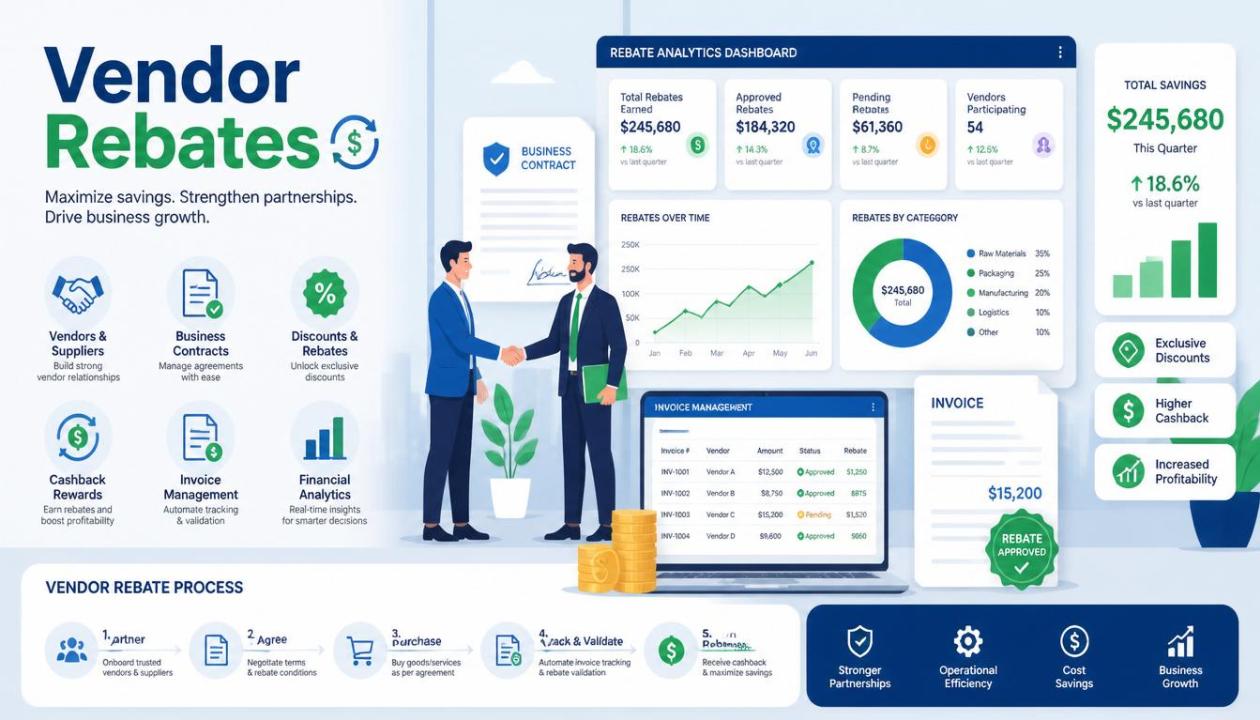
You negotiated hard. You signed the contract. You met your purchase volumes every quarter. Yet, at the end of the year, you may find yourself quietly leaving thousands, sometimes hundreds of thousands of dollars behind. Does this sound familiar? If you run a mid-size business or handle procurement, your vendor rebates program may be broken or barely working. You are not alone, and it is not your fault, but it can definitely be fixed.
Most finance and procurement teams understand that vendor rebates exist on paper. In reality, though, the process of tracking, claiming, and reconciling them gets scattered across spreadsheets, email threads, and supplier portals that don’t communicate with each other. The result is missed deadlines, unclaimed credits, and a growing gap between the rebates you are supposed to receive and the rebates you actually get.
This guide explains what vendor rebates are, why businesses often fail to capture them, and what an effective system actually looks like.
What Are Vendor Rebates, Exactly?
A vendor rebate is a payment or credit that a supplier gives a buyer after certain purchasing conditions are met, usually a volume threshold, a spending target, or a loyalty milestone. Think of it as a reward that comes after the fact: you buy, you qualify, you get paid back.
Unlike upfront discounts, which reduce the invoice amount at the time of purchase, vendor rebates accumulate over time and are claimed later. This delay makes them difficult to manage and easy to overlook.
Common Types of Vendor Rebates
Volume rebates: Triggered when total purchases exceed a set threshold within a specific time frame.
Growth rebates: Awarded when your spending with a supplier increases by a certain percentage each year.
Loyalty or exclusivity rebates: Earned by focusing spending with one main supplier instead of splitting it among competitors.
Promotional rebates: Limited-time incentives tied to specific products or campaigns.
Early payment rebates: Given when invoices are paid before the usual deadline.
Each type has its own rules, reporting requirements, and claim deadlines. If you miss a deadline or misinterpret a tier structure, the rebate simply won’t happen, there’s no reminder and no second chance.
Why So Many Businesses Fail to Capture Them
Here's the uncomfortable truth: most organizations recover only a small part of the vendor rebates they qualify for. Research across mid-market procurement teams constantly highlights the same set of issues.
60%: Of businesses lack a centralized rebate tracking system
30%: Oof earned rebates go unclaimed due to missed deadlines or poor documentation
4×: More rebate value recovered by companies using automated vs. manual processes
The Spreadsheet Trap
When rebate tracking relies on a spreadsheet managed by just one person, you create a single point of failure. Staff turnover, formula errors, and version conflicts can silently erase months of tracking. The spreadsheet seems easy to handle at first but eventually becomes something everyone avoids.
Contracts Written in Supplier Language
Vendor rebate agreements often favor the supplier's understanding. Thresholds might be set by SKU category instead of total spend. Tiered structures may reset unexpectedly. If no one reviews these contracts closely and connects each condition to your purchasing data, you will frequently underestimate what you are owed.
The Accrual Disconnect
Finance teams often record expected vendor rebates as income, but if those records don’t match actual claim amounts, you create a gap that confuses your profit and loss statement and complicates audit season. The rebate gets recorded as income before it's claimed but is never actually collected. It’s one of the quieter forms of revenue loss.
"A vendor rebate program that no one actively manages isn’t a revenue stream; it’s a theoretical one. The money only moves when someone takes action to make it move. "
Building a Rebate Program That Actually Works
The good news is that fixing a broken vendor rebate process does not require you to replace your ERP or hire a specialist team. It takes discipline, a clear owner, and the right workflow. Here are the common features of effective programs.
Centralize all rebate agreements in a single location.
Whether you use rebate management software or a well-organized SharePoint folder, every contract, amendment, and communication with suppliers should be stored in one searchable location that is accessible to both finance and procurement.
Extract and code every condition.
For each agreement, document the qualifying metric, such as spend, volume, or growth. Also include the threshold amounts, the rebate percentage or fixed amount for each tier, the performance period, and the claim submission deadline. This will be your rebate register.
Connect purchasing data to rebate conditions in real time.
Your rebate register is valuable only if you can see how close you are to each threshold at any point in the year. Integrate your purchase order data so the register updates automatically. This changes rebate management from a year-end scramble to a live dashboard.
Set internal deadlines well before supplier deadlines.
Suppliers claim windows close quickly. Set internal alerts 45 to 60 days in advance so finance has time to gather supporting documentation, resolve any data discrepancies, and submit without rushing.
Assign a single owner and make it a KPI.
Rebate recovery should be a specific job responsibility, not just a background task. Link a percentage of the recovered rebate value to that person's performance metrics. Ownership changes behavior.
Consider Dedicated Rebate Management Software
For businesses with more than 20 to 30 active supplier agreements, manual processes will always have gaps. Platforms designed for vendor rebate management can automate threshold tracking, generate claim documents, and flag performance issues early enough to act on them. For example, you can consolidate orders with a specific supplier in Q4 to reach a tier you are close to hitting.
Using Rebates as a Purchasing Lever, Not Just a Reward
The best procurement teams don’t just track vendor rebates; they use them to influence purchasing decisions. This represents a significant change in thinking: moving from "what rebates did we earn?" to "what purchasing behavior will maximize rebate income?"
In practice, this means reviewing rebate tier structures during yearly supplier negotiations and including them in total cost-of-ownership calculations. A supplier with a slightly higher unit price but a generous volume rebate structure may result in a lower total annual cost once rebates are included. Most sourcing decisions overlook this completely.
Signs Your Rebate Program Needs Attention
You only review rebates at year-end or during audits.
Rebate claims are submitted by the supplier, not initiated by you.
Finance and procurement manage rebates separately without shared visibility.
You've never mapped your actual spend against a rebate tier structure mid-year
No one can say, right now, how much in vendor rebates you've accrued this quarter.
Negotiate Rebate Terms Not Just Prices
When entering or renewing supplier contracts, consider the rebate structure as a negotiating point, not a take-it-or-leave-it clause. Push for lower entry thresholds, better tier increments, and longer claim submission windows. Suppliers who value your long-term business are often more flexible than buyers expect.
Always request multi-year rebate agreements, as they allow for more strategic purchasing planning.
Ask for quarterly rather than annual rebate periods to improve cash flow predictability.
Negotiate cumulative thresholds that roll over to subsequent periods if you fall short in one quarter.
Ensure rebate terms are reflected in your ERP system at the point of contract signing.
Build annual rebate income projections into your budgeting process as a line item.
The Money Is Already There. Go Get It
Vendor rebates are not a bonus or a nice-to-have. For businesses with significant supplier spending, they represent a real and often substantial source of revenue that needs active management to realize. The businesses that capture the most aren’t necessarily spending more or negotiating harder on unit prices. They’re simply more organized, proactive, and deliberate about treating rebate income as a managed asset instead of a pleasant surprise.
If your current process relies on a spreadsheet, an annual reminder email, or institutional memory held by one or two people, it’s costing you money right now. The solution isn't complicated; it requires consistency. Build the register, assign an owner, connect the data, and treat every supplier agreement as a financial instrument with measurable returns. The money your suppliers owe you doesn’t automatically get deposited into your account. But with the right systems in place, it absolutely can.
Frequently Asked Questions
What is a vendor rebate, and how does it work?
A vendor rebate is a retroactive payment from a supplier to a buyer, triggered when the buyer meets certain purchase conditions, such as reaching a volume threshold or spending a set amount within a specific period. Unlike an upfront discount, rebates are paid after the fact, usually quarterly or annually, based on verified purchasing data.
What’s the difference between a vendor rebate and a discount?
A discount lowers the price at the time of purchase; it shows up immediately on the invoice. A rebate is earned over time and paid back later, typically based on cumulative spend or volume. Rebates need active tracking and claiming; discounts are automatic. This is why rebates are often overlooked.
How do I track vendor rebates effectively?
Effective tracking starts with listing all supplier contracts that include rebate terms. From there, you need to regularly compare your actual purchasing data against those terms, set reminders for claim deadlines, and assign one person to manage the process. Software can automate much of this, but a structured spreadsheet works well for businesses with a manageable number of supplier agreements.
Are vendor rebates taxable income?
In most places, vendor rebates are seen as a reduction in the cost of goods purchased rather than income, which affects how they are recorded in your accounts. However, the tax treatment can vary depending on the type of rebate and local rules. It’s important to confirm the correct accounting and tax treatment with your finance team or accountant, as misclassification can lead to reporting issues.
How do I negotiate better vendor rebate terms?
The best position comes from having accurate data on your purchasing history. When you can show consistent volume, on-time payments, and contract compliance, you gain real leverage. Before renegotiating, review which tiers you’ve reached, how close you are to higher tiers, and what spend consolidation might look like. Suppliers reward buyers who make their business predictable, and they know when you’re tracking.