Brake problems rarely announce themselves all at once. They build gradually, a faint squeal here, a slightly longer stopping distance there. until what started as a minor inconvenience becomes a genuine safety hazard. For drivers who put off auto brake repair, the cost of that delay is almost always higher than the cost of addressing the problem early. It is a gamble with both your bank account and your road safety.
This guide breaks down exactly what happens if you don't fix your brakes, what the warning signs look like, and why timely action is the only practical approach.
The Early Warning Signs You Shouldn't Overlook
Braking systems are designed to communicate. The challenge is that many drivers either misread those signals or simply turn up the radio to drown them out.
Understanding the signs you need for brake auto repair starts with paying attention to sound and feel. A high-pitched squealing when applying the brakes is typically the first indicator. Brake pads are manufactured with a small metal wear indicator, a "scratcher", that produces this noise precisely to alert the driver. That squeaking or grinding brakes meaning is straightforward: your pad material is running thin.
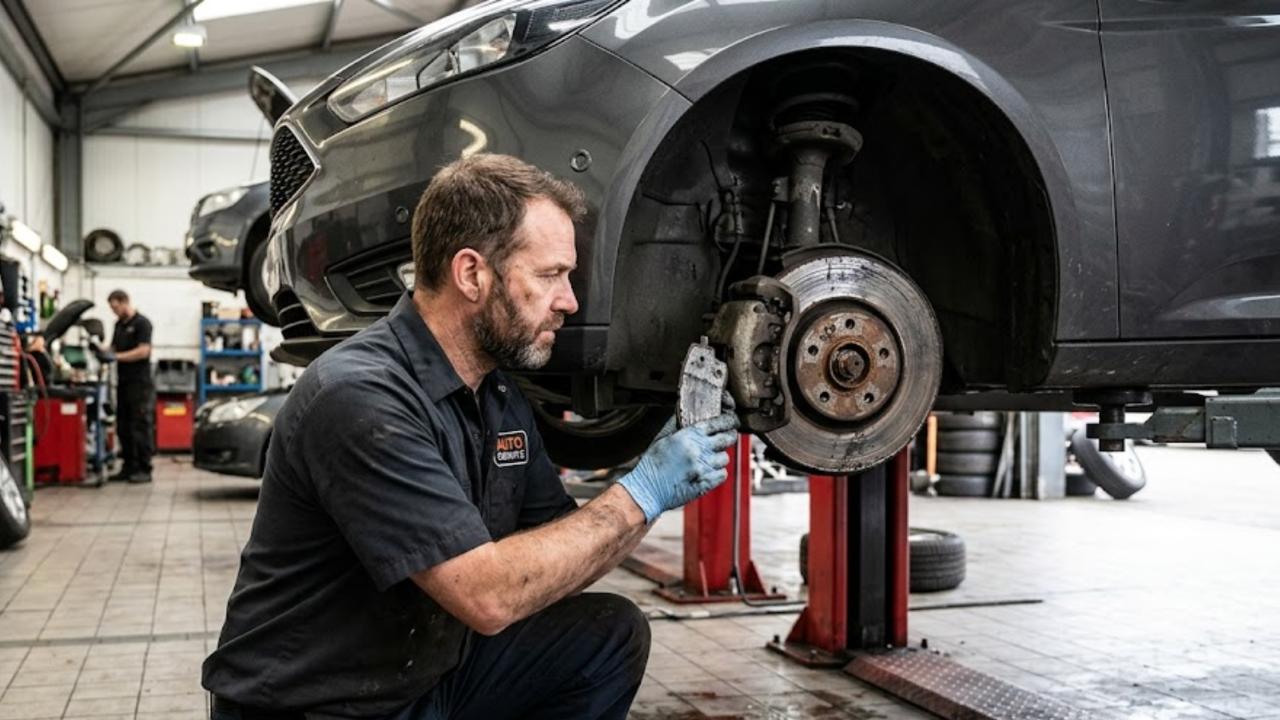
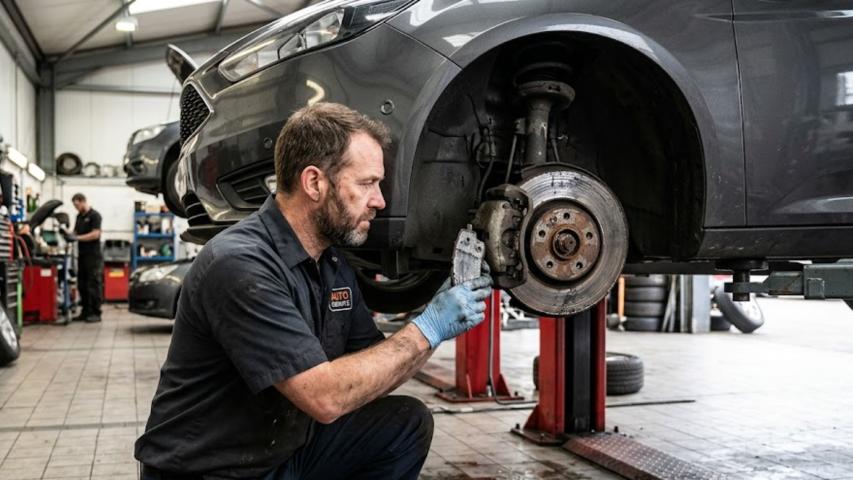
If that sound progresses to a harsh, metallic rasp, the pads have likely worn through completely. At this stage, metal-on-metal contact is occurring between the caliper and the rotor. The damage is no longer limited to the pads; you are now grinding away at the foundation of the system.
Other bad brake symptoms to watch for include:
- The Spongy Pedal: A brake pedal that feels unusually soft or sinks to the floor.
- The Shudder: Vibrations felt through the steering wheel or seat during braking.
- The Pull: The vehicle drifting to one side when you try to stop.
- The Smell: An acrid, chemical burning odor after a long drive.
Any dashboard brake warning light that stays illuminated is an immediate flag. It isn't a suggestion; it’s a warning that the system is compromised.
What Happens When Brake Problems Are Left Unaddressed
Stopping Distance Increases
The first consequence is a gradual increase in the distance required to bring the vehicle to a halt. This change happens slowly. Drivers often adapt without realizing it, pushing the pedal a little harder or braking a little sooner. In normal traffic, it feels manageable. In an emergency, like a car suddenly stopping ahead, that extra yard of travel can be the difference between a close call and a collision. This is one of the most underestimated driving with worn brakes risks because it doesn't feel urgent until the moment you need a hard stop and the car won't give it to you.
Damage Spreads to Other Components
Brake pads are the "sacrificial" component of your car. They are designed to be inexpensive and easy to replace to protect the heavy-duty parts around them. When brake pads worn out symptoms are ignored, the destruction spreads.
- Rotors: The friction surfaces become scored, warped, or thinned.
- Calipers: The pistons can seize or sustain heat damage.
- Wheel Bearings: Excessive heat from metal-on-metal friction can even degrade the grease in your bearings.
What started as a simple pad replacement becomes a massive overhaul.
Brake Failure Becomes a Real Possibility
Driving on compromised brakes eventually leads to the "point of no return." The brake failure warning signs include a pedal that touches the floorboards, visible fluid leaking near the wheels, and a dramatic loss of stopping power.
If you experience these, the car is no longer safe to operate. Total failure at highway speeds is a documented outcome of prolonged neglect, not just a worst-case scenario.
The Financial Cost Grows Significantly
From a purely financial standpoint, the brake repair cost for a standard pad replacement is modest. However, once you involve rotors and calipers, the price tag can easily triple or quadruple. Delay is not cost-neutral; it is a compounding debt.
How Long Can You Actually Drive With Bad Brakes?
People often ask this looking for a specific mileage, but the answer is absolute: there is no safe duration. Is it dangerous to drive with bad brakes? Unambiguously, yes.
The braking system is the single most critical safety mechanism on your vehicle. Unlike a broken air conditioner, a degraded brake system determines whether you can actually control the vehicle in a crisis. The question isn't how long you can drive, but how quickly you can get to a mechanic.
Common Causes of Brake Problems
Understanding the car not stopping properly causes helps you stay ahead of the curve. The most frequent culprits are:
- Worn friction material: Simple old age.
- Contaminated fluid: Moisture entering the lines and reducing hydraulic pressure.
- Air pockets: Causing that "spongy" feeling.
- Warped rotors: Caused by excessive heat and hard braking.
Most of these issues are entirely preventable with a simple visual inspection during a routine oil change.
Why Maintenance Intervals Are Non-Negotiable
Automotive maintenance schedules exist for a reason. Most mechanics recommend an inspection every 10,000 to 15,000 kilometers. However, if you drive in heavy stop-and-go city traffic or navigate steep hills, your wear will be much faster.
The brake maintenance importance extends beyond your own car. A vehicle that can’t stop effectively is a hazard to every other person on the road. Knowing when to replace brake pads before they fail is part of responsible ownership.
Most modern cars have sensors or visual indicators; acting on them the moment they appear keeps the repair bill low and the safety margin high.
Practical Brake Safety Tips
The best brake safety tips are often the simplest.
- Listen: If you hear a chirp or squeak, don't wait.
- Downshift: Use engine braking on long descents to prevent heat buildup.
- Quality Matters: Use high-quality replacement parts. Cheaper pads often wear out faster and create more dust.
- Flush the Fluid: Ensure your brake fluid is replaced according to your manual’s timeline to keep the hydraulics crisp.
Addressing grinding brakes the moment they appear, rather than weeks later, protects your car and your passengers.
Fix Your Brakes Before it Unfixes Your Pocket
The consequences of ignoring your brakes are consistently worse than the inconvenience of a repair.
From extended stopping distances and structural damage to an escalating brake repair cost, the pattern is clear: small problems left alone become large, dangerous ones.
Recognizing the squeaking or grinding brakes' meaning, understanding the car not stopping properly causes, and acting on brake pads worn out symptoms early is the only way to drive with confidence.
Your brakes are the only thing standing between a controlled stop and a serious accident. Keep them in top shape, and they’ll do the same for you.