What Happens When Workflow Chaos Slows Enterprise Growth?
Think about a multinational corporation in which HR
requisitions go unattended for days, IT tickets vanish into thin air during
departmental transfers, compliance authorizations take time to arrive, and
customer care teams operate in disparate environments. In a Fortune 500
company, inefficient workflows are more than operational issues – they affect
income, staff efficiency, client satisfaction, and continuity of operations.
It is precisely this issue that Fortune 500 businesses are
addressing by leveraging ServiceNow.
Rather than relying on fragmented communications,
spreadsheets, and software applications to control their operational processes,
Fortune 500 enterprises use ServiceNow to integrate, automate, and optimize
their workflows. For IT operations, cybersecurity, HR onboarding, and customer
services, the application serves as the central workflow management solution for
an efficient process flow in an enterprise environment.
The end outcome would be better decision-making, cost reduction, compliance, and improved digital experiences for both employees and clients.
Why ServiceNow Became a Preferred Enterprise Workflow Platform
Large companies function within very complex ecosystems. A
single workflow can consist of several teams, programs, approvals, and
compliance checks. The existing workflows are rarely capable of handling such
complexity.
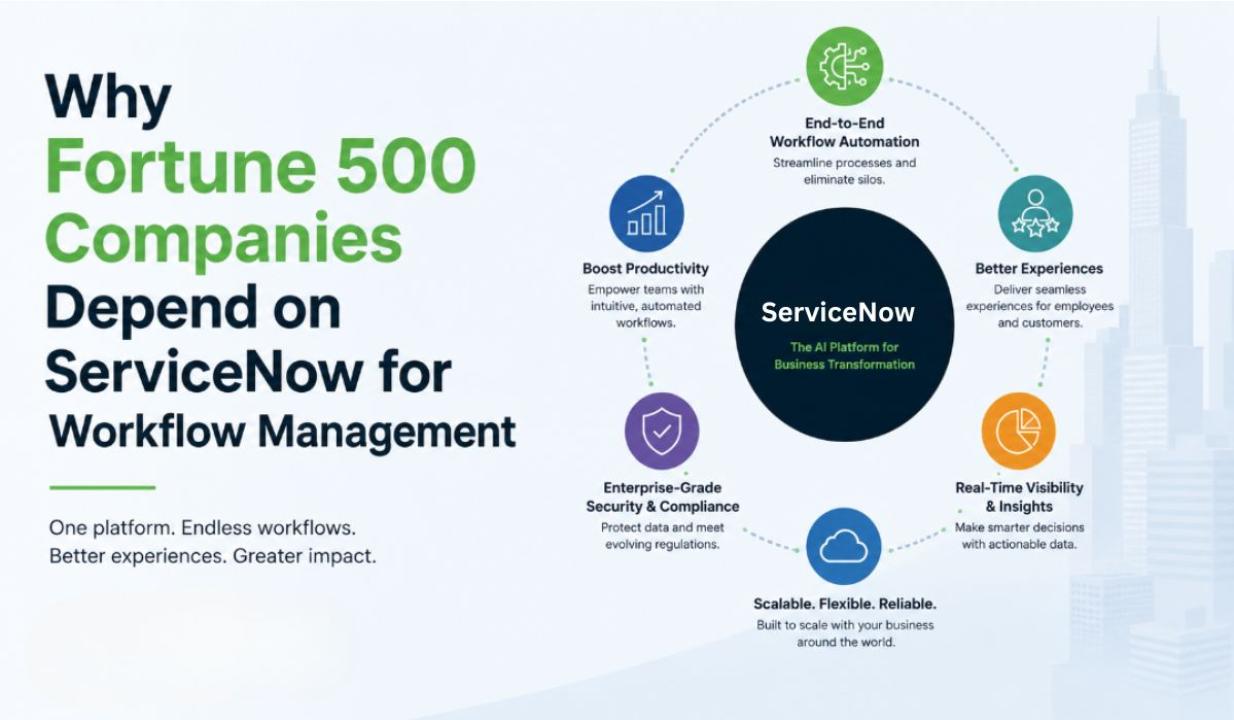
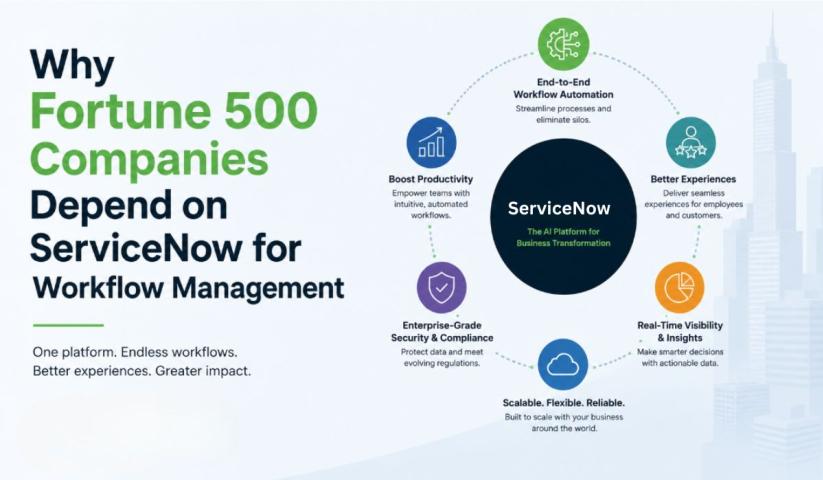
ServiceNow addresses this problem through:
- Cloud-based workflow automation
- Artificial intelligence process management
- Cross-department collaboration
- Visibility into operations in real time
- Governance and enterprise-class security
- Scalability and digital transformation
This enables the creation of an integrated digital workflow ecosystem rather than individual workflows for Fortune 500 companies.
Centralized Workflow Management Across Departments
Among the reasons why enterprises rely on ServiceNow is the ability of the application to integrate workflows from various departments within the organization.
As opposed to having different platforms for:
- IT service management
- Human Resources processes
- Finance approvals
- Security operations
- Procurement management
- Customer service workflows
The application offers an integrated approach to managing workflows across the enterprise.
The integrations help organizations' management to track bottlenecks, improve collaboration, and keep a consistent workflow across all departments within the organization globally.
Examples include:
- HR onboarding workflows, which can be linked to allocating IT assets.
- Security threats that could create incident response tickets immediately.
- Approvals from procurement, which would be subjected to automatic checks.
AI and Automation Drive Enterprise Efficiency
Automation is highly preferred by Fortune 500 companies owing to the fact that manual operations are time-consuming, costly, and prone to errors.
AI-based automation capabilities provided by ServiceNow include:
- Automatic routing of tickets
- Predictive analytics
- Approval automation
- Virtual agents and chatbots
- Workflow suggestions
- Incident prioritization
This enables organizations to minimize repetitive administrative tasks for more value-driven operations.
In the case of multinational corporations managing thousands of transactions per day, even minor workflow optimizations may yield substantial productivity improvements.
Strong IT Service Management (ITSM) Capabilities
ServiceNow has made an especially noteworthy name for itself in the field of Enterprise IT Service Management (ITSM).
The Fortune 500 companies rely very much upon a dependable IT infrastructure. Any issues in the form of downtime, slow resolution of problems, or faulty ticket handling can create disruptions throughout the entire company.
Some of the things that companies get with ServiceNow include:
- Enterprise IT ticket management
- Incident and problem management
- Change management processes
- Asset management
- Configuration management databases (CMDB)
- Operational monitoring
Security and Compliance Matter at Enterprise Scale
Large organizations have tight regulations and security policies in place. Workflow applications need to have the capability for governance, compliance, and risk management.
ServiceNow offers:
- Workflow audit trails
- Role-based access control
- Compliance workflows
- Security incident response
- Risk management dashboards
Some key industries that will benefit from these capabilities include:
- Healthcare
- Banking
- Insurance
- Manufacturing
- Government contracts
- Telecommunications
Organizations will be able to automate their compliance process while minimizing risks.
Better Employee and Customer Experiences
Modern companies know that efficient workflows can make or break experience.
Employee expectations include:
- Fast approvals
- Automated self-services
- Visibility into requests
- Efficient internal workflows
Customer expectations include:
- Quicker problem solving
- Consistency in service
- Faster responses
With ServiceNow, companies can do this.
The company’s digital workflow environment will improve productivity within and outside the company – a necessity for successful enterprise growth.
Why Fortune 500 Adoption Continues to Grow
Two things are driving the widespread usage of ServiceNow at
Fortune 500 organizations: one simple truth – today’s enterprises can only
survive if they are agile.
Companies that leverage workflow automation tools such as
ServiceNow will be able to react quickly to all changes, both on the market and
in customers’ needs and digital transformation requirements.
As enterprise operations evolve, workflow automation systems
such as ServiceNow will be required components rather than simply useful
software.
ServiceNow at Fortune 500 firms means much more than just a tool for workflow automation – it is an advanced system of scalability, productivity, innovation, and transformation.