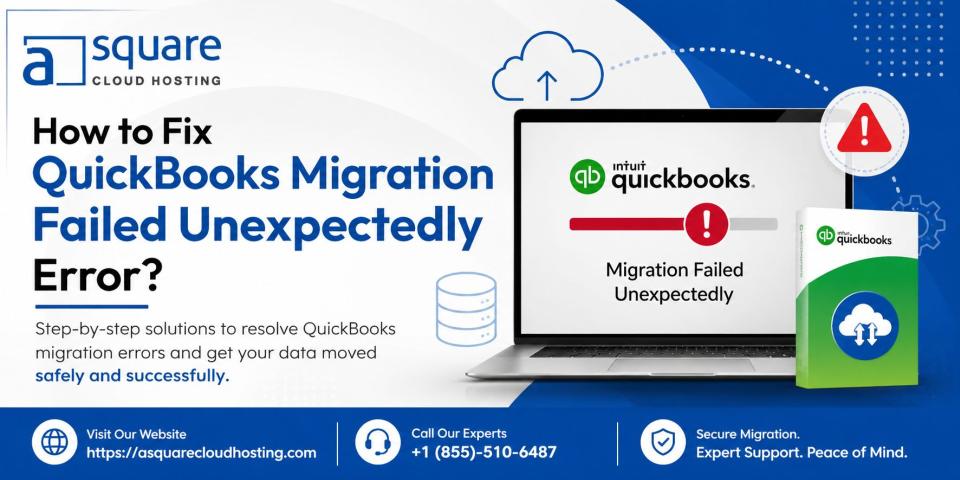

When you receive the message "QuickBooks Migration Failed Unexpectedly" , your carefully planned data transfer has come to an abrupt halt. Whether you are moving from QuickBooks Desktop to QuickBooks Online, upgrading to a new computer, or migrating between versions, this error can be frustrating and time-consuming . The impact on business operations is immediate: workflow disruption, payroll interruption, company file access issues, and potential data loss across your organization .
This comprehensive guide provides step-by-step solutions to resolve migration failures, specifically addressing Error 1009 and other common migration errors that prevent successful data transfer .
What Is the QuickBooks Migration Failed Unexpectedly Error?
The "QuickBooks Migration Failed Unexpectedly" error occurs when the migration process between QuickBooks applications or computers is interrupted or cannot complete successfully. This error can manifest in several ways, including Error 1009 (internal exception: unknown) , general tool failure, or connection issues between QuickBooks Desktop and QuickBooks Online .
When this error appears:
When using the QuickBooks Migration Tool to move data from an old computer to a new one
When exporting data from QuickBooks Desktop to QuickBooks Online
When creating backup copies of client files
When converting company files between QuickBooks versions
When attempting to import CSV files containing customer or vendor data
Common error messages users may see:
"QuickBooks Migration Failed Unexpectedly"
"Error 1009: Internal error: unknown exception"
"Migration Tool Error 1009 – QuickBooks Online backup issues"
"You cannot import because the QuickBooks Online company has been cancelled"
"Your file is too big to export"
This issue affects QuickBooks Desktop Pro, Premier, and Enterprise, as well as QuickBooks Online migration processes . The error signals data corruption issues, version incompatibility, permission problems, or network connectivity failures that prevent successful data transfer .
Common Causes of QuickBooks Migration Failure
Understanding the root cause of QuickBooks migration error helps you apply the correct fix. Below are the most frequent triggers identified by Intuit support and migration specialists.
Region Mismatch Between QBDT and QBO
When migrating from QuickBooks Desktop to QuickBooks Online, both applications must be set to the same region. If your QuickBooks Desktop is from the UK, US, or Canada, your QuickBooks Online subscription must align with that location . A region mismatch can cause the migration tool to fail or shortcuts like Ctrl+B+Q to stop working.
Damaged or Corrupted Company File
A corrupted .QBW file is one of the most common causes of migration failure. Data damage can occur due to improper shutdowns, network interruptions, or software conflicts . Running Verify and Rebuild Data can identify and repair many forms of corruption.
Outdated QuickBooks Version
Running an outdated version of QuickBooks can cause compatibility issues with the migration tool. QuickBooks updates often include critical fixes for migration processes . Ensuring both the source and destination applications are on the latest release is essential.
Disabled QuickBooks Desktop Usage & Analytics Study
The migration tool relies on the QuickBooks Desktop Usage & Analytics Study feature to establish a secure connection between applications. When this feature is disabled or not functioning, Error 1009 frequently appears .
Company File Stored on Network Drive
If your QuickBooks company file is located on a network drive, cloud storage folder (OneDrive, Dropbox, Google Drive), or in multi-user mode, the migration tool may fail. The migration process requires the file to be on a local C-drive in single-user mode .
File Path Too Long
If the path to your company file exceeds four folders in depth (e.g., C:\My Stuff\QuickBooks files\My Company\2016\Work Files\data.qbw), the migration may fail with an error .
Company File Exceeds Target Limits
QuickBooks Desktop files cannot have more than 4,000,000 targets (a measure of data volume). Enterprise editions have the same limit of 4,000,000 targets . Press F2 or Ctrl+1 to check your file's target count.
Insufficient Permissions
Lack of administrator rights on the computer can block the migration process. The migration tool must be run with elevated privileges to access system resources and write data .
Antivirus or Firewall Interference
Security software may block the migration tool or interrupt the connection between QuickBooks applications. Temporarily disabling security software can help diagnose this issue .
32-bit vs 64-bit Compatibility Issues
The QuickBooks Migrator Tool operates with 64-bit files when moving them between computers that also have 64-bit systems. Utilizing a USB with QuickBooks 2022 or 2023 files on a 32-bit Windows system can cause the migrator tool to stop unexpectedly .
Large File Size or Network Instability
Very large company files or unstable internet connections can disrupt the migration process, causing timeouts or incomplete transfers .
Common Symptoms of QuickBooks Migration Failure
If you experience any of these symptoms during the migration process, your data transfer is compromised.
Multi-user mode not working – Migration fails when attempting to transfer multi-user company files
Company file inaccessible – The source or destination file cannot be opened
Server communication failure – QuickBooks cannot connect to Intuit's migration servers
Slow performance – The migration process takes unusually long before failing
System freezing – QuickBooks becomes unresponsive during migration
Error pop-ups – Error 1009 or other migration-specific error codes appear
Incomplete data transfer – Only partial data transfers successfully
Certificate window does not appear – The expected security certificate prompt never opens during migration
How to Fix QuickBooks Migration Failed Unexpectedly (Step-by-Step Solutions)
Follow these solutions in order. Most cases resolve by Solution Two or Solution Three.
Solution One: Use the QuickBooks Desktop Usage & Analytics Study Fix
The most effective fix for QuickBooks Migration Error 1009 involves disabling and re-enabling the Usage & Analytics Study feature .
Steps:
Open QuickBooks Desktop on your source computer
Go to Help > QuickBooks Desktop Usage & Analytics Study
Click Discontinue
Close QuickBooks Desktop completely
Reopen QuickBooks Desktop
Try the Migration Tool steps again
Why this works:
This feature is required to establish a secure connection between QuickBooks Desktop and QuickBooks Online during migration. When it is not functioning properly, the certificate window never appears, and Error 1009 occurs. Several users have confirmed that this simple fix resolved their migration issues after hours of troubleshooting .
Solution Two: Update QuickBooks Desktop to Latest Release
Ensuring you have the latest release is crucial for migration compatibility. QuickBooks will automatically download updates when available. When the update is downloaded, you will see "Update available" on the status bar in the top right corner .
Steps:
Open QuickBooks Desktop
Go to Help > Update QuickBooks Desktop
Select the Update Now tab
Click Get Updates
Wait for the download to complete
Close and restart QuickBooks
When prompted, accept the updates to install
Press
F2(orCtrl+1) to open the Product Information window to check your current version and release
If the migration still fails:
Download the update again and repeat the steps a couple of times to see if the release number advances
Ensure both the source and destination QuickBooks installations are on the latest release
Solution Three: Move Company File to Local C-Drive (Single-User Mode)
If your company file is on a network drive or in multi-user mode, moving it locally is essential for successful migration .
Steps:
Open QuickBooks Desktop
Locate your company data file (typically in
C:\Users\Public\Public Documents\Intuit\QuickBooks\Company Files)Close QuickBooks Desktop completely
Copy your company file (
.QBW) to a new folder on your local C-driveExample:
C:\new folder\mycompany.qbw
Reopen QuickBooks Desktop
Open your company file from the new local location
Go to File and select Switch to Single-user Mode
Now attempt the migration again
Solution Four: Verify and Rebuild Company File
Data corruption can prevent successful migration. Running the Verify and Rebuild utilities can identify and repair many forms of file damage .
Steps:
Open QuickBooks Desktop
Go to File > Utilities > Verify Data
Wait for the verification to complete
If errors are found, go to File > Utilities > Rebuild Data
When prompted, back up your company file
Click OK to begin the rebuild
Wait for the rebuild to complete
After rebuilding, run Verify Data again to confirm all issues are resolved
Attempt the migration again
Solution Five: Use QuickBooks Tool Hub (Quick Fix My File)
The QuickBooks Tool Hub contains specialized tools for resolving migration and file issues .
Step One: Download and Install QuickBooks Tool Hub
Close QuickBooks Desktop completely
Download the latest version of the QuickBooks Tool Hub from Intuit's official website
Save the file to your Downloads folder
Open the downloaded file (
QuickBooksToolHub.exe)Follow the on-screen installation instructions
Step Two: Run Quick Fix My File
In QuickBooks Tool Hub, select the Company File Issues tab
Click Quick Fix my File
Wait for the tool to complete
Restart QuickBooks and attempt the migration again
Step Three: Run QuickBooks File Doctor (if needed)
In QuickBooks Tool Hub, select the Company File Issues tab
Click Run QuickBooks File Doctor
Select your company file from the dropdown menu
Select Check your file (middle option)
Enter your QuickBooks admin password
Wait for the scan to complete (10-15 minutes)
Attempt the migration again
Solution Six: Run Migration Tool as Administrator
Insufficient permissions are a common cause of migration failure .
Steps:
Close QuickBooks Desktop
Right-click the QuickBooks Desktop icon on your desktop or Start menu
Select Run as administrator
If prompted by User Account Control, click Yes
Attempt the migration again
To set QuickBooks to always run as administrator:
Right-click the QuickBooks icon and select Properties
Go to the Compatibility tab
Check Run this program as an administrator
Click Apply then OK
Solution Seven: Temporarily Disable Antivirus and Firewall
Security software can block the migration process. Temporarily disabling it can help identify if this is the cause .
Steps for Windows Defender Firewall:
Open Control Panel > System and Security > Windows Defender Firewall
Click Turn Windows Defender Firewall on or off
Select Turn off Windows Defender Firewall for both private and public networks
Temporarily disable your antivirus software
Attempt the migration again
After the migration completes (or fails), re-enable your firewall and antivirus
If successful, add QuickBooks as an exception in your security software
Solution Eight: Check Company File Size and Target Count
If your file is too large, the migration may fail. QuickBooks Desktop files cannot have more than 4,000,000 targets .
Steps:
Open QuickBooks Desktop
Press
F2(orCtrl+1) to open the Product Information windowLook for the Total Targets count
If your file exceeds 4,000,000 targets, consider condensing your data or creating a new company file with only recent data
Solution Nine: Shorten Company File Path
If your company file path is more than four folders deep, the migration may fail .
Steps:
Close QuickBooks Desktop
Create a new folder on your local C-drive
Example:
C:\QB_Migration\
Copy your company file (
.QBW) to this new folderReopen QuickBooks Desktop
Open the company file from the new short path
Attempt the migration again
Solution Ten: Create a Backup and Restore Manually
If the migration tool continues to fail, manual backup and restore is a reliable alternative .
Steps:
On your source computer, open QuickBooks Desktop
Go to File > Back Up Company > Create Local Backup
Select Local Backup and save the
.QBBfile to an external drive or USBClose QuickBooks on the source computer
On the destination computer, install QuickBooks Desktop (if not already installed)
Go to File > Open or Restore Company
Select Restore a backup copy and click Next
Select Local Backup and browse to the
.QBBfile on your external driveComplete the restore process
After successful restore, remove QuickBooks from the source computer if no longer needed
Solution Eleven: Contact QuickBooks Live Support for Complex Issues
If none of the above solutions work, the issue may require advanced assistance. Migration Error 1009 may need to be addressed by Intuit's Data Services team, who can perform the migration on the back end .
Steps to Contact Support:
Go to the Help menu and choose QuickBooks Desktop Help/Contact Us
Select Contact Us
Type a brief description of your issue and concern in the box provided, then click Continue
Sign in to your Intuit account
You will receive a single-use code in your email; enter the code and select Continue
Click Have us call you or choose Chat
Important Note: QuickBooks Online allows you to export your data for up to 60 days after your subscription start date. If you try to move your data more than 60 days after your subscription start date, you may encounter errors .
If support cannot resolve the issue:
Consider using a third-party conversion service for complex data migration, especially when dealing with Enterprise-level data or particularly complex company files .
Tips to Prevent QuickBooks Migration Failure
Avoid future QuickBooks migration failed emergencies with these proactive measures.
Verify region settings – Ensure QuickBooks Desktop and QuickBooks Online are set to the same region
Keep QuickBooks updated – Install the latest releases before attempting migration
Back up your company file – Always create a backup before beginning the migration process
Use the Usage & Analytics Study fix – Discontinue and restart the feature before migration
Move files to local C-drive – Never migrate files from network drives or cloud storage folders
Use single-user mode – Ensure the company file is not in multi-user mode during migration
Check target count – Verify your file does not exceed 4,000,000 targets
Keep file paths short – Avoid deeply nested folder structures for company files
Run Verify and Rebuild – Run these utilities monthly to catch data corruption early
Test with a copy – Always test migration with a copy of your company file first
Frequently Asked Questions (FAQ)
FAQ One: What is QuickBooks Migration Error 1009?
QuickBooks Migration Error 1009 is an internal exception error that occurs when there is a disruption in communication between QuickBooks Online and QuickBooks Desktop during the migration process . This error typically appears when the QuickBooks Desktop Usage & Analytics Study feature is not functioning properly, preventing the security certificate window from appearing. Users have successfully resolved this error by discontinuing and restarting the Usage & Analytics Study feature .
FAQ Two: How do I fix QuickBooks Migration Failed Unexpectedly on Windows 11?
On Windows 11, the most effective fix is to ensure your system meets QuickBooks requirements, run the QuickBooks Tool Hub, and ensure you are running the migration tool as administrator . Additionally, check that your company file is on a local drive, not in a cloud-synced folder like OneDrive, and that you are using the latest QuickBooks release. If problems persist, reinstall QuickBooks Desktop or restore from a backup file .
FAQ Three: Can a region mismatch cause QuickBooks migration to fail?
Yes. If your QuickBooks Desktop is from the UK, US, or Canada, your QuickBooks Online subscription must align with that location . A region mismatch can cause the migration tool to fail or prevent shortcuts like Ctrl+B+Q from working. You can manually export your QuickBooks Desktop lists to Excel in CSV format and import them into your QuickBooks Online account as an alternative .
FAQ Four: Why does my migration fail with "Your file is too big to export"?
This error occurs when your QuickBooks Desktop file exceeds 4,000,000 targets (a measure of data volume) . QuickBooks Desktop Pro/Premier 2022 and newer, as well as QuickBooks Desktop Enterprise, have a limit of 4,000,000 targets. Press F2 or Ctrl+1 to open the Product Information window and check your Total Targets count. If your file exceeds the limit, consider condensing your data or creating a new company file with only recent data .
FAQ Five: What does "Please delete all employees already entered in QuickBooks Online" mean?
This error occurs because QuickBooks Online cannot replace employees when you move data, as they are linked to payroll items, year-to-date history, and other payroll setup . QuickBooks Online will not let you delete employees with paychecks or pay history. To resolve this, you need to create a new QuickBooks Online company without payroll setup to move your data .
FAQ Six: How do I know if my QuickBooks company file is too big for migration?
QuickBooks Desktop files cannot have more than 4,000,000 targets . To check your file size, open QuickBooks Desktop and press F2 (or Ctrl+1) to open the Product Information window. Look for the Total Targets count. If your file exceeds the limit, the migration will fail. You can either condense your data or create a new company file with only recent history. For extremely large files, consider using a third-party conversion service .
FAQ Seven: What should I do if the QuickBooks Tool Hub doesn't fix my migration issue?
If the QuickBooks Tool Hub does not resolve your migration issue, you have several options: verify system requirements, run QuickBooks as administrator, restore your backup file for a fresh start, or reinstall QuickBooks Desktop . For complex issues, contact QuickBooks Live Support as they can access Intuit's Data Services team to perform the migration on the back end . Some users with Enterprise-level data have successfully used third-party conversion services when the official tool failed .
When Should You Seek Assistance?
While the solutions above resolve most QuickBooks migration issues, certain scenarios require advanced assistance.
Seek help when:
Persistent migration failures – After completing all eleven solutions, the migration still fails
Error 1009 continues – The Usage & Analytics Study fix does not resolve Error 1009
Data Services escalation needed – The migration tool has not worked for extended periods
QuickBooks Online backup issues – You cannot create backup copies of client files
Complex data structures – Your company data is too complex for the standard migration tool
Multi-client environment – You manage multiple online clients and need batch migration solutions
Third-party conversion required – Intuit specialists recommend professional conversion services
To contact QuickBooks Live Support:
Go to the Help menu and choose QuickBooks Desktop Help/Contact Us
Select Contact Us
Sign in to your Intuit account
You will receive a single-use code in your email; enter the code
Click Have us call you or choose Chat
Note: If the migration tool has not worked for you and you have many clients, you may need to go through Data Services each time . For persistent issues, QuickBooks can escalate your case to their Next Level Help team for specialized assistance .
Final Thoughts
QuickBooks Migration Failed Unexpectedly is a frustrating error that can disrupt your workflow and delay critical data transfers. Whether you are moving to a new computer, upgrading QuickBooks versions, or transitioning from Desktop to Online, a failed migration can put your financial data at risk and leave you without access to essential accounting functions.
The importance of resolving QuickBooks migration errors quickly cannot be overstated. Your business depends on accurate, accessible financial data for invoicing customers, processing payroll, tracking expenses, and generating reports. Every hour your migration is stalled represents lost productivity and potential data accessibility issues.
Common fixes—discontinuing the Usage & Analytics Study feature, updating QuickBooks to the latest release, moving company files to a local C-drive, running Verify and Rebuild Data, using the QuickBooks Tool Hub, running as administrator, temporarily disabling security software, checking file size limits, shortening file paths, and performing manual backup and restore—resolve most QuickBooks Migration Tool failed unexpectedly cases within 30 minutes .
If you have worked through all solutions without success, deeper issues may exist. Complex data structures, severe company file corruption, or region-specific compatibility problems may require professional intervention. QuickBooks Live Support and Data Services teams have specialized tools to perform migrations on the back end .
Do not let migration failures prevent you from accessing your financial data. Start with the Usage & Analytics Study fix, update QuickBooks, and work through the solutions in order. If problems persist, contact QuickBooks Live Support through the Help menu. Your business depends on smooth data migration – resolve migration errors today.