As sales teams grow and increase their calling efforts, one question keeps coming up: What drives growth more: generating leads or converting them?
This is where the discussion around Telesales vs Telemarketing becomes important.
Some teams prioritize outreach to build a stronger pipeline, while others focus on improving conversion from existing leads. Both approaches are essential, but without clear alignment, it becomes difficult to identify what is actually impacting revenue.
This isn’t just a strategic question. It directly influences how teams are structured, how leads are handled, and how performance is measured.
Many teams also overlook the role of a structured telemarketing system in keeping this entire process consistent — from the first outreach call to the point a lead is handed off to sales. Without that foundation, even the best reps struggle to perform predictably.
To understand what truly works for sales growth, it’s important to look at how each function contributes within the pipeline and where it creates the most impact.
Telesales vs Telemarketing: Definitions That Reflect Real Work
Most definitions stop at “selling vs promoting.” That’s too simplistic to be useful in real operations.
Telesales
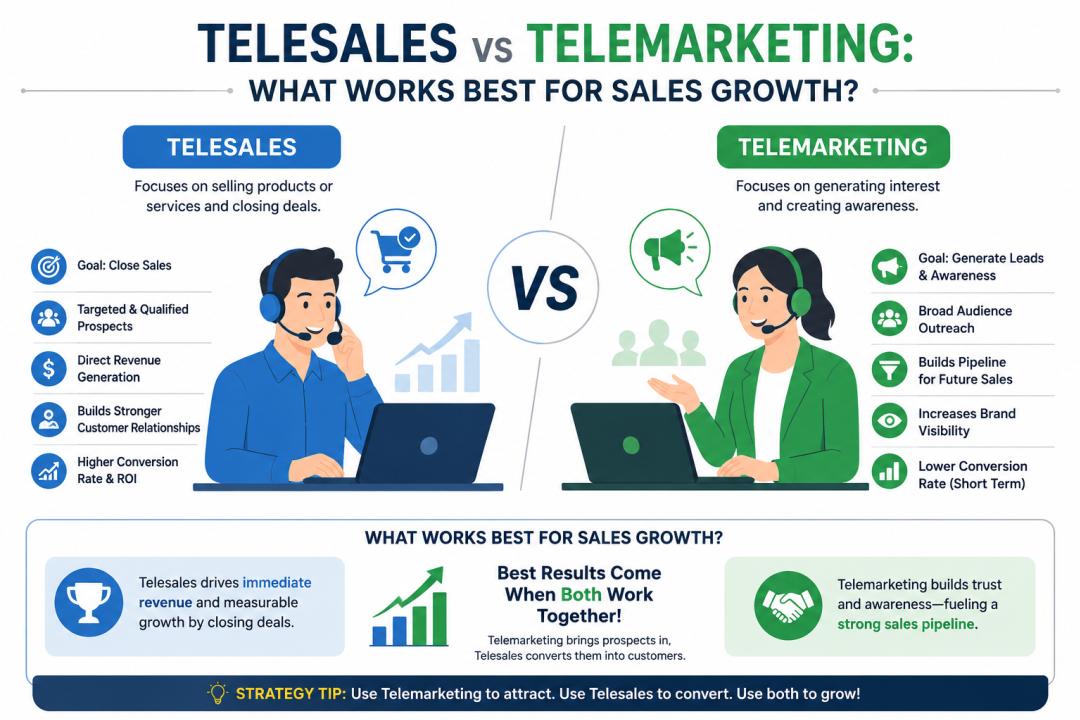
Telesales is a sales function focused on converting interested or qualified leads into customers through direct phone conversations. It operates at the decision stage of the funnel, where the objective is to address specific concerns, guide the buyer, and close the deal.
Role of Telesales in a Sales Team
Taking ownership of leads that already show intent
Understanding customer context beyond surface-level responses
Handling objections that shift during the conversation
Structuring follow-ups based on buying signals, not scripts
Closing deals and improving revenue per interaction
What actually happens on these calls:
A good telesales rep isn’t just pitching. They’re diagnosing hesitation, building trust in limited time, and guiding the buyer toward a decision. This requires context, not just communication.
Telemarketing
Telemarketing is an outreach function focused on initiating conversations, creating awareness, and identifying potential interest among prospects through calls. It operates at the early stages of the funnel, where the goal is to generate and qualify opportunities rather than close them.
Role of Telemarketing in a Sales Team
Starting conversations with people who may not be actively looking
Testing whether there is any real need or interest
Filtering curiosity from genuine buying intent
Passing only relevant leads forward for deeper engagement
What actually happens on these calls:
Most telemarketing calls don’t convert, and that’s expected. The job is not to sell. The job is to identify who is worth selling to.
Key Insight
Telemarketing creates direction in the pipeline
Telesales creates outcomes from that direction
This is the foundation of the Difference Between Telesales and Telemarketing, and ignoring it leads to inefficiency at scale.
Difference Between Telesales and Telemarketing (What Actually Changes Outcomes)
| Factor | Telesales | Telemarketing |
| Objective | Convert interest into revenue | Identify and create interest |
Funnel Position | Decision stage | Discovery & early consideration |
| Lead Readiness | Aware / interested | Unaware / uncertain |
| Call Depth | High (context-driven) | Surface-level (screening) |
| Decision Influence | Direct | Indirect |
| Failure Impact | Lost revenue | Lost opportunity |
| Feedback Loop | Improves closing strategy | Improves targeting strategy |
The Telesales and Telemarketing Difference becomes clearer when you look at outcomes, not activities.
A telesales failure means a deal didn’t close.
A telemarketing failure means the wrong lead entered your system in the first place.
Why Most Teams Misuse Both (And Pay for It Later)
This is where things start breaking in real teams.
Instead of designing a flow, teams often:
Push telemarketing teams to “close deals”
Expect telesales reps to “figure out the lead”
Measure both teams using the same KPIs
On paper, it looks efficient. In practice, it creates friction everywhere.
I’ve seen teams where:
Sales reps spend 40% of their time disqualifying leads
Follow-ups drop because new leads keep coming in
Conversion rates fluctuate without any clear reason
The root cause almost always traces back to one thing:
No clear understanding of the Telesales and Telemarketing Difference in execution.
What Actually Drives Sales Growth
Where Telesales Actually Moves the Needle
Telesales don't work because of persuasion alone. It works because of timing and context.
Use telesales when:
Leads have already interacted with your brand
There is a defined problem and some urgency
The product requires explanation or trust-building
What makes it effective:
Conversations are built on existing context
Objections are specific, not generic
Follow-ups are purposeful, not repetitive
What most teams underestimate:
Follow-ups are not reminders. They are continuation points.
If your team treats every follow-up like a fresh pitch, conversion drops.
Where Telemarketing Actually Creates Leverage
Telemarketing becomes powerful when it is used to shape demand, not just chase it.
Use telemarketing when:
Your inbound pipeline is inconsistent
You’re testing new segments or geographies
Campaign performance is unclear
What makes it effective:
It surfaces patterns early (who responds, who doesn’t)
It helps refine targeting faster than passive channels
It prevents dependency on a single lead source
What most teams get wrong:
They measure success based on number of leads generated, not lead usability.
A strong telemarketing setup improves conversion rates downstream without touching the sales team.
The Real Answer: Telesales vs Telemarketing Is Not a Choice
The conversation around Telesales vs Telemarketing often turns into a comparison. That’s the wrong lens.
Telemarketing without telesales → leads accumulate, revenue stalls
Telesales without telemarketing → short-term wins, long-term gaps
What works is not balance. It’s sequencing.
And that sequencing is where most growth actually comes from.
The Structure That Actually Scales Revenue
Teams that grow consistently don’t rely on effort. They rely on flow.
Layer 1: Telemarketing (Entry Layer)
High-volume outreach
Early-stage filtering
Pattern identification
Layer 2: Qualification (Control Layer)
Intent scoring
Lead prioritization
Assignment logic
Layer 3: Telesales (Conversion Layer)
Context-driven conversations
Objection handling
Revenue ownership
Why This Works in Practice
When this structure is in place:
Sales reps don’t waste time figuring out intent
Telemarketing teams improve based on feedback, not assumptions
Conversion becomes measurable and repeatable
In one team setup, just introducing a basic qualification filter reduced wasted calls significantly and improved conversions without increasing effort.
Metrics That Actually Reflect Growth (Not Just Activity)
Telemarketing Metrics That Matter
Cost per qualified lead
Contact-to-interest ratio
Lead rejection rate from sales
These indicate whether your pipeline is usable.
Telesales Metrics That Matter
Conversion rate by lead source
Revenue per lead
Follow-up conversion ratio
These indicate whether your pipeline is being monetized effectively.
Key Insight
If telemarketing improves, telesales performance usually improves automatically.
But most teams try to fix conversions without fixing inputs.
That’s why results plateau.
Real Scenarios That Show What Works
Scenario 1: High Volume, Low Conversion
You’re generating leads, but closing is weak.
Actual issue: Poor qualification
Fix: Strengthen telemarketing filters
Scenario 2: Good Closers, Empty Pipeline
Your sales team performs well but lacks opportunities.
Actual issue: Weak telemarketing effort
Fix: Scale outreach with better targeting
Scenario 3: Burnout Without Growth
Reps are busy, but results are inconsistent.
Actual issue: Role overlap
Fix: Separate responsibilities clearly
How to Decide What Your Team Needs Right Now
Instead of guessing, ask:
Are we struggling to get relevant leads?
Are deals dropping after interest is shown?
Is our team spending more time qualifying or closing?
Decision Direction
Pipeline issue → focus on telemarketing
Conversion issue → strengthen telesales
Both → fix structure before scaling
This is where understanding the Difference Between Telesales and Telemarketing becomes practical, not theoretical.
Final Takeaway: What Works Best for Sales Growth?
There isn’t a single winner in Telesales vs Telemarketing.
But there is a clear pattern in teams that grow consistently:
Telemarketing builds a usable pipeline
Telesales turns that pipeline into revenue
Growth becomes predictable when
Each function is clearly defined
Leads are filtered before reaching sales
Conversations are aligned with the stage of the buyer
Most teams don’t need more calls.
They need fewer misaligned calls.
Pro Tips from Real Teams
Pass fewer leads, but make them actionable
Track lead rejection from sales, it reveals upstream issues
Use a structured telemarketing system instead of ad-hoc calling
Review real call recordings to understand where conversations break