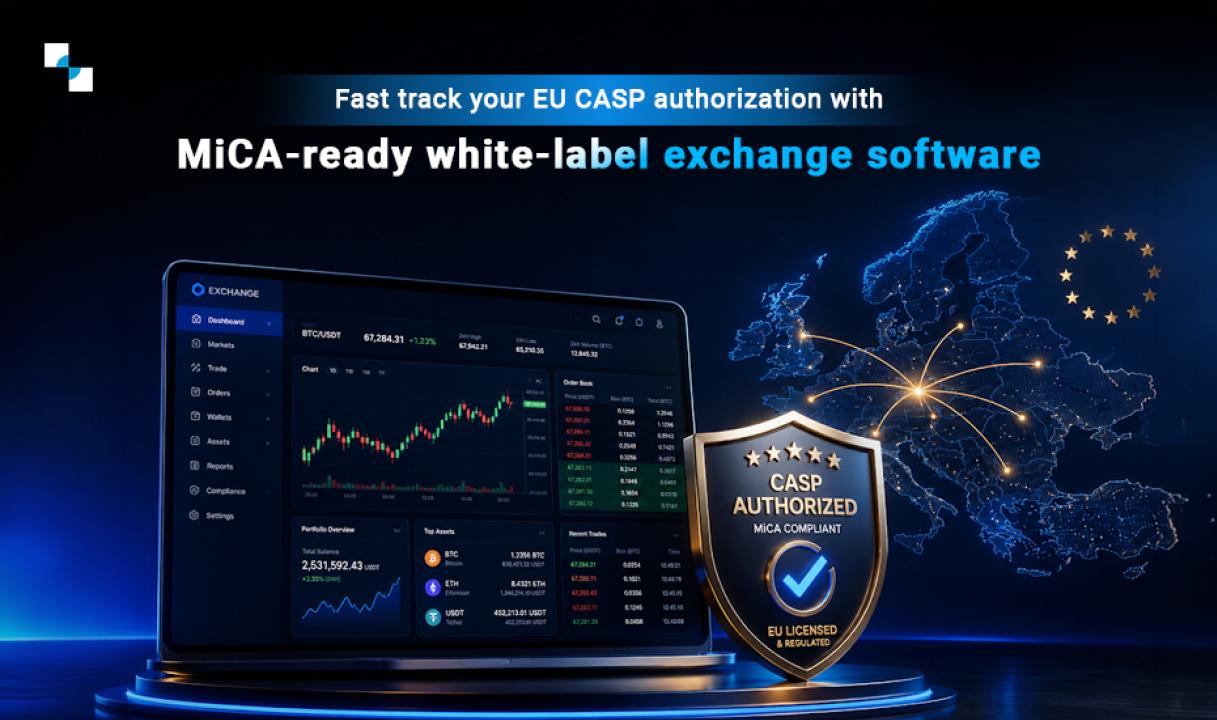

On July 1, 2026, the European Securities and Market Authority (ESMA) will enforce the final MiCA transitional deadline. Any entity offering crypto-asset services to EU clients without an MiCA license will be in breach of EU law. They’ll be forced to cease operations immediately and will no longer be provided any grace period or extension. This will be happening in weeks, and the majority of crypto exchange software operators serving European markets are still unlicensed and scrambling.
| Category | Entities / Specific Platforms | Operational Status & MiCA Context |
|---|---|---|
| Major Transitional Platforms (Holding expiring local registrations) | Gate.io, HTX (formerly Huobi), and various mid-tier regional exchanges | Operating purely under localized VASP grandfathering rules. Facing a hard operational cutoff on July 1, 2026, as they lack the centralized master CASP approvals. |
| Offshore / Non-EU Entities (Active market avoidance) | MEXC, Bitget, KuCoin, Bitfinex | Unlicensed within the EU. These platforms do not maintain physical EU substance or required asset reserves, resulting in active geo-blocking, domain restrictions, and banking rail limitations. |
| Decentralized Front-Ends (Regulatory grey area) | Uniswap, dYdX, Hyperliquid (web interfaces) | The underlying smart contracts are decentralized, but any web-based portal, app interface, or white-label wrapper targeting EU citizens is classified as an unlicensed service provider if it lacks a corporate CASP license. |
| No-KYC P2P Platforms (Anonymity networks) | Hodl Hodl, localized P2P escrow scripts | Entirely unlicensed. These services operate outside the regulatory perimeter due to noncompliance with the zero-threshold data-collection mandates of the Transfer of Funds Regulation (TFR). |
If you’re planning to launch your crypto exchange software anywhere in the European region, MiCA compliance should be your number one priority.
What MiCA Actually Requires From Crypto Exchange Software?
Before understanding the MiCA-ready white label crypto exchange development solution, founders need to learn what compliance actually demands in simple terms.
MiCA defines a Crypto Asset Service Provider (CASP) as any legal entity offering digital asset-related services to EU clients on a professional and commercial basis. This covers ten distinct service types.
- Custody and administration of crypto assets
- Operating a trading platform for crypto assets
- Exchange of crypto assets against fiat currency
- Exchange of crypto assets against other crypto assets
- Execution of orders on behalf of clients
- Placing of crypto assets
- Reception and transmission of orders
- Providing advice on crypto assets
- Portfolio management of crypto assets
- Transfer services for crypto assets
If your cryptocurrency exchange software touches any of these, you need a CASP license to operate anywhere in the EU region.
Authorization requires meeting five core compliance pillars:
- Governance and organizational requirements:
- Must establish a physical EU office with at least two local managing directors
- All board members and >10% shareholders must pass a fit-and-proper criminal and financial background check
- The board must collectively prove “dual expertise,”, i.e. a verified track record in both tradFi regulation and crypto-asset tech governance.
- Must implement structural and technological walls that completely segregate the exchange’s proprietary trading desk or market-making arms from the client order-matching engine to eliminate front-running.
- Clear policies must prevent board members from holding structural roles or equity in projects natively listing tokens on the platform.
- Capital adequacy:
- Must maintain a minimum liquid fiat buffer for your service tier ($€50,000$, $€125,000$, or $€150,000$) OR hold one-quarter (25%) of the preceding year’s fixed overhead costs in reserve, whichever number is higher. For growing crypto exchanges, this dynamic requirement sets a higher effective floor than the minimum.
MiCA Capital Requirements For Launching Crypto Exchange Software In the EU
Service Tier Service Types Minimum Own Funds Tier 1: Basic Advice, order reception/transmission, and placement of crypto-assets EUR 50,000 Tier 2: Exchange Exchange against fiat/crypto, order execution, portfolio management, transfers EUR 125,000 Tier 3: Full Platform Custody and administration, operating a trading platform EUR 150,000 - AML/KYC/CFT Infrastructure:
- Cryptocurrency exchange software must natively execute the zero-threshold Travel Rule (attaching sender/receiver identity data to all transfers).
- Must enforce cryptographic ownership verification for self-hosted wallet transfers over $€1,000 and feature real-time on-chain transaction monitoring.
- ICT risk management as per DORA:
- Crypto exchange systems must provide multi-region cloud redundancy, undergo mandatory annual third-party penetration testing, and maintain immutable, tamper-proof, time-stamped transaction logs archived for a minimum of 5 years.
- The activity log data containing administrative access, configuration changes, data modifications, and trade executions, must be cryptographically protected against tampering and retroactive deletion to ensure forensic traceability during regulatory investigations.
- Must implement an automated classification framework to identify “major” ICT incidents based on criteria like data loss, affected users, and system downtime.
- Once a major incident is detected, the platform is legally mandated to submit to the National Competent Authority (NCA):
- An initial notification within 4 hours of classification
- Intermediate report within 1 week,
- a comprehensive final root-cause analysis within 1 month
- Consumer disclosures
- Must publish legally binding MiCA-compliant token white papers, including environmental impact metrics
- Must provide live dashboards showing total segregation of client assets from corporate funds
- Technically support a 14-day right of withdrawal for primary token offerings
- Platforms must display non-avoidable disclosures during account creation, trade execution, and on all promotional materials, stating that crypto-assets are unregulated, highly volatile, and not covered by investor compensation or deposit guarantee schemes.
How Long Does MiCA CASP Authorization Take?
MiCA CASP authorization takes around 3 to 6 months from initial preparation, which itself takes 8-12 weeks. The NCA has 25 working days to assess application completeness, then up to 40 working days to issue a fully reasoned decision. But the clock starts only after crypto exchanges or other crypto-related services providers submit a complete application...........for detailed information read the complete Blog: https://www.antier.com/blogs/how-white-label-crypto-exchanges-are-becoming-the-fastest-path-to-mica-authorization-before-july-2026/