Convenience Becomes a Key Factor in Maternal Healthcare
The growing demand for flexible and convenient breastfeeding solutions is transforming the maternal healthcare landscape. As more women balance professional responsibilities with motherhood, wearable breast pumps are emerging as an innovative solution that allows mothers to express milk discreetly while maintaining daily activities.
Unlike traditional breast pumps, wearable devices offer hands-free functionality and enhanced mobility, enabling users to pump milk at work, during travel, or while managing household responsibilities. This convenience is making wearable breast pumps increasingly popular among modern parents seeking greater flexibility without compromising infant nutrition.
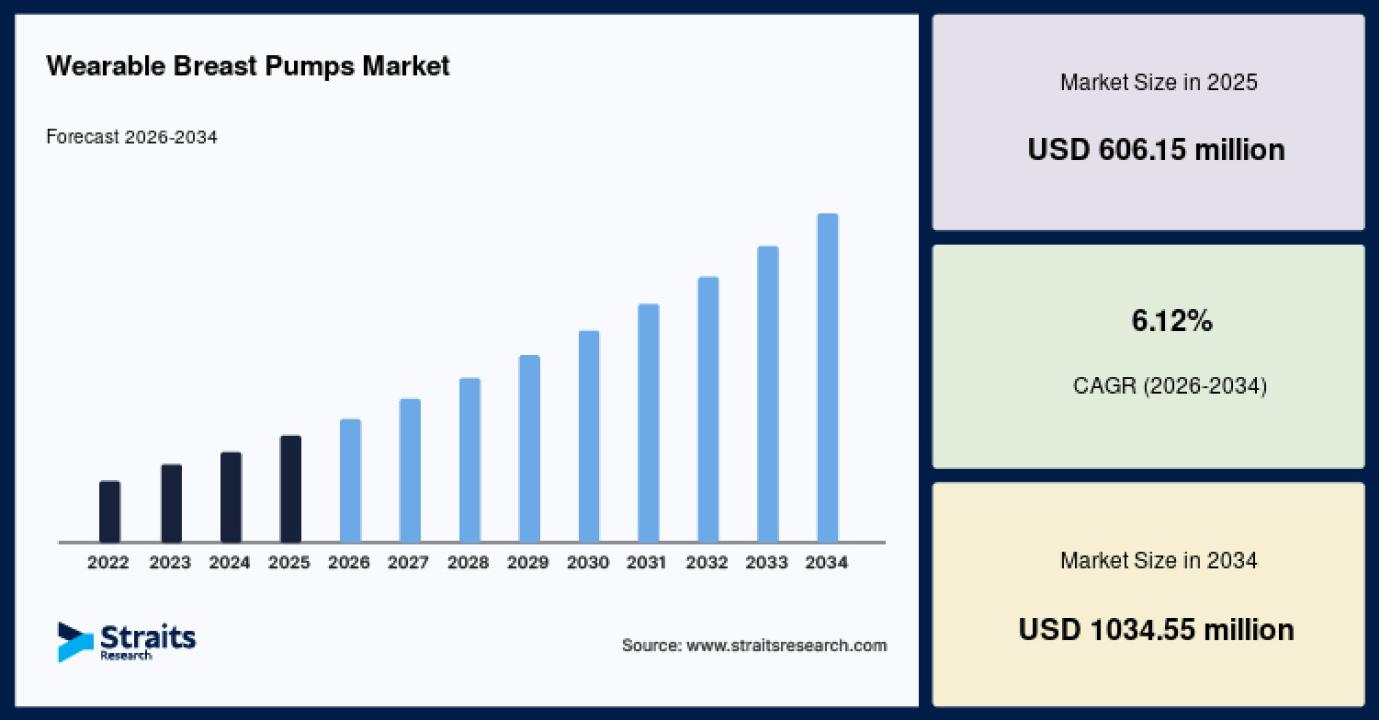
The global wearable breast pumps market was valued at USD 606.15 million in 2025 and is projected to grow from USD 643.24 million in 2026 to USD 1,034.55 million by 2034, registering a CAGR of 6.12% during the forecast period (2026–2034).
Growing awareness regarding breastfeeding benefits, rising female workforce participation, and technological advancements in maternal healthcare devices are expected to support continued market growth.
Changing Life>
The increasing number of working mothers worldwide is creating strong demand for portable breastfeeding solutions that fit into busy schedules.
Wearable breast pumps eliminate many of the limitations associated with conventional devices by providing a more discreet and comfortable pumping experience. This shift aligns with broader consumer preferences for products that enhance convenience, mobility, and ease of use.
As workplace policies become more supportive of maternal health, adoption of wearable pumping technologies is expected to increase significantly.
Product Innovation Enhances User Experience
Hands-Free Pumping Solutions
One of the primary advantages of wearable breast pumps is their ability to operate discreetly without requiring mothers to remain stationary. This feature provides greater freedom and flexibility throughout the day.
Quiet Operation Technology
Manufacturers are focusing on reducing operational noise to improve user comfort and allow more discreet usage in professional and public environments.
Improved Comfort and Ergonomics
Modern wearable pumps are designed to fit comfortably within clothing while minimizing discomfort during prolonged use.
Smart Connectivity Features
Many next-generation devices include mobile app integration that allows users to track pumping sessions, milk output, and device performance through smartphones.
For Detailed Insights, Visit:
https://straitsresearch.com/report/wearable-breast-pumps-market
Digital Health Integration Creates New Opportunities
The growing adoption of connected healthcare devices is influencing innovation across the wearable breast pumps industry.
Mobile Application Support
Companion applications provide personalized insights, reminders, and data tracking capabilities that help mothers manage breastfeeding routines more effectively.
Personalized User Experiences
Smart technologies enable customized pumping settings tailored to individual preferences and breastfeeding requirements.
Data-Driven Maternal Care
Healthcare professionals can increasingly utilize digital data to support breastfeeding guidance and improve maternal health outcomes.
Consumer Awareness Strengthens Market Demand
Healthcare organizations and pediatric associations continue to promote breastfeeding as an important component of infant nutrition and development.
Educational initiatives highlighting the health benefits of breastfeeding are encouraging mothers to adopt products that make breastfeeding more manageable and sustainable. Increased awareness is also helping reduce barriers associated with pumping and milk expression.
As public understanding of maternal health continues to improve, wearable breast pumps are becoming an increasingly accepted and preferred solution.
Market Challenges Remain
Premium Product Pricing
Wearable breast pumps often carry higher price points than traditional breast pumping systems, which may limit accessibility for some consumers.
Insurance Coverage Variability
Reimbursement policies and insurance coverage for wearable pumping devices vary across regions, influencing adoption rates.
Battery and Performance Limitations
Manufacturers continue to address challenges related to battery life, pumping efficiency, and long-term device reliability.
Product Awareness Gaps
Despite growing popularity, awareness regarding wearable breast pump technology remains limited in certain developing markets.
Regional Trends Shaping Industry Growth
North America remains a dominant market due to high awareness regarding maternal healthcare, strong healthcare infrastructure, and widespread adoption of innovative consumer health technologies.
Europe continues to experience steady growth supported by favorable maternity policies, increasing healthcare investments, and rising demand for breastfeeding support solutions.
Asia-Pacific is expected to witness significant growth during the forecast period. Rising birth rates in certain countries, increasing female workforce participation, expanding healthcare access, and growing awareness regarding infant nutrition are driving market expansion.
Latin America and the Middle East & Africa are also gradually adopting advanced maternal healthcare products as healthcare infrastructure and consumer awareness continue to improve.
Future Outlook
The future of the wearable breast pumps market will be shaped by advancements in device miniaturization, smart technology integration, and personalized maternal healthcare solutions.
Manufacturers are expected to focus on improving comfort, efficiency, battery performance, and connectivity features to meet evolving consumer expectations. As healthcare systems continue to emphasize maternal and infant well-being, wearable breast pumps are likely to play an increasingly important role in supporting breastfeeding practices.
The growing intersection of femtech, digital health, and consumer wellness is expected to create new opportunities for innovation and market expansion throughout the forecast period.
Competitive Landscape
The wearable breast pumps market remains competitive, with leading manufacturers focusing on product innovation, smart technology integration, and consumer-centric design improvements.
Major companies operating in the market include:
Willow Innovations, Inc.
Elvie
Medela AG
Spectra Baby USA
Lansinoh Laboratories, Inc.
Freemie
Ameda, Inc.
Motif Medical
Ardo Medical AG
Pigeon Corporation
These companies continue to invest in wearable technologies, user experience enhancements, and digital health capabilities to strengthen their market positions.
Related Insights
Breast Pumps Market
https://straitsresearch.com/report/breast-pumps-market
FemTech Market
https://straitsresearch.com/report/femtech-market
About Us
Straits Research is a leading market intelligence and consulting organization specializing in industry analysis, business forecasting, and strategic market research solutions. The company provides actionable insights that help organizations identify emerging opportunities and make informed business decisions.
Contact Us
Email: sales@straitsresearch.com
Tel: +1 646 905 0080 (U.S.)
Tel: +44 203 695 0070 (U.K.)