You built a great product. You’re signing up users. And then the question hits you like a wall: how do I actually charge for this? It sounds simple until you’re staring down a dozen pricing page screenshots, three conflicting blog posts, and a spreadsheet you made at midnight that still doesn’t feel right. The truth is, your SaaS billing model isn’t just a finance decision; it directly shapes how customers perceive value, when they churn, and how predictable your revenue actually is. Get it wrong, and no amount of product polish will save your bottom line.
Why Your SaaS Billing Model Matters More Than You Think
Most founders spend months perfecting their onboarding flow and maybe twenty minutes picking a pricing structure. That’s backward. Your SaaS billing model is one of the highest-leverage decisions you’ll make; it determines who buys, when they upgrade, and whether your revenue scales with your costs or fights against them.
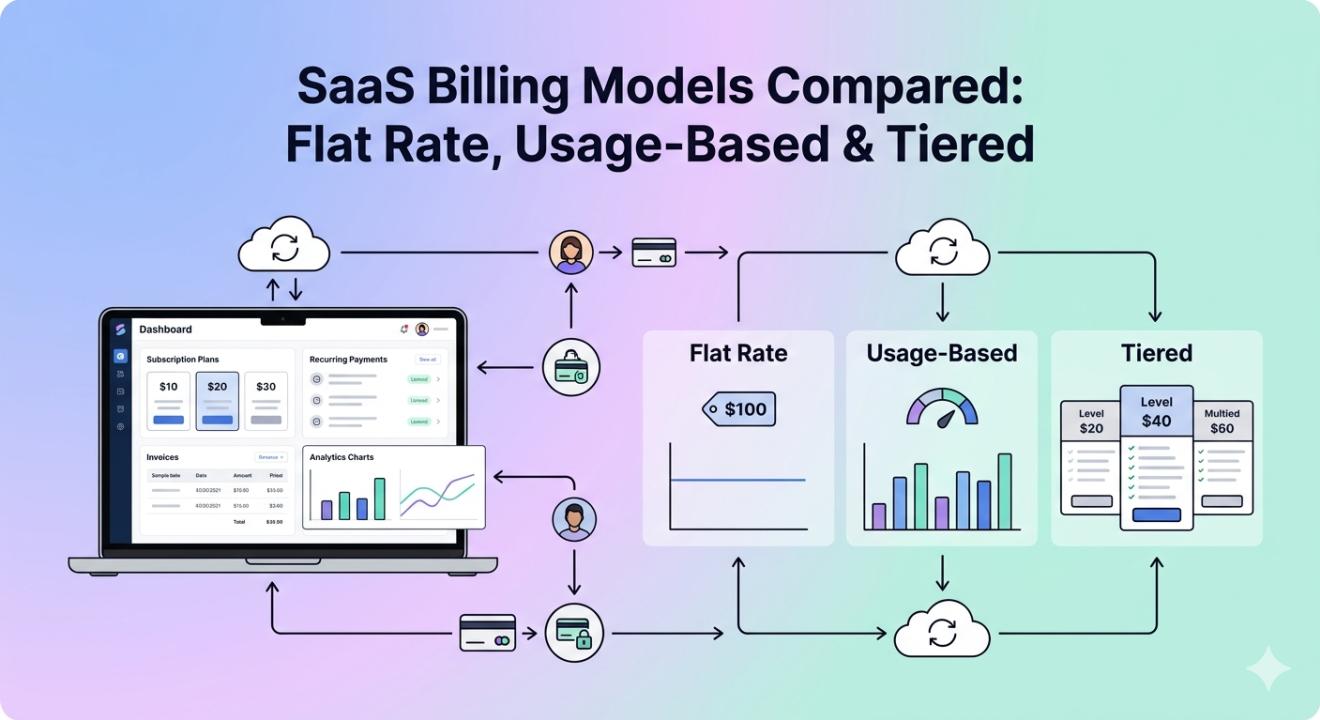
There are three primary models that account for the vast majority of SaaS pricing in the wild: flat rate, usage-based, and tiered. Each has a genuine use case. Each has real trade-offs. And the best one for you depends on what your product actually does and who your customer actually is, not what your competitor charges.
A quick note on terminology: “SaaS billing” refers broadly to how software companies collect recurring revenue. A SaaS billing system or SaaS billing software is the infrastructure, like Stripe Billing, Chargebee, or Recurly, that automates invoicing, renewals, and upgrades. This article focuses on the model (what you charge) rather than the tool (how you collect it), though the two are deeply connected.
The Three Core SaaS Billing Models
Flat Rate: One price, full access
Simple to communicate
Easy MRR forecasting
Lower support overhead
Best for single-persona tools
Usage-Based: Pay for what you use
Scales with customer growth
Low friction to start
Revenue tied to value
Best for infra & API products
Tiered: Plans for every stage
Upsell path built in
Serves multiple personas
Feature-based segmentation
Best for multi-team SaaS
1. Flat Rate Billing
Flat rate pricing is exactly what it sounds like: one price, one plan, complete access. Think of the early days of Basecamp, $99 per month, no matter how many users or projects. It’s the closest SaaS gets to a “one-size-fits-all” model.
The appeal is real. Your sales conversation is clean, your invoices are clean, and your MRR is completely predictable month to month. There’s no metering infrastructure to build, no confusing overage emails to send, and no customer service tickets about “why did my bill triple this month.” For solo-use tools, narrow-scope utilities, or products with a single buyer persona, a flat rate can be the perfect fit.
But here’s where it gets complicated: flat rate pricing doesn’t scale with value. A solo freelancer and a 200-person agency using the same tool at the same price means you’re leaving serious money on the table with the agency while potentially overcharging the freelancer and losing them entirely.
| Flat Rate | The Upside | The Trade-off |
| Revenue predictability | Very high | No expansion revenue path |
| Customer clarity | Excellent | One price fits no one perfectly |
| SaaS billing system complexity | Minimal | Hard to segment high-value users |
2. Usage-Based Billing (aka Pay-As-You-Go)
Usage-based billing ties what a customer pays directly to how much they consume API calls, data processed, messages sent, active users, or minutes used. AWS made this famous in the infrastructure world. Twilio, Snowflake, and OpenAI all run on it.
The fundamental premise is elegant: customers only pay for the value they actually receive. There’s no upfront commitment barrier, which reduces the friction of trying the product. And as customers grow, their bills grow with them, meaning your revenue scales organically with their success.
The hard part is the unpredictability for both sides. Customers can’t always budget accurately, which sometimes causes sticker shock or anxiety, leading to underuse (or churn). On your end, forecasting becomes genuinely difficult. Your SaaS subscription billing infrastructure also needs to be significantly more sophisticated: metering pipelines, real-time usage tracking, and accurate invoicing at scale are all non-trivial engineering problems.
| Usage-Based | The Upside | The Trade-off |
| Aligns price with value | Very strong | Revenue is variable & hard to forecast |
| Low barrier to entry | Excellent for PLG | Some customers self-limit usage to save cost |
| Billing system requirements | Scales automatically | Requires robust metering |
3. Tiered Pricing
Tiered pricing is the most common SaaS billing model you’ll encounter today, and for good reason. It packages features, limits, and support into distinct plans, typically named Starter, Growth, and Enterprise, each targeting a different buyer at a different stage.
The genius of tiered pricing is that it lets you serve multiple customer segments without building separate products. A small startup gets the Starter plan, which includes core features. A scaling team upgrades to Growth for collaboration tools. An enterprise signs an annual deal for SSO, advanced reporting, and a dedicated success manager. Each tier is priced to match the value that segment extracts from your product.
It also gives your SaaS billing software a clear expansion revenue story: customers naturally outgrow tiers as they scale, creating organic upsell moments you don’t have to manufacture. The downside? Too many tiers cause paralysis. Tiers that don’t map cleanly to real use cases cause confusion. And if your feature differentiation between tiers isn’t meaningful, you’ll spend an uncomfortable amount of time explaining why the $199 plan is worth $150 more than the $49 plan.
| Tiered Pricing | The Upside | The Trade-off |
| Expansion revenue | Built into the model | Tier design is genuinely hard |
| Multi-segment coverage | Strong | Can confuse buyers if tiers feel arbitrary |
| Revenue predictability | Good (especially annual) | Mix shifts can complicate forecasting |
So, Which One Should You Actually Use?
There’s no universal right answer here, but there is a useful framework: identify the primary driver of value in your product, then choose the model that most closely charges for it.
Quick Decision Guide
Flat Rate: Your product has one core use case and one buyer type. Value doesn’t vary dramatically between customers. You want predictable MRR and low operational overhead.
Usage-Based: Your product is infrastructure, API-driven, or consumption-heavy. Value scales directly with volume. Customers are technical and comfortable with variable billing.
Tiered: You serve multiple buyer personas at different stages of the company. Features matter more than usage volume. You want a natural upsell path baked in from day one.
Hybrid: Many mature SaaS companies combine models, a tiered base with usage overages, or flat-rate plans with a usage-based add-on layer. Don’t be afraid to mix.
One more thing worth noting: your SaaS billing model should evolve. Most successful SaaS companies start with something simple, often a flat rate or basic tiers, and layer in complexity as they better understand their customer segments. Starting with a perfect model is less important than being willing to revisit it as you learn.
A Word on SaaS Billing Software and Systems
Whatever model you choose, you’ll eventually need a dedicated SaaS billing system to operationalize it. Manually invoicing customers works for your first twenty customers. It doesn’t work for your first two hundred.
The right SaaS billing software handles subscription renewals, failed payment recovery (dunning), plan upgrades and downgrades, proration logic, and revenue recognition all automatically. For usage-based billing specifically, you need a system that can ingest metering data and generate accurate invoices without manual intervention. For tiered billing, you need a system that can handle mid-cycle plan changes gracefully.
The most common options in this space are Stripe Billing (best for developer-forward teams already on Stripe), Chargebee (strong for mid-market SaaS with complex billing logic), and Recurly (well-suited to subscription-heavy B2C models). The “best” choice depends less on features and more on where your team’s technical comfort level sits and how complex your pricing logic actually is.
The Bottom Line
Flat rate is simple and predictable but leaves money on the table at scale. Usage-based aligns revenue with value but introduces forecasting complexity. Tiered pricing gives you an upsell path and multi-segment coverage but demands careful, intentional plan design. None of these is a wrong answer; the wrong answer is picking one without thinking through who your customers are and what they actually value about what you’ve built.
Your SaaS billing model is a living thing. The best companies revisit it as they grow, as their customer mix shifts, and as they get sharper about what keeps customers, including the role of loyalty incentive programs. Start somewhere intentional, measure what matters, and don’t be afraid to change it.
Frequently Asked Questions
What is the most common SaaS billing model?
Tiered pricing is the most widely used SaaS billing model, particularly among B2B SaaS companies. It allows businesses to serve different customer segments, from small startups to large enterprises, with distinct plans that reflect the varying levels of value each segment derives from the product. That said, usage-based billing has grown significantly in popularity, especially for developer tools, infrastructure products, and AI-native applications where consumption is the natural unit of value.
What is the difference between usage-based billing and tiered pricing?
Usage-based billing charges customers based on how much they consume API calls, data processed, messages sent, etc. The bill varies month to month depending on actual usage. Tiered pricing, on the other hand, places customers into fixed plan levels (e.g., Starter at $49/month, Pro at $149/month), with prices set regardless of how heavily they use the product. Many SaaS companies blend both: a fixed base tier with usage-based overages on top.
What SaaS billing software should I use?
The right SaaS billing software depends on your team’s setup and billing complexity. Stripe Billing is a strong default for developer-led teams who are already using Stripe for payments. It handles subscriptions, usage metering, and invoicing well. Chargebee is better suited to mid-market SaaS with more complex billing logic, such as multi-currency, multi-plan subscriptions, or revenue recognition needs. Recurly tends to work well for subscription-heavy B2C or media businesses. Evaluate based on the complexity of your pricing model and how much customization your team can maintain.
How do I choose between flat rate and usage-based pricing?
Ask yourself: does the value a customer gets from your product vary significantly based on how much they use it? If yes, especially if you’re building an API, an infrastructure product, or anything else, consumption-driven, usage-based pricing tends to be a better fit because it aligns cost with value. If your product delivers roughly the same value to most customers regardless of usage volume, a flat rate is simpler to communicate and easier to forecast. Also consider your customer type: technical buyers are generally more comfortable with variable billing than non-technical buyers who prefer cost certainty.
Can I change my SaaS billing model after launch?
Yes, and many successful SaaS companies have done exactly that. The key is to handle existing customers carefully. Most companies grandfather active subscribers into their old pricing for a defined period, communicate the change well in advance, and make the business case for why the new model better reflects value. Changing from a flat rate to a tiered rate is generally easier than switching to usage-based pricing, which requires new metering infrastructure. Starting with a simpler model and evolving it is a reasonable strategy; just make sure the switch is driven by real customer data, not competitive pressure alone.