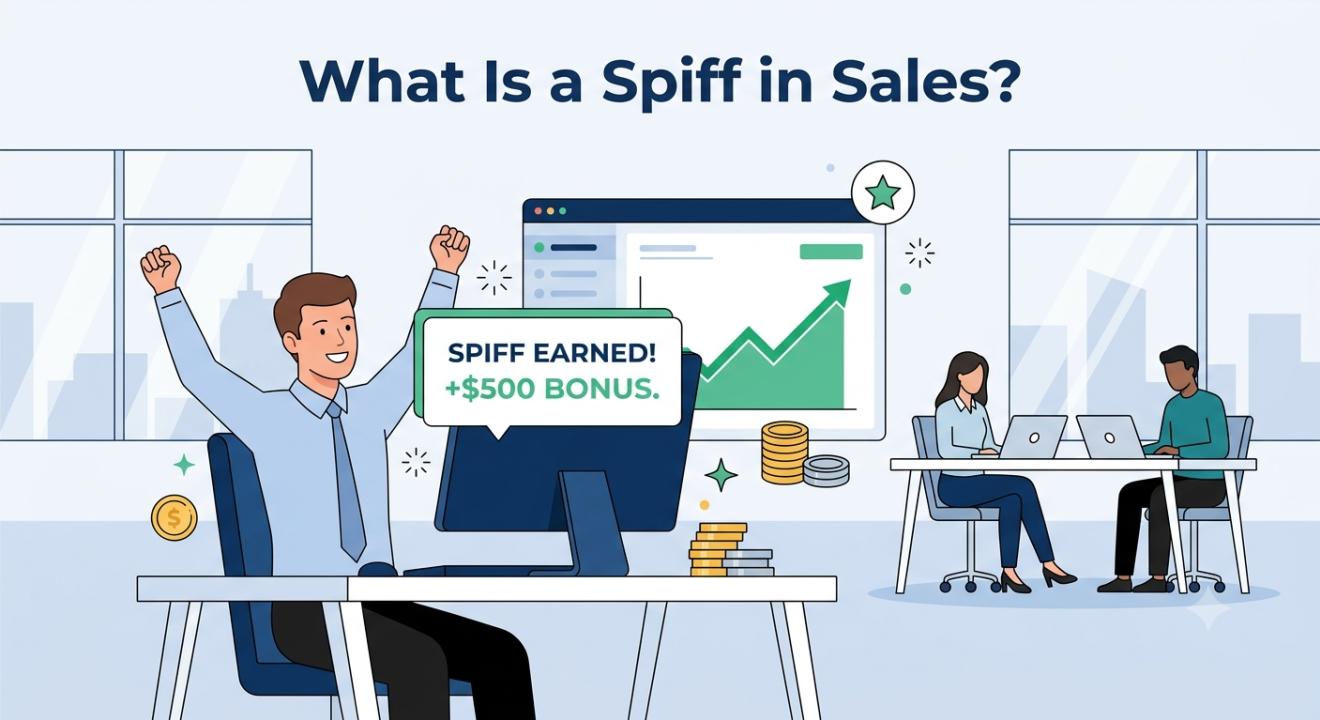
You're a sales rep who just hit quota again, and yet something still doesn't feel urgent enough to push for that one extra deal this week. Or maybe you're a sales manager trying to figure out why the team keeps hitting 98% of the target but never blows past it. If either scenario sounds familiar, you've already bumped into the exact problem that a SPIFF is designed to solve: standard commission structures are great at rewarding consistency, but they're not built to create a sudden, focused spark of motivation around something specific, a new product, a slow month, a stalling product line.
What Does SPIFF Stand For?
A SPIFF (also written as spiff) is a short-term, direct cash bonus or sometimes a non-cash reward paid to a salesperson for selling a specific product or achieving a specific outcome, usually outside of their normal commission structure.
The acronym is sometimes said to stand for Sales Performance Incentive Fund or Special Performance Incentive for Field Force, but honestly, its origin is murkier than that. What matters far more than the etymology is what a SPIFF actually does in practice: it puts an immediate, visible reward on a specific action, and it does it fast.
Unlike your base salary or your standard commission rate, which reward overall performance over a longer period, a SPIFF is targeted. It says: sell this product this week, and get paid this bonus on top of everything else you'd normally earn.
How SPIFF Programs Actually Work
The mechanics of SPIFF programs are deliberately simple; that's part of what makes them effective. A manager or employer identifies a short-term goal, attaches a specific reward to it, communicates it clearly to the sales team, and then runs it for a defined period (a day, a week, a month, rarely longer).
Here's what typically defines a well-run SPIFF:
1. A Clear, Singular Focus
The best SPIFFs target one thing: one product SKU, one service tier, one customer type. The moment you add three competing priorities, reps start doing mental math instead of selling. Keep it narrow.
2. Immediate or Fast Payout
A SPIFF that pays out in 60 days isn't really a SPIFF; it's just a delayed commission. The psychological power of a SPIFF comes from the speed of reward. Cash on Friday, a gift card the same day, or points redeemable immediately all reinforce the behavior while it's still fresh.
3. A Hard Time Limit
Urgency is the engine. If a SPIFF runs indefinitely, it stops being special; it just becomes part of the compensation landscape and loses its motivational edge. A hard deadline like "through the end of quarter" or "this week only" is what creates action.
4. Visibility Within the Team
SPIFFs work better when everyone on the team knows about them and can see progress. A leaderboard, a daily Slack update, or even a whiteboard tally transforms a bonus into a small internal competition, which is often exactly the energy a slow week needs.
Real-World SPIFF Examples
SPIFFs show up across industries in slightly different forms, but the structure is always recognizable. Here are some common scenarios:
SaaS / Software: A $200 cash bonus for every annual contract (vs. monthly) closed during Q4 is designed to improve cash flow and reduce churn heading into the new year.
Retail / Consumer Electronics: A $15-per-unit spiff paid by a manufacturer directly to a retail sales associate for selling a specific TV model the brand is trying to move before a new model launches.
Insurance / Financial Services: A weekend trip or bonus payout for the rep who sells the most policies on a newly launched product line in its first month, giving the product an early adoption push.
Automotive: A dealer incentive from the manufacturer: an extra $500 per unit to the sales team for every vehicle from a specific overstocked trim level sold this month.
Worth noting: In retail and consumer electronics, SPIFFs often come directly from a vendor or manufacturer, not from the retailer, to influence which product a sales associate recommends. This is sometimes called a "vendor spiff," and it's worth understanding if you're on either side of that relationship.
SPIFF vs. Commission: What's the Difference?
These two are easy to confuse, especially since both put money in a rep's pocket for selling. But they serve different functions:
Commission is structural; it's the ongoing percentage or flat fee a rep earns as a natural result of closing any deal. It's built into the compensation plan, it's predictable, and it rewards total volume over time.
A SPIFF is situational. It layers on top of commission for a specific product or behavior, for a limited time. A rep can earn both on the same deal and often does.
Think of commission as the engine and a SPIFF as the turbo boost you engage for a specific stretch of road. You don't drive with the turbo on all the time. You use it strategically.
When SPIFFs Connect to Broader Incentive Strategy
For sales leaders thinking longer-term, individual SPIFFs are most powerful when they sit inside a larger framework. Loyalty incentive programs, which reward reps or channel partners for sustained performance over time, work well alongside SPIFFs rather than in competition with them. The loyalty program builds habit and retention; the SPIFF drives a short burst of specific behavior. Together, they cover different motivational timeframes without cannibalizing each other.
Common SPIFF Mistakes to Avoid
A poorly designed SPIFF can actually backfire, demotivating reps, creating confusion, or cannibalizing the existing pipeline. Here's what to watch for:
Running too many at once. If your team has three active SPIFFs competing for attention, none of them will move the needle. Pick one priority at a time.
Targeting the wrong behavior. A SPIFF that inadvertently encourages discounting just to close a deal, or rushing a customer who isn't ready, will cost you more in margin or churn than the incentive was worth.
Forgetting to communicate clearly. Reps who don't fully understand what qualifies for which product, which customer type, or which time window either ignore the SPIFF or flood you with eligibility questions after the period closes.
Setting the payout too low. If the bonus isn't meaningfully motivating relative to the extra effort required, reps will notice, and participation will be weak. Test different amounts and track response rates over time.
The Bottom Line
A SPIFF is one of the most practical, flexible tools in a sales manager's kit, not because it solves every motivation problem, but because it solves a specific one really well: getting a focused group of people to do a specific thing, now. When it's clearly defined, time-limited, and pays out fast, a well-structured SPIFF can move product, hit short-term revenue targets, and inject some energy into a team that's otherwise running on autopilot. Used thoughtfully and not overused, it stays effective. The moment it becomes background noise, it stops being a spiff and starts being just another line item nobody reads.
Frequently Asked Questions
Is a SPIFF taxable income?
Yes. In the United States, SPIFF payments are considered taxable income by the IRS and must be reported. Cash SPIFFs paid directly by a manufacturer or vendor to a retail salesperson bypassing the employer are typically reported on a 1099-NEC rather than a W-2. If you're receiving SPIFFs regularly, it's worth setting aside money for taxes or talking to a tax professional, especially if they come from multiple sources.
What's the difference between a SPIFF and a bonus?
A bonus is usually tied to overall performance, such as hitting a quarterly or annual target, and is often paid on a set schedule. A SPIFF is more surgical: it's tied to a specific product or behavior and is typically paid out faster. Bonuses are planned in advance as part of a comp structure; SPIFFs can be deployed reactively when a business need suddenly appears.
How much should a SPIFF be?
There's no universal answer, but the amount needs to feel meaningfully rewarding for the specific action required. A common approach is to set the SPIFF at a value that represents a noticeable bump, not pocket change. For lower-ticket products, $25–$100 per unit can work well. For larger deals or enterprise sales, SPIFFs of $250–$1,000+ aren't unusual. The key question is: is this amount enough to change a rep's behavior this week?
Can SPIFFs hurt your sales culture?
They can, if overused. When every week has a new SPIFF, reps start waiting for the "bonus flavor of the week" instead of selling consistently. They can also create tension if some reps feel the structure favors certain territories or customer types. Used occasionally and fairly, SPIFFs are well-received. Used constantly, they erode trust in the core compensation plan.
Do SPIFFs work in channel or partner sales?
Yes, and this is actually one of the most common uses. Manufacturers and brands frequently use SPIFFs to incentivize reseller or distributor reps who aren't their direct employees. Because you can't directly manage those reps' priorities, a well-timed SPIFF is one of the most effective ways to get mindshare and push your product to the front of their recommendation list. Just make sure your channel agreement allows for direct incentives to partner reps.