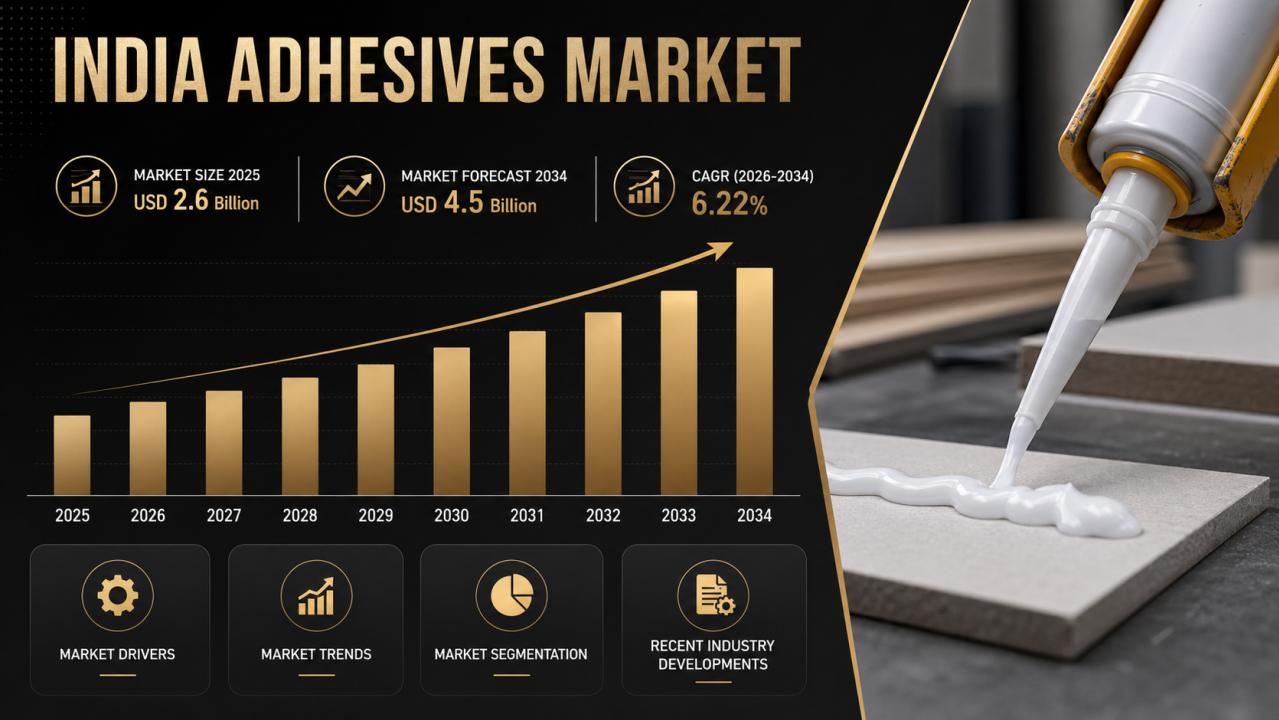
According to IMARC Group's report titled "India Adhesives Market Size, Share, Trends and Forecast by Technology, Resin, End User Industry, and Region, 2026-2034", the report offers a comprehensive analysis od the industry, including adhesive market share in india, forecast, growth, and regional insights.
India's adhesives market is one of the specialty chemicals sector's most resilient growth stories serving automotive, construction, packaging, and electronics simultaneously, which insulates overall demand from single-industry cycles. Here is what investors need to know:
- Market reached USD 2.55 Billion in 2025, projected to reach USD 4.51 Billion by 2034 at a CAGR of 6.22%.
- Water-borne adhesives lead technology at 32.6%; acrylic resin dominates at 26.4%; West India commands 34.1% regional share.
- UV-cured adhesives are growing fastest at ~7.5% CAGR and polyurethane resin at ~7.4% CAGR both driven by electronics manufacturing and EV structural bonding demand.
- India's EV market crossed 2 million units in 2024 a 24% year-on-year increase creating structural bonding demand for battery pack assembly and lightweight body panels.
- Henkel completed Phase 3 of its Kurkumbh manufacturing facility near Pune in July 2024, reflecting deepening international commitment to localised adhesive production in India.
The Strategic Market Challenge: Navigating the Adhesives Market in India
The most structurally significant challenge is import dependency on specialty resin systems. High-performance reactive, UV-cured, and silicone adhesive formulations rely heavily on imported specialty monomers and photoinitiators creating supply chain disruption risk and cost uncertainty for premium segment manufacturers. Combined with global crude oil price volatility directly impacting acrylate, polyurethane polyol, and epoxy resin raw material costs, margin predictability remains a persistent operational challenge particularly for smaller domestic formulators without the scale to absorb input cost swings through long-term procurement agreements.
India's Strategic Vision for the Adhesives Market:
- National Infrastructure Pipeline (USD 1.4 Trillion Target): Government infrastructure investment is generating sustained demand for tile adhesives, waterproofing compounds, sealants, and construction-grade epoxies across highway, urban, and housing development projects.
- PLI Scheme for Automobiles and Electronics: Production-linked incentives are accelerating EV manufacturing and electronics production creating downstream structural adhesive demand for battery cell fixation, thermal interface bonding, and PCB assembly applications.
- Smart Cities Mission and Housing for All: These programs sustain multi-year construction adhesive demand across urban infrastructure, residential development, and commercial real estate segments nationwide.
- CPCB VOC Emission Regulations: Tightening environmental standards are compelling conversion from solvent-borne to water-borne and reactive adhesive systems directly accelerating the technology transition toward low-VOC formulations across packaging, woodworking, and construction applications.
➤ Access Industry-Focused Insights and Future Forecasts - Request Sample Report
Why Invest in the India Adhesives Market: Key Growth Drivers & ROI
- EV Transition Creating a New Premium Adhesive Demand Vertical: EV battery pack assembly requires structural bonding adhesives for cell fixation, thermal management interfaces, and lightweight body panel joining applications where adhesives replace conventional welding and reduce vehicle weight by 8–12%. This demand is growing from near-zero to significant commercial scale by 2034, with automotive adhesives commanding premium CAGR within the broader market offering manufacturers and investors exposure to India's most technically demanding and highest-margin adhesive application category.
- Multi-Sector Demand Providing Defensive Revenue Resilience: Unlike single-sector industrial chemical categories, adhesives serve automotive, construction, packaging, electronics, footwear, and healthcare simultaneously. India's packaging market expanding at approximately 8% annually driven by e-commerce and FMCG, the National Infrastructure Pipeline construction boom, and PLI-backed electronics manufacturing together create a diversified demand base that reduces revenue cyclicality a structurally defensive characteristic that is particularly valuable for investors in specialty chemicals.
- Global Player Localisation Validating Long-Term Market Confidence: Henkel's Kurkumbh Phase 3 expansion, 3M's specialty adhesive portfolio expansion, and Pidilite's April 2024 Fevikwik product line extension collectively demonstrate that both global multinationals and domestic leaders are investing in India capacity and product development simultaneously a dual-validation signal that India's adhesives market has achieved the commercial scale and growth trajectory warranting sustained capital commitment.
India Adhesives Market Trends & Future Outlook:
- Water-borne adhesives are growing at ~7.1% CAGR the fastest among established technology segments as CPCB VOC mandates compel conversion from solvent-borne formulations across packaging, woodworking, and textile lamination.
- UV-cured adhesives are the fastest-growing technology at ~7.5% CAGR, driven by rapid cure cycles, solvent-free composition, and growing electronics and medical device manufacturing across Tamil Nadu, Karnataka, and Telangana.
- Bio-based and sustainable adhesive development is attracting growing investment, with EPR mandates on packaging waste and green building certifications driving demand for starch, soy protein, and lignin-derived formulations from domestic and multinational formulators.
- South India is the fastest-growing region, with semiconductor and electronics manufacturing expansion in Chennai, Bengaluru, and Mysuru creating demand for high-performance UV-cured and thermally conductive adhesive systems currently largely imported.
Regulatory Landscape & Policy Catalysts in India:
- CPCB VOC Emission Norms: Central Pollution Control Board's tightening VOC regulations are the single most powerful technology transition catalyst compelling solvent-borne adhesive manufacturers to invest in water-borne and reactive system reformulation across regulated industries.
- PLI Scheme for Automobiles and Electronics: Government production incentives are accelerating EV and electronics manufacturing that generate premium adhesive demand with battery pack bonding and PCB assembly adhesives growing at approximately 9% CAGR through 2034.
- National Infrastructure Pipeline: The government's USD 1.4 trillion infrastructure investment commitment sustains multi-year structural demand for construction adhesives, tile fixing compounds, and waterproofing sealants across highway, urban, and housing project categories.
- EPR Mandates on Packaging Waste: Extended Producer Responsibility requirements are compelling packaging converters to adopt recyclable-compatible and bio-based adhesive systems accelerating sustainable formulation investment and creating a compliance-driven premium product demand channel.
➤ Explore the Complete TOC and Data Coverage - Get Full Brochure
By the IMARC Group, the Top Competitive Landscape & their Positioning:
- Pidilite Industries Ltd.
- Henkel Adhesives Technologies India Private Limited
- 3M
- H.B. Fuller Company
- Arkema
- Jubilant Bhartia Group
- Astral Adhesives
Covering an in-depth analysis of the competitive landscape, market structure, key player positioning, competitive dashboards, top winning strategies, and detailed profiles of all major industry participants you will gain access to all these exclusive insights within the full research report.
Market Segmentation Breakdown and Share Analysis:
Analysis by Technology:
- Water-borne (Dominant segment with 32.6% market share)
- Solvent-borne (18.7% market share)
- Hot Melt (24.8% market share)
- Reactive (13.9% market share)
- UV Cured Adhesives (10.0% market share)
Analysis by Resin:
- Acrylic (Dominant segment with 26.4% market share)
- Polyurethane (PU) (18.7% market share)
- Epoxy (16.2% market share)
- Silicone (10.6% market share)
- VAE/EVA (14.8% market share)
- Cyanoacrylate (7.9% market share)
- Others
Analysis by End User Industry:
- Packaging (Largest consumer segment)
- Building and Construction
- Automotive
- Footwear and Leather
- Woodworking and Joinery
- Healthcare
- Aerospace
- Others
Regional Insights:
- West India (Industrial hub with significant chemical manufacturing capabilities with 34.1% market share)
- North India (26.8% market share)
- South India (24.7% market share)
- East India (14.4% market share)
Note: If you need specific information that is not currently within the scope of the report, we can provide it to you as a part of the customization.
➤ Tailor the Research to Your Exact Business Needs - Request Customization
Frequently Asked Questions (FAQs):
Q1: What is the current value and projected growth of the India Adhesives Market?
According to IMARC Group, the India adhesives market reached USD 2.55 Billion in 2025 and is projected to reach USD 4.51 Billion by 2034, growing at a CAGR of 6.22% from 2026 to 2034. Growth is driven by rising demand from automobile, construction, packaging, and electronics sectors, the shift toward eco-friendly high-performance adhesives, and tightening environmental regulations.
Q2: Which technology and resin segments lead the market?
Water-borne adhesives lead technology at 32.6%, driven by CPCB VOC compliance mandates and growing packaging and construction adoption. Acrylic resin leads resin type at 26.4% through superior UV stability and multi-substrate bonding versatility. UV-cured adhesives at ~7.5% CAGR and polyurethane resin at ~7.4% CAGR are the fastest-growing segments through 2034.
Q3: Which region generates the highest adhesive demand in India?
West India leads at 34.1%, anchored by Maharashtra's automotive OEM clusters and Gujarat's chemical manufacturing corridor. North India follows at 26.8% through auto component manufacturing and footwear industries. South India at 24.7% is the fastest-growing region, driven by electronics and semiconductor manufacturing expansion creating demand for UV-cured and thermally conductive adhesive systems.
Q4: How is the EV transition reshaping India's adhesives market?
India's EV market crossing 2 million units in 2024 is creating structural bonding adhesive demand for battery cell fixation, thermal interface bonding, and lightweight body panel assembly replacing conventional welding and reducing vehicle weight by 8–12%. EV battery pack adhesives represent the market's highest-growth new demand vertical, expected to scale significantly from the current base through 2034.
Q5: What are the primary challenges constraining market growth?
Three constraints limit growth velocity: raw material price volatility from petroleum-derived chemical feedstock dependence creating margin pressure; VOC regulatory compliance costs requiring capital-intensive reformulation investment from smaller domestic formulators; and counterfeit and unbranded product competition in price-sensitive tier-2 and tier-3 markets eroding revenue and brand trust for organised market participants.
Strategic Insight & Verdict
India's adhesives market presents a multi-sector, structurally resilient investment opportunity where EV transition, infrastructure investment, and electronics manufacturing localisation are simultaneously creating premium demand growth vectors within a broadly diversified market. Based on rigorous market analysis, we at IMARC Group have observed that manufacturers investing in UV-cured, polyurethane, and bio-based adhesive formulations alongside localised production capacity are best positioned to capture the highest-margin growth as India's adhesives market nearly doubles to USD 4.51 Billion by 2034.
Verified Data Source: India Adhesives Market Report by IMARC Group