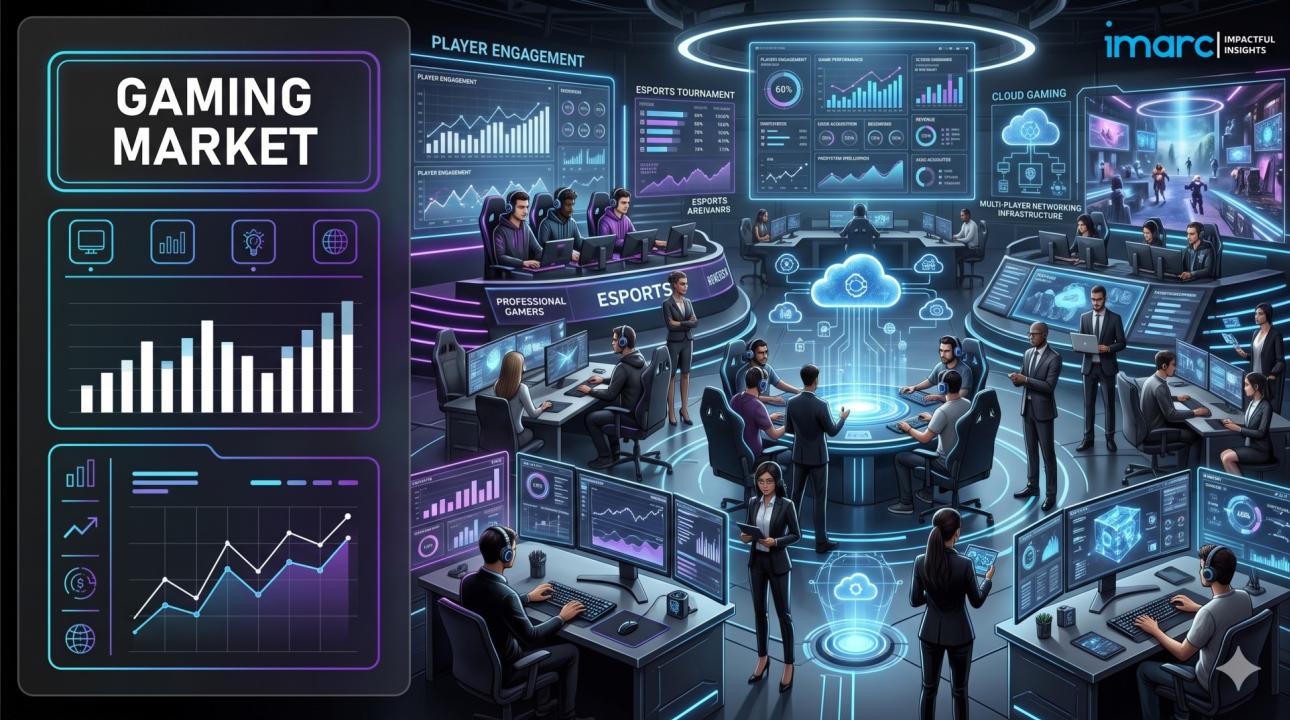
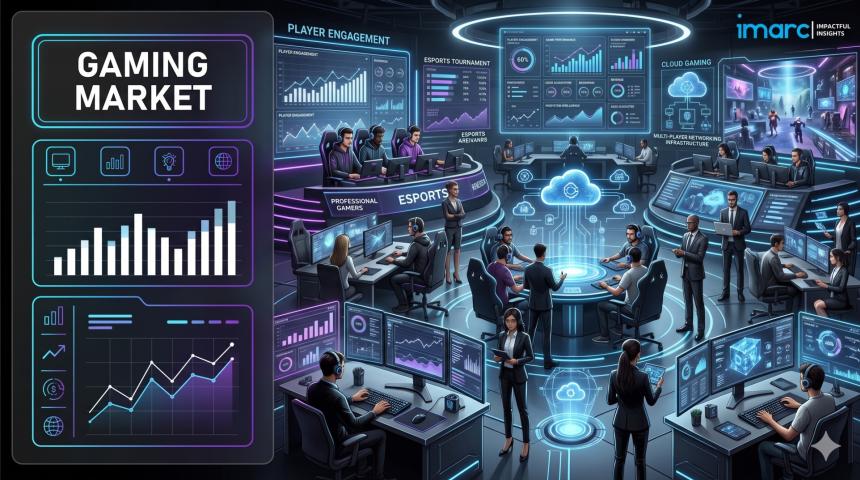
IMARC Group, a leading global market research and management consulting firm, has published its latest market intelligence report on the gaming market. The global gaming market size was valued at USD 261.1 Billion in 2025. Looking forward, IMARC Group estimates the market to reach USD 539.0 Billion by 2034, exhibiting a CAGR of 8.22% during 2026-2034. The market continues to expand at a strong pace, driven by rising smartphone penetration, the growing popularity of esports and online multiplayer games, increasing adoption of cloud gaming and immersive technologies such as VR and AR, and the continuous diversification of revenue models including in-game purchases, subscriptions, and advertising.
The market is experiencing strong momentum driven by the convergence of mobile accessibility, social connectivity, and technological innovation. Mobile gaming continues to lead in markets such as India, where it accounts for around 90% of total gaming revenue, fueled by a tech-savvy youth demographic of over 600 Million individuals below the age of 35. The expanding install base of smartphones and tablets, combined with affordable data plans, is bringing gaming to new demographics across emerging economies, while console and PC gaming continue to thrive in mature markets through exclusive titles, high-performance hardware, and live-service models.
The gaming market share is expanding due to the growing popularity of mobile gaming, cloud gaming, and esports. Rising digital adoption, advanced gaming technologies, and increasing consumer spending are encouraging companies to innovate and strengthen their market position across global gaming platforms.
How AI is Reshaping the Future of the Gaming Market
AI-Driven Procedural Content Generation and Game Design: Machine learning tools are enabling studios to generate vast, dynamic game worlds, NPC behaviors, and quest structures automatically, reducing development time and cost while allowing smaller and indie studios to compete with larger players on content depth and replayability.
Real-Time Player Behavior Analytics for Personalized Engagement: AI-powered analytics platforms are helping publishers track in-game player behavior, churn risk, and spending patterns to deliver personalized offers, difficulty adjustments, and matchmaking, improving retention and monetization across free-to-play and live-service titles.
AI-Enhanced Graphics and Real-Time Rendering: Neural rendering and AI upscaling technologies are allowing developers to deliver console-quality visuals on lower-power devices, including mobile phones and cloud streaming endpoints, narrowing the gap between high-end and budget gaming hardware.
Intelligent Anti-Cheat and Fraud Detection Systems: AI-based behavioral detection models are being deployed across competitive multiplayer titles to identify cheating, bot accounts, and payment fraud in real time, helping publishers protect the integrity of esports ecosystems and in-game economies.
Conversational AI and NPC Interaction: Large language model integration is enabling more natural, responsive non-player character dialogue and companion systems, deepening immersion in role-playing and adventure titles and opening new possibilities for dynamic, player-driven storytelling.
Download a sample copy of the Report: https://www.imarcgroup.com/gaming-market/requestsample
Gaming Market Trends and Drivers
The gaming industry is being reshaped by a sustained shift toward mobile-first consumption, with internet penetration expanding rapidly across Asia Pacific, Latin America, and the Middle East and Africa. Industry estimates suggest global internet users will grow sharply over the coming years, with users already spending an average of around 6.5 hours daily online, and younger demographics between 16 and 24 years old spending notably more time online than older age groups. This sustained online engagement is translating directly into higher mobile gaming consumption, in-app purchase activity, and longer average session times across casual and competitive titles alike.
Esports and online multiplayer gaming have become central pillars of industry growth, attracting large-scale investment from both private and government sources. Saudi Arabia's National Development Fund, for instance, established venture funds together worth around USD 120 Million specifically targeting gaming and esports, aiming to build local accelerator programs and encourage private investment in the sector. South Korea has likewise unveiled multi-year plans to expand its share of the global console gaming market, reflecting how national governments increasingly view gaming as a strategic economic and cultural export. Streaming platforms such as Twitch have further amplified esports visibility, turning competitive gaming into a mainstream spectator activity that drives sponsorship, advertising, and merchandise revenue streams.
Technological advancement in gaming hardware and software continues to be a major growth driver. Virtual reality systems, high-performance gaming consoles, and cloud gaming services are improving accessibility and immersion simultaneously. Systems such as full-body VR treadmills paired with dedicated headsets and curated game libraries are pushing the boundaries of physical immersion, while cloud streaming services are allowing players to access high-quality titles without expensive hardware investment. Meanwhile, advanced processors with enhanced cache technologies are being launched specifically to meet the performance demands of modern AAA titles, reflecting how the hardware ecosystem is evolving in lockstep with software ambitions.
Regional dynamics show distinct growth patterns. Asia Pacific holds the largest share of the global market, supported by dense populations, rapid smartphone adoption, and thriving esports cultures in countries like China and South Korea. North America remains a key innovation hub, with the United States benefiting from a large, diverse base of active gamers and strong streaming and content creation ecosystems. Europe continues to strengthen its position through a robust game development ecosystem in countries such as the UK, Germany, and France, alongside rising esports investment. Latin America and the Middle East and Africa are emerging as high-growth frontiers, propelled by rising smartphone adoption, expanding 5G connectivity, and growing disposable incomes.
Gaming Industry Segmentation
Analysis by Device Type: Mobiles and tablets represent the largest device segment, accounting for around 51.4 percent of the market, driven by widespread smartphone adoption, improved mobile processing power, and a vast ecosystem of free-to-play titles. Consoles and computers continue to hold strong positions, particularly for high-fidelity, narrative-driven, and competitive gaming experiences.
Analysis by Platform: Offline gaming leads with around 53.6 percent share, supported by single-player, narrative-rich experiences and the practicality of gaming without reliance on stable internet connections, particularly relevant for handheld and portable devices. Online gaming continues to grow rapidly alongside expanding connectivity and multiplayer ecosystems.
Analysis by Revenue Type: In-game purchases dominate revenue generation, accounting for around 63.4 percent of the market, reflecting the success of free-to-play monetization models that offer cosmetic items, virtual currency, and gameplay advantages. Game purchases and advertising represent complementary revenue streams across different game categories.
Analysis by Type: Adventure and role-playing games lead with around 41.1 percent share, owing to their immersive storytelling, expansive open worlds, and character customization features that encourage long-term player investment. Puzzles, social games, strategy, and simulation titles continue to attract dedicated audiences across casual and core gaming segments.
Analysis by Age Group: Adults account for the largest share at around 75.1 percent, supported by mature storytelling, esports participation, flexible gaming schedules, and higher disposable income available for hardware and in-game spending.
Regional Insights
Asia Pacific dominates the global gaming market with a share exceeding 49.5 percent, underpinned by large populations, rapid mobile adoption, and globally recognized esports ecosystems in China, South Korea, and India. The United States remains a pivotal market within North America, supported by a large base of active gamers, major console releases, and strong streaming culture. Europe benefits from a mature game development talent pool and rising esports investment, while Latin America and the Middle East and Africa are seeing accelerated smartphone-led adoption and improving digital payment infrastructure that is making game purchases and in-app transactions easier for new players.
Leading Companies
Activision Publishing, Inc.
Apple Inc.
Bandai Namco Entertainment America Inc.
Electronic Arts Inc.
Epic Games Inc.
KRAFTON, Inc.
Microsoft Corporation
NetEase, Inc.
Nintendo Co., Ltd.
Rovio Entertainment Ltd.
Sega of America, Inc.
Sony Corporation
Tencent Holdings Limited
Recent News and Developments in the Gaming Market
March 2025: Morocco and France launched the Video Game Incubator program to support nine video game startups, offering a five month training course covering business administration, production supervision, branding, and financial planning.
February 2025: HP released its updated Victus 15 gaming laptop in India, featuring an AI-enabled processor designed to improve performance and adaptability for gaming workloads.
January 2025: Acer launched its new Nitro V lineup of entry-level gaming laptops, aimed at students and developers seeking accessible AI-driven gaming performance.
October 2024: SuperGaming, an India-based developer, released Indus Battle Royale for mobile, introducing a distinctive double winning condition and a new in-game feature allowing players to seek out past opponents.
June 2024: Apple introduced Game Mode within iOS 18, designed to optimize device performance during intensive gaming sessions for a smoother experience.
May 2024: Solana Labs expanded its partnership with Google Cloud to bring its Web3 gaming platform to a wider developer base, simplifying access to blockchain-based gaming technology.
Note: If you require specific details, data, or insights that are not currently included in the scope of this report, we are happy to accommodate your request. As part of our customization service, we will gather and provide the additional information you need, tailored to your specific requirements. Please let us know your exact needs, and we will ensure the report is updated accordingly to meet your expectations.
About Us:
IMARC Group is a global management consulting firm that helps the world's most ambitious changemakers to create a lasting impact. The company provides a comprehensive suite of market entry and expansion services. IMARC offerings include thorough market assessment, feasibility studies, company incorporation assistance, factory setup support, regulatory approvals and licensing navigation, branding, marketing and sales strategies, competitive landscape and benchmarking analyses, pricing and cost research, and procurement research.
Contact Us:
IMARC Group
134 N 4th St. Brooklyn, NY 11249, USA
Email: sales@imarcgroup.com
Tel No: (D) +91 120 433 0800
United States: +1-201-971-6302