Most teachers I know plan the school year twice. The first time is the official version: the pacing guide, the unit sequence, the standards spreadsheet handed down by the department. The second time happens in August, quietly, when someone actually lays the calendar out and realizes the third unit lands on top of a four-day week, a fire drill, and picture day.
The gap between those two plans is where a year gets stressful. A pacing guide tells you what to teach and roughly when. It rarely tells you that the week you scheduled your big project is also the week of parent-teacher conferences, or that a public holiday quietly erased a lesson you were counting on.
Why a good curriculum plan still runs into the wall
Curriculum plans tend to assume a clean, uninterrupted stream of instructional days. Real school years are not clean. They are full of half-days, testing windows, assemblies, snow days that get made up in odd places, and holidays that shift the rhythm of a week without removing it from the calendar entirely.
The trouble is that these interruptions are invisible until you look at them together. One early-release day is nothing. But if three of them cluster in the same month you planned to cover your densest material, you have a problem you could have seen in July and instead discover in October, mid-lesson, with thirty students watching.
Digital planning tools are good at the granular level. They will remind you about tomorrow. They are less good at the thing teachers actually need in summer, which is a wide, physical view of ten months at once, where you can see the shape of the whole year and where the pressure points sit.
The paper year map
Here is a routine that takes an afternoon and saves a lot of scrambling later. The idea is to build the year backward and on paper, before the official plan gets anywhere near a lesson.
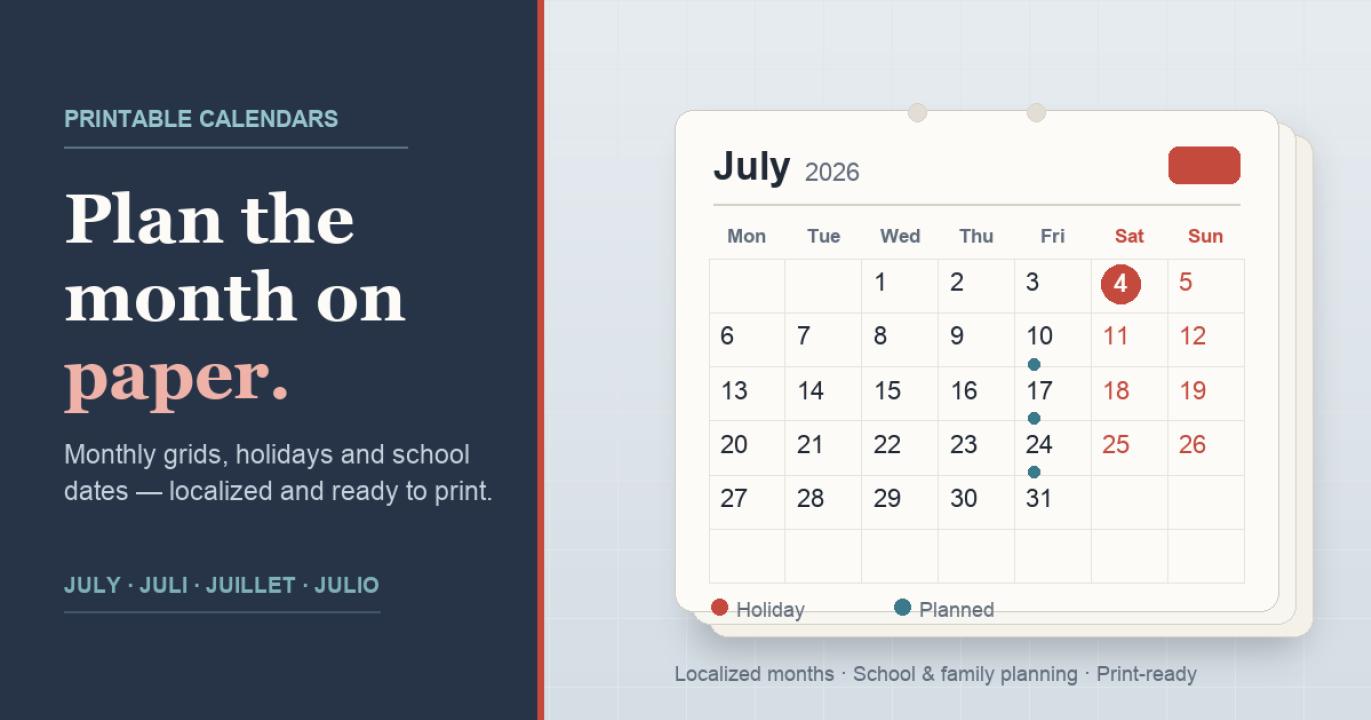
Start by printing a blank month for every month of your school year, August through June, and putting them where you can see several at once — a table, a wall, the floor if that is what it takes. A stack of printable monthly pages works better than a screen here because you can spread them out and mark them by hand. If you don't already have a set, a source of clean, no-frills monthly sheets like Calendana's printable calendar pages covers this without much fuss. The format matters less than being able to lay the whole year flat.
Then fill them in this order:
- Fixed dates first. Term start and end, holidays and breaks, testing windows, report card deadlines, conference days, and any early-release or professional-development days your school has already published. These are the walls of your year. Everything else has to fit between them.
- The heavy weeks. Mark the weeks that are already loaded — the ones with three short days, or a testing window butting against a holiday. These are the weeks you do not want to schedule a major project or a brand-new unit.
- Your big rocks. Now place the things that need protected time: the research project, the science fair, the two-week unit that always runs long. Slot them into the calm stretches you just found, not the crowded ones.
- Buffer. Leave a few days genuinely empty in each term. Not as a plan, as insurance. Something will run long. Something always does.
When the official pacing guide arrives, you lay it against this map instead of against a blank void. Most of it will fit. The parts that don't will be obvious, and you will have weeks of lead time to adjust rather than a Sunday-night panic.
A small example of what it catches
A middle-school teacher I talked to used to schedule her persuasive-writing unit for the first two weeks of November because that is where the curriculum put it. Two years running, it collapsed. She finally spread the year out on paper and saw why: that stretch held a professional day, a two-day holiday, and the start of a testing window, leaving her about six usable instructional days for a unit that needs nine or ten.
She moved it two weeks earlier into a clean October run. Same content, same standards, no heroics — just a unit placed where the days actually existed. That is the entire value of the exercise. It does not make you a better teacher. It stops the calendar from quietly sabotaging the teaching you were already going to do.
One caution before you commit dates in pen
Published school and holiday calendars are not always final, and they vary a lot by district, region, and institution. Make-up days get added. Board decisions move things. A holiday that falls on a weekend in your region may or may not shift the surrounding week the way you expect.
Treat your paper map as a planning aid, not a source of truth. Confirm the dates that carry real weight — testing windows, grade deadlines, official closures — against whatever your school publishes, and check anything locale-specific before you build a unit around it.
The point of the map is not precision to the day. It is perspective. Seeing ten months at once tells you something a daily reminder never will: where your year is going to get tight, and how much room you actually have to teach the way you planned to.
If you teach, the best afternoon you can spend this summer is the one where you print the whole year, put it on a table, and look at it before it starts looking back at you.