You describe the same kitchen to three contractors. Same cabinets, same rough footprint, same "nothing fancy, just tired and dated." A week later the bids come back: one at $18,400, one at $24,900, and one at $31,200. Now you're standing in the kitchen holding three pieces of paper that supposedly price the exact same room, and they disagree by almost the cost of a car.
The instinct is to assume someone is wrong. The low bid feels like a deal and the high bid feels like a rip-off, so you lean toward the cheap one and try not to think about it too hard. That instinct is where a lot of remodel regret starts.
A quote is a plan, not a price tag
A contractor's number isn't a lookup. It's their guess about how a specific job will actually go, wrapped around their own cost of doing business. Two honest, competent people can price the same kitchen very differently because they're pricing different plans for it.
The low bid might assume your existing plumbing stays put, your cabinets are stock, and nothing surprising lives behind the wall. The high bid might build in a few days of buffer for the stuff that usually goes sideways, a better-paid crew, and a fixture grade a step up from builder-basic. Neither of them is lying. They're answering slightly different questions, and the paper doesn't spell that out unless you make it.
The gap also hides things that have nothing to do with your kitchen. How busy the contractor is this month. Whether they actually want the job. What they got burned on last time and now pad for. A bid is a human estimate under uncertainty, and it moves with all of that.
Why the spread is easy to misread
When three numbers land that far apart, most people do one of two things. They pick the lowest and hope, or they average the three and call it fair. Both treat the bids as if they're measuring the same thing to different degrees of accuracy. They aren't. They're describing different versions of the project.
The more useful reaction is to walk in with a rough sense of what a job like yours tends to run before the bids arrive. Not to catch anyone out. To have a frame. If you already expect a mid-grade kitchen refresh in your area to land somewhere in the low-to-high twenties, then the $18,400 bid stops reading as "the winner" and starts reading as "what did this person leave out, or what do they know that the others don't." That's a question worth asking out loud.
Getting a frame before the paper arrives
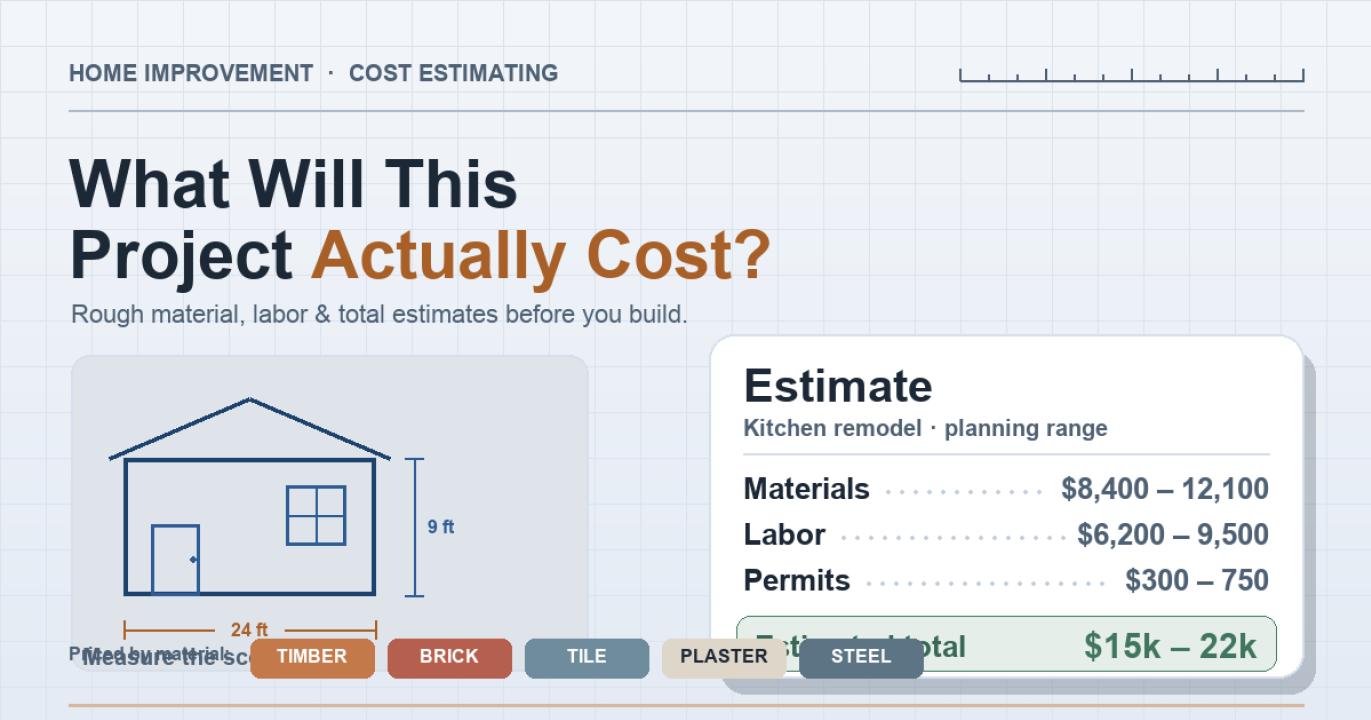
You don't need a contractor in the room to build that frame. Running the project through a few free home-project cost calculators organized by category gives you a planning range to hold the bids up against. For a kitchen you might get back something like $21,000 to $28,500 for a mid-grade refresh, split roughly into materials and labor. That range isn't a quote and it can't see your house. What it does is turn three mystery numbers into three numbers you can interrogate.
With a frame in hand, the conversation changes. The bid under your range gets a question: is my plumbing staying put, are these stock cabinets, what happens if the subfloor is soft? The bid over your range gets one too: what are you building in that the others aren't? Sometimes the expensive bid is the honest one and the cheap bid is the change-order trap. A rough estimate doesn't tell you which. It tells you where to point.
The estimate's job is to make the quotes legible. It is not a substitute for them.
Where the estimate stops being useful
A calculator can only price the job you describe, and the job you describe is usually the optimistic one. It can't see that the cabinets are screwed into plaster that will crumble, that the range wall hides old knob-and-tube, or that your slab isn't level and every counter run needs shimming. Those are the things that separate a clean $22,000 kitchen from a stressful $30,000 one, and they only show up when someone competent looks at the real space.
Costs also move with things a general range can't know: your region, the grade of materials you actually choose, the local labor market, site conditions, permits, and how complex the layout really is. A national ballpark is a starting point, not a local truth. Anything touching gas, electrical, plumbing, or structure needs a licensed person to look before you commit money against a number.
So the estimate isn't the answer. It's the thing that keeps you from accepting the wrong answer too quickly.
What to actually do with three bids
Line the bids up next to your planning range and read them as descriptions, not verdicts. The one that clusters near your range and explains its assumptions is usually the safer bet than the outlier in either direction. Ask each contractor what their number assumes and what would push it up. Get the scope in writing, including who eats the cost when something unexpected turns up behind the wall, because on an older house something usually does.
The point of a rough estimate was never to replace the person doing the work. It's to walk into that conversation knowing enough to ask the right questions. Three bids that once looked like a coin flip become three plans you can compare on purpose, and that's most of the distance between a remodel you chose and one that just happened to you.