There's a specific kind of overwhelm that happens when you get interested in a game that isn't out yet. You watch a trailer, you like the look of it, and you go read up. Within ten minutes you have eleven browser tabs open, half of them contradict each other, and you still couldn't name three characters if someone asked. The problem isn't that you're bad at this. It's that you're trying to memorize a moving target from a dozen sources that each know a different slice of the truth.
Modern games ship with big casts. A single title can arrive with a couple dozen named characters, plus companions, factions, and whatever the game's version of collectible creatures happens to be. When the game is already out, this sorts itself out over time. You play, you meet people in the order the story introduces them, and the names stick because they're attached to something you did. Pre-release is harder. You're meeting everyone at once, out of order, with no gameplay to hang the memory on.
Why this is trickier than it looks
The instinct is to treat it like flashcards: read the wiki, learn the roster, done. That misses what actually makes pre-release cast information slippery. It isn't the volume. It's that every fact you pick up carries a different level of certainty, and most sources don't tell you which is which.
Some details come straight from an official reveal. Some were seen once in beta footage and might change before launch. Some are a fan's reasonable guess that got repeated enough times to sound official. If you memorize all of it with equal confidence, you'll walk into the finished game holding a mental model that's a third wrong, and you won't know which third.
A concrete example
Take Azur Promilia, an open-world game that's been running closed beta tests with a steady stream of information about its characters and the small creatures it calls Kibo. If you go looking, you'll find character art, beta clips, discussion of how the Kibo companions might work, and a fair amount of speculation about systems that haven't been locked down. It's a good stand-in for the general problem: a large cast, an entire creature layer sitting alongside it, and a mix of confirmed and unconfirmed material that all looks similar at a glance.
Trying to hold that in your head as one flat list doesn't work. What does work is giving it a little structure before you start.
The workflow
None of this is clever. It just front-loads a bit of organizing so the rest sticks.
Group the cast by role, not by name. Your brain won't retain fifteen names in a row, but it will retain "the healer, the two heavy hitters, the one who does support." Sort characters into rough buckets first, and let the names attach themselves to a function you can already picture. When the game launches and you actually control these people, the buckets are already built.
Keep the creatures on their own track. In a game with both characters and companion creatures, mashing them into one list is where most of the confusion comes from. The Kibo in Azur Promilia are their own system, so learn them as their own thing. What are the broad types, what role do they seem to play, which ones keep showing up in official material. Separate shelf, separate mental folder.
Tag every fact with how sure you are. This is the one that saves you later. Three labels are enough: confirmed by the developers, shown in beta but not final, and community guesswork. You don't need a spreadsheet. You just need to never let a "probably" quietly become a "definitely" in your memory.
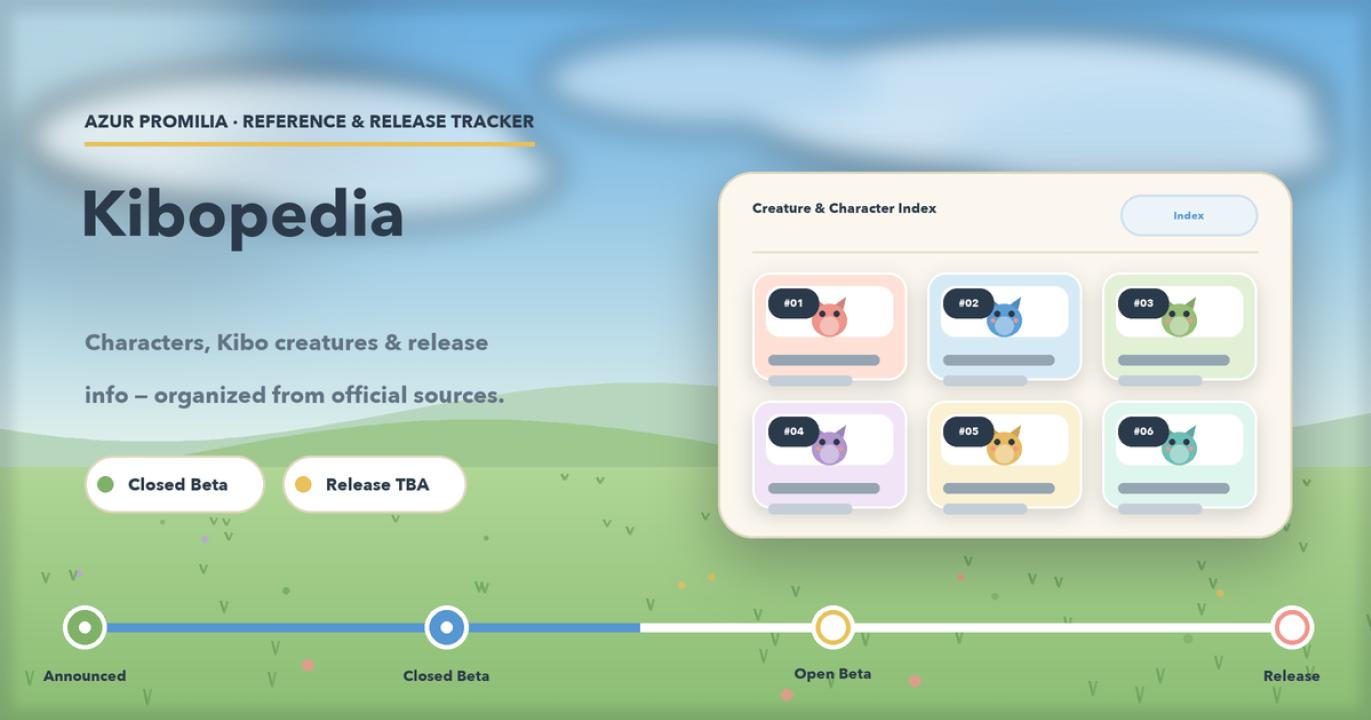
Pick one home for the facts. Fifteen scattered posts age badly and start contradicting each other within months. A single reference page you check beats a feed you scroll. This is where a maintained tracker earns its keep, because someone is doing the work of keeping entries current and noting what's official. One such option is a fan-run reference that gathers Azur Promilia's character and Kibo entries in one place. It isn't run by the studio and doesn't claim to be. What it does is collect release details, character and creature information, and beta updates, and lean on official-source language instead of presenting rumor as settled fact. The value isn't insider knowledge. It's that the sorting and the confidence-tagging are already done for you.
Where this approach runs out
Worth being honest about the ceiling. Any reference is only as reliable as the sources underneath it, and when a game is still in beta, the ground genuinely moves. A character's role that looks settled in July can be reworked by the time the game ships. A creature type shown in an early build might not survive to launch. No amount of tidy organizing changes that, and anyone promising certainty about an unreleased game is selling you something.
So the goal isn't to be right about the final game. It's to arrive at launch with a map that's roughly accurate and clearly labeled, so that when things shift, you can update one entry instead of rebuilding your whole understanding from scratch.
If you're the type who likes to hit the ground running on day one, this small bit of upfront sorting pays for itself in the first hour of play. And if the game turns out not to be for you, you've lost twenty minutes instead of a weekend. Either way you spent the wait understanding the thing, which is more than eleven open tabs ever gave anyone.