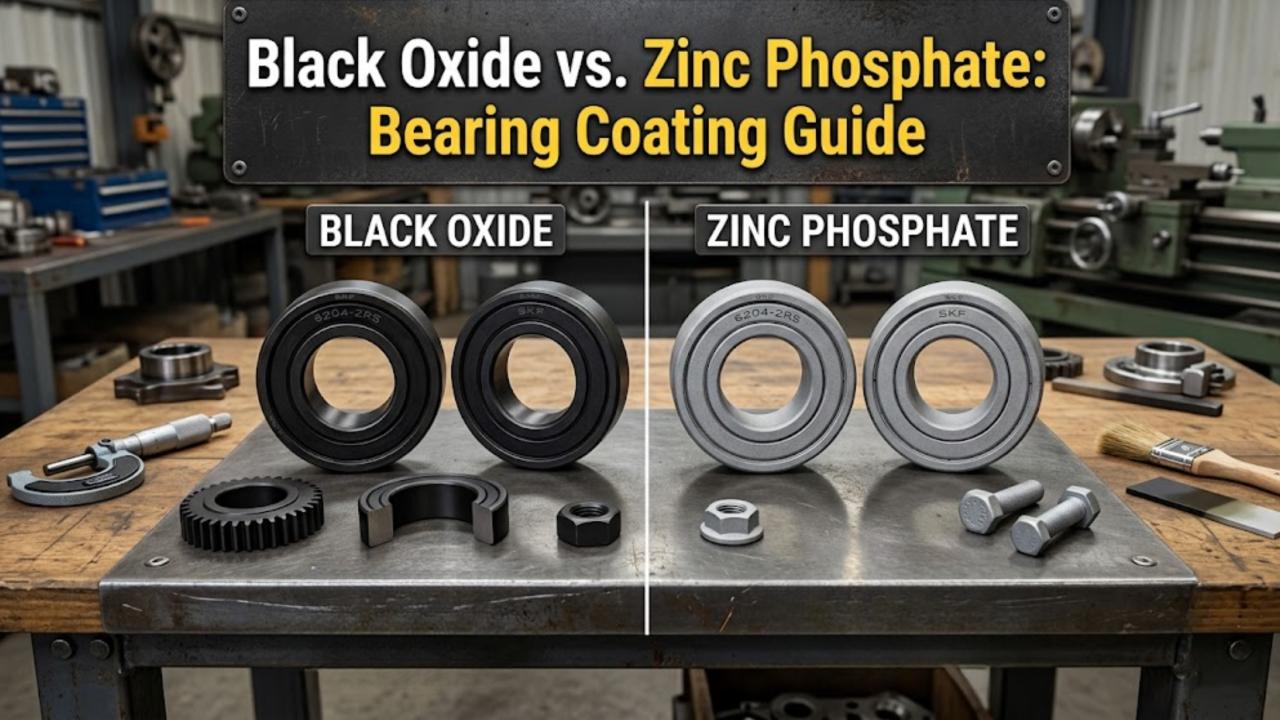
Bearings are the quiet workhorses of the industrial world. They keep everything moving, from massive factory conveyor belts to the high-precision components inside automotive engines. However, because they constantly face friction, intense heat, and environmental moisture, raw steel bearings do not last very long on their own. Without proper surface protection, rust and wear will quickly cause premature failure, leading to expensive equipment downtime.
To prevent this, engineers use chemical surface treatments to shield the steel. Two of the most reliable and widely used options in the industry are black oxide and zinc phosphate. But how do you know which one is right for your specific application?
When a professional bearing manufacturing company designs components, it looks closely at the operating environment to make this choice. Both coatings offer unique advantages, but they perform very differently under stress.
This guide will break down the differences between Black Oxide vs. Zinc Phosphate bearings so you can choose the best option for your next project.
Understanding Black Oxide for Bearings
Black oxide is a conversion coating, meaning it does not just sit on top of the metal like paint. Instead, a chemical reaction transforms the outermost layer of the steel into a microscopic layer of black iron oxide (Fe_3O_4), also known as magnetite.
The main advantage of using black oxide bearings is their dimensional stability. Since no new layer is added to the outer surface, and instead the existing surface undergoes a chemical change, we observe virtually no change in the thickness of the part. It is usually less than 0.00002 inches. For high-precision bearings, this is incredibly important, as the slightest change in size can be detrimental to the already tight tolerances that are required for smooth rotation.
Black oxide by itself has minimal corrosion protection. In order to fully safeguard the steel from rust, manufacturers will add a separate layer of oil, wax, or lacquer. The oxide layer will essentially help the layer of rust-preventative oil to adhere to the surface of the steel.
Bearings that have a black oxide finish have a smooth, deep black color. It is a very thin coating that is only one of many that keep the black oxide coating looking like raw steel. Black oxide is matte on unpolished steel, so with a steel background, the oxide coating is very glossy. Matte finishes are preferred for mechanical items that will be seen on the exterior.
Understanding Zinc Phosphate for Bearings
Zinc phosphate is also a coating via conversion. The process, however, is completely different. The application of zinc phosphate involves immersion of the steel components into a chemical solution, which will subsequently form a dense layer of zinc phosphate on the steel surface.
The resulting layer of zinc phosphate will contain a highly porous and crystalline structure. It is essentially a very small sponge and is specifically designed to absorb and retain rust-inhibiting oils and heavy lubricants. Since Zinc Phosphate can retain a larger volume of oil than a black oxide layer, bearings that have been phosphated will have a definite improvement in corrosion resistance, particularly in damp or outdoor environments.
Since this crystalline layer forms on the surface of the components, it results in a change of thickness, which can be in the range of 0.0002 to 0.001 inches. While this is a small change in thickness, it can still result in impacts to really precise machinery. Zinc phosphate also leaves a dull and matte gray to dark gray surface finish, which is less visually appealing than the sleek, dark finish of black oxide.
Head-to-Head Comparison: Phosphating vs. Black Oxide
To help visualize how these two surface treatments match up, we can look at their core performance differences side by side:
1. Corrosion Protection (Rust Resistance):
- Black Oxide: Moderate protection. It relies heavily on a layer of oil to keep rust away.
- Zinc Phosphate: Superior protection. Its unique texture locks in oil tightly to block out moisture.
2. Dimensional Change (Size & Fit):
- Black Oxide: Virtually zero change. It keeps the part's exact size, making it perfect for high-precision machinery.
- Zinc Phosphate: Adds a tiny layer of buildup. You have to allow extra room for this slight increase in thickness.
3. Surface Appearance (Look):
- Black Oxide: A very deep black coating that is sleek and has a glossy finish. Because of the oxide coating, the polished steel will finish very glossy, and unpolished steel will have a matte finish.
- Zinc Phosphate: Zinc Phosphate has a dull industrial finish that leaves a plain matte gray coating, so it is not preferred.
4. Lubricant Retention (Holding Oil):
- Black Oxide: Fair. It holds oil okay, but the surface is smooth.
- Zinc Phosphate: Excellent. The surface acts like a microscopic sponge to soak up and hold heavy lubricants.
5. The Main Advantage:
- Black Oxide: It protects the metal without changing the precise measurements of the bearing.
- Zinc Phosphate: It offers maximum survival against harsh, wet, and high-moisture environments.
When comparing phosphating vs black oxide, the right choice always comes down to a trade-off between absolute dimensional precision and heavy-duty environmental survival.
Component Selection: Matching the Coating to the Environment
Choosing the wrong coating can cause a bearing to degrade long before its expected lifespan. Let's look at the specific scenarios where each treatment excels.
When to Specify Black Oxide
Black oxide should be used when the greatest dimensional stability is most important. Black oxide is used most often in indoor machinery that has little to no moisture or humidity. It is also commonly used in optical devices, printing, and lab automation as well as high-speed robotic assemblies. For all of these devices, black oxide is ideal, as the risk of machinery friction and misalignment is greatest when the bearing clearance is tightest.
When to Specify Zinc Phosphate
Zinc phosphate should be your go-to choice for bearings working in rough environments, especially if your machinery works outdoors, is subjected to high humidity, and/or comes in contact with road salts and moisture. Zinc phosphate is resistant to these conditions. It is also commonly used for heavy industrial equipment, farming, mining, and automotive under-hood components.
The Big Picture: Quality Matters
Choosing the right chemical coating is an important first step towards stopping rust, but it is only one factor. Coatings won't help the bearing if it is made of a low quality steel and poor manufacturing.
Especially in the most demanding applications of the industrial sector, using quality bearings should be a priority. The best bearings will have the best metallurgy and the most precise engineering. High-quality bearings with the right surface coating will keep your machinery working optimally, save energy by lowering friction, and prevent costly replacement and maintenance.
Choosing Your Bearing Coating
Modern engineering relies heavily on black oxide and zinc phosphate. Black oxide creates a perfect, zero-tolerance finish, so parts can be made to fit tightly without adding extra bulk. Zinc phosphate, as a trade-off for a very small amount of dimension tolerance, creates a thick, oil-absorbing coating that protects against rust and moisture.
To get the longest life out of your machinery, always evaluate the exact conditions your equipment will face. Partnering with an experienced, certified bearing manufacturer ensures you select the correct internal clearances, steel grades, and protective coatings required to keep your specific operations moving smoothly for years to come.