The Real Problem With Selling Into Print
The global printing market tops 800 billion dollars annually. It is massive. Yet most vendors trying to reach this sector waste 40 to 60% of their budget on cold outreach that never lands with the right person.
Here is why: Printing companies are vertical silos. A plant manager does not approve software. A prepress specialist does not buy presses. An owner does not choose ink formulations. A title-blind list assumes everyone at a print shop might be relevant. In reality, that approach guarantees you will alienate three people for every one person who can actually say yes to your offer.
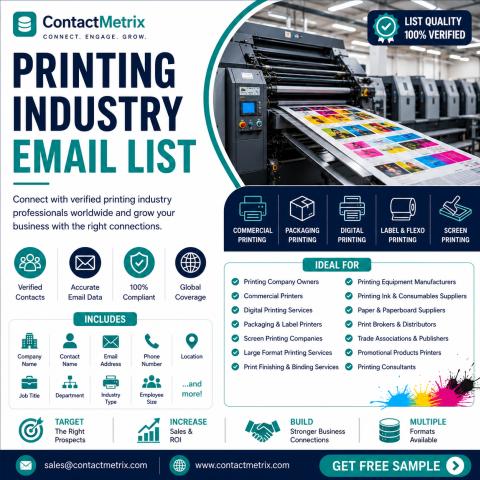
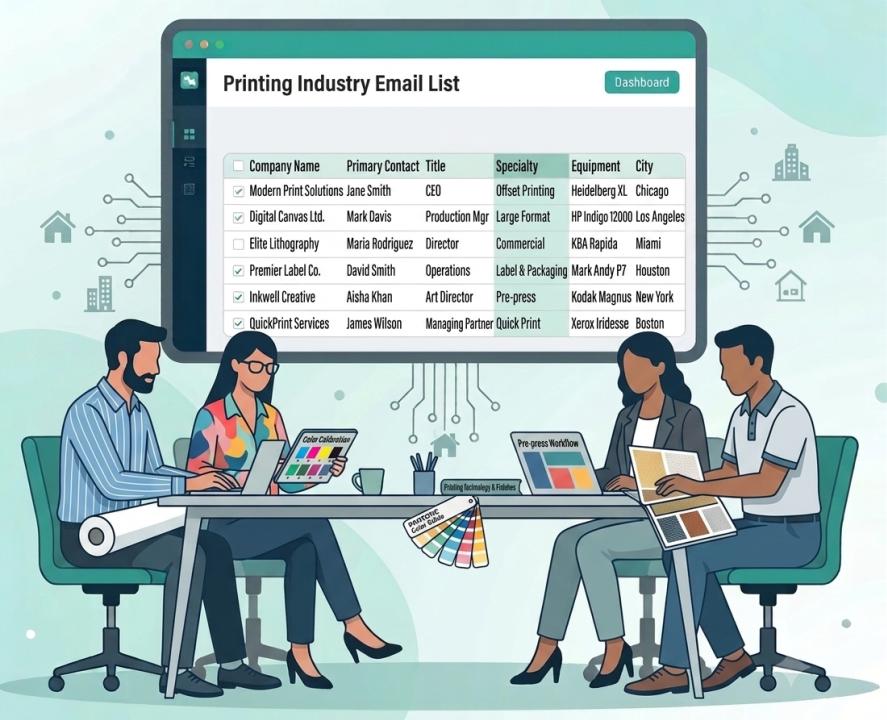
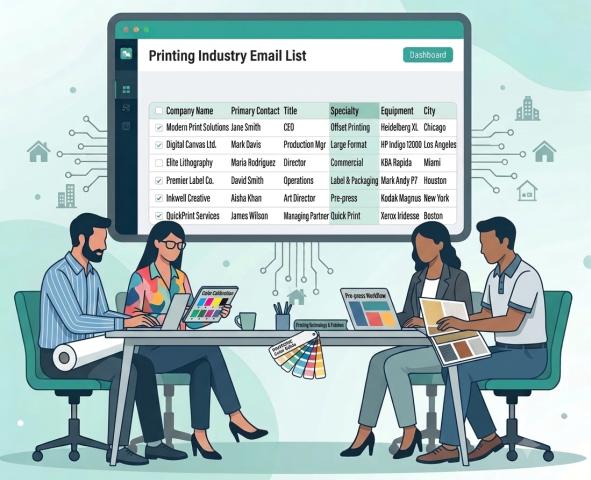
ContactMetrix's Printing Industry Email List fixes this fundamental problem through role-specific segmentation that mirrors how printing companies actually make buying decisions.
The Segmentation Problem: Why Most Lists Miss
Consider this real scenario: You sell UV-curable inks for digital printing. A generic list gives you 500 names at printing companies in your region. You send emails to all 500. Response rate? Typically 0.5 to 1.5%.
Why so low? Because your email landed on desks belonging to:
- A bindery manager (handles post-press, not inks)
- A sales estimator (quotes jobs, doesn't buy materials)
- An HR director (completely wrong department)
- A plant owner who never reads unsolicited vendor emails
- A prepress manager (specifies software, not inks)
Out of those 500, maybe 30 to 40 actually work in production and materials purchasing. Out of those, maybe 5 to 10 actively evaluate ink suppliers. You just wasted time and sender reputation reaching the other 460.
ContactMetrix's Printing Industry Email List reverses this math. Instead of 500 blind names, you get 40 precisely targeted production managers and procurement heads who actually evaluate inks. Response rate climbs to 3 to 6%. Cost per qualified lead drops by 60%.
How Role-Specific Targeting Works Across Print Sub-Sectors
Printing is not one market. It is eight distinct markets with completely different buying structures.
Commercial Printing involves owners, plant managers, and production directors. These roles control equipment and material budgets. A CTP system vendor reaches the right person on the first email because ContactMetrix has already tagged that contact as a "prepress manager" responsible for CTP decisions, not a "sales estimator" who only prices jobs.
Packaging Printing involves packaging production managers, plant supervisors, and procurement heads. A corrugated substrate supplier using a generic list reaches a press operator. A supplier using ContactMetrix's list reaches the procurement head who actually negotiates material contracts. The first gets 0.8% response. The second gets 4.2%.
Label Printing involves label production managers, press operator leads, and sales directors. A pressure-sensitive label stock supplier needs the production manager, not the art director. ContactMetrix segments by that distinction. A generic list does not.
Digital Printing involves digital print managers, variable data print specialists, and production coordinators. A workflow automation software vendor is looking for the digital print manager who evaluates software, not the VDP specialist who runs the system. ContactMetrix labels the difference. Generic lists treat both as "printing company contact."
Offset Printing involves offset pressroom managers, plate makers, and quality control leads. An offset ink vendor needs the pressroom manager, not the plate maker or QC lead. ContactMetrix makes that distinction. A title-blind list does not.
Wide Format and Signage involves graphics production managers and sign shop owners. A wide-format substrate supplier needs to reach the person authorizing material purchases, not the operator running the machine. ContactMetrix segments this. Most lists do not.
Screen Printing involves screen print shop owners, production managers, and art directors. An emulsion supplier needs the production manager, not the art director. ContactMetrix makes this clear. Generic lists mix these roles together.
Book and Bindery involves bindery managers, production planners, and fulfillment directors. A finishing equipment vendor needs the bindery manager, not the production coordinator. ContactMetrix tags this distinction. Generic lists do not.
The Data Depth Difference
A typical generic B2B list gives you name, title, company, and email. ContactMetrix's Printing Industry Email List includes all of that plus:
- Printing category (commercial, packaging, label, digital, offset, screen, wide format, book and bindery)
- Printing process specification (offset, flexo, gravure, digital, letterpress)
- Specialization area (books, magazines, brochures, labels, corrugated, wide format)
- Company revenue band
- Employee size (often a proxy for equipment budget)
- Years in operation
- Technology platforms in use
This depth lets you build campaigns that feel personally relevant instead of generic.
Example: You sell a color management RIP software. ContactMetrix lets you filter for commercial printers in the Northeast with 50 to 200 employees currently running older RIP systems. You end up with 45 highly qualified prospects. A generic list gives you 2,000 generic names in the region, of which maybe 10 are relevant.
Real Comparison: A Case Study
Scenario 1: Generic List Approach
You buy a list of 3,000 printing companies in your region. You segment by company size and location, but not by role or printing process. You send 3,000 emails to "printing company contacts." You get a 1.2% response rate. That is 36 responses. Of those, maybe 12 are truly qualified prospects. You convert 2 to 3 deals. Cost per deal: roughly 1,500 to 2,000 dollars in list and campaign expense.
Scenario 2: ContactMetrix Role-Specific Approach
You buy a targeted list of 180 production managers and procurement heads at commercial and digital printing operations in your region. You segment further by company revenue and printing process. You send 180 emails. You get a 4.5% response rate. That is 8 responses. Of those, 7 are qualified because they already match your targeting criteria. You convert 3 to 4 deals. Cost per deal: roughly 300 to 400 dollars in list and campaign expense.
The second approach costs 75% less per deal and closes 50% more business despite having a smaller list.
Why Refresh Cycles and Accuracy Matter in Print
Print company staffing turns over fast. A prepress manager leaves. A production director gets promoted. An owner sells the business. A generic list that is a year old has lost 30 to 40% of its accuracy in the print sector.
ContactMetrix refreshes every 30 to 45 days. It combines automated validation with manual spot-checks. That 95% accuracy means nearly all your email gets to an active, current contact in the right role at the right company.
A stale list means you are reaching job titles that no longer exist, companies that have closed or merged, and contact details that bounce immediately. Your sender reputation suffers. Email deliverability tanks. Even good messaging fails because the data is bad.
Multi-Channel Real Usage
ContactMetrix's Printing Industry Email List is designed for more than just email. Here is how real customers use it:
Email campaigns targeting production managers with relevant ink or substrate offers see 3 to 5% response because the recipient actually makes that decision.
Cold calling using verified direct phone numbers is far more productive when you already know the person's exact job function and printing process specialty. A call to a prepress manager about CTP systems is a real conversation, not a cold interruption.
Direct mail sending product samples and spec sheets to the right person costs more per piece but closes at 2 to 3 times the rate of blind mail because you are mailing to decision-makers, not just "printing companies."
LinkedIn prospecting becomes targeted when you know someone is a "packaging production manager" or "digital print manager." You can write personalized connection messages that reference their specific role and challenges.
Combine two or three channels and response rates often double again.
The Bottom Line
The printing sector rewards precision. Title-blind lists waste budget and hurt sender reputation. Role-specific, process-aware segmentation transforms cold outreach into warm, relevant conversations.
ContactMetrix's Printing Industry Email List gives you 170,000 verified, segmented printing professionals tagged by actual job function, printing process, company size, and location. You reach the buyer responsible for your specific product category, not a list of generic "printing company contacts."
That is the difference between campaigns that close deals and campaigns that just drain budget.
Ready to improve your printing sales? Request a free sample of ContactMetrix's Printing Industry Email List today and see the difference role-specific targeting makes.