Transportation isn't one supply chain, it's several that happen to connect. Trucking, rail, air freight, maritime shipping, 3PL, warehousing, and public transit each move different things through different infrastructure, on different regulatory timelines, with completely different buyers sitting at the top of each decision. A contact list that treats all of that as one audience is really just guessing.
That's where a lot of transportation outreach falls apart. A fleet manager evaluating telematics for a trucking company and a port operations manager evaluating vessel scheduling software are both "transportation," but one thinks in miles and fuel costs while the other thinks in berths and cargo throughput. A generic pitch aimed at both usually reads as irrelevant to each, and irrelevant pitches don't just get ignored, they teach the recipient to stop opening your emails at all.
Trucking and freight carriers are their own world. Fleet managers, dispatchers, and safety directors are dealing with driver shortages, fuel costs, and maintenance schedules on a daily basis, and owner-operators are making decisions with a completely different risk tolerance than a fleet manager at a large carrier. A pitch about enterprise telematics platforms lands differently with a 200-truck fleet than it does with an owner-operator running three rigs, even though both technically fall under "trucking."
Rail and maritime shift the conversation entirely. Rail operations managers and terminal managers care about scheduling, track capacity, and safety compliance across a fixed network, while port operations managers, shipping coordinators, and marine superintendents are thinking in terms of vessel turnaround, berth allocation, and customs coordination. Neither group responds to messaging built for trucking fleets, and neither group has patience for a vendor who clearly doesn't understand the difference.
Air freight adds another distinct buyer profile. Cargo operations managers and ground handling supervisors are working against tight scheduling windows and handling requirements that don't map onto trucking or rail at all. A pitch about warehouse automation might be relevant to their operation, but only if it's framed around cargo handling speed and compliance, not generic supply chain language borrowed from a trucking campaign.
3PL and freight forwarding sit in a different position still, closer to logistics orchestration than physical transport. Logistics directors, freight brokers, and customs compliance officers at these companies are evaluating software, visibility platforms, and partner networks rather than vehicles or vessels directly. Selling into this segment means understanding that the buyer's problem is coordination across other people's fleets, not their own.
Warehousing and cold chain round out the picture, and they're often overlooked entirely in generic transportation lists. Warehouse managers and distribution center directors care about throughput and inventory accuracy, while cold chain managers and refrigeration specialists are managing a completely different set of compliance and quality assurance requirements tied to temperature-controlled goods. A refrigeration equipment vendor pitching a dry warehouse manager is wasting a message that would have landed well with the cold chain team one department over.
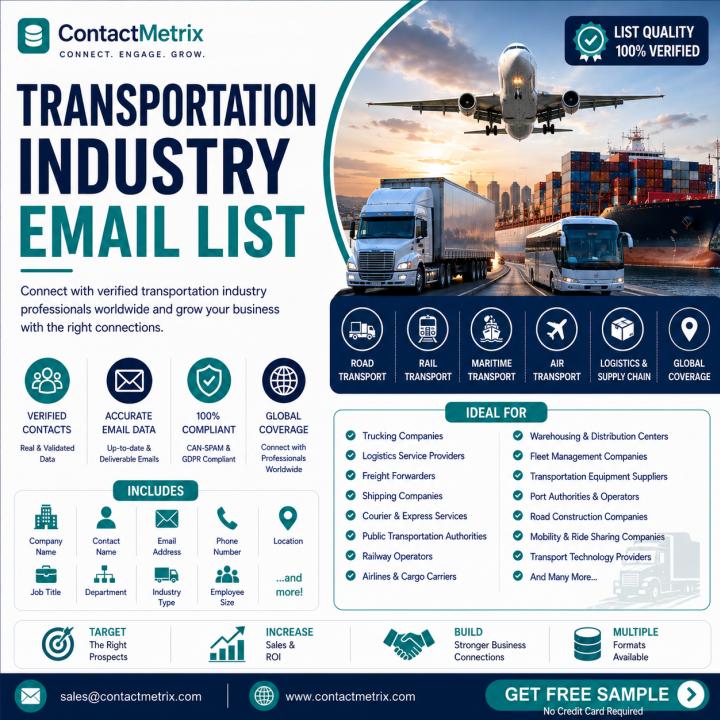
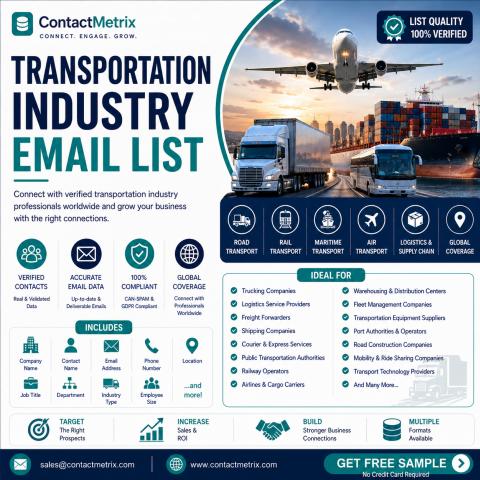
ContactMetrix's Transportation Industry Email List is segmented specifically to reflect all of this, sorting contacts by transportation mode (trucking, rail, air, maritime, 3PL, warehousing, cold chain, public transit) and by functional role (fleet operations, logistics, procurement, safety and compliance, warehouse management), so a pitch for route optimization software reaches a logistics director instead of a safety compliance officer who has no reason to care, and a fuel program pitch reaches a fleet operations manager instead of a customs compliance officer at a freight forwarder.
Geographic coverage matters here too, since transportation infrastructure varies enormously by region. A campaign targeting port operations needs contacts clustered around major shipping hubs, while a trucking-focused campaign needs coverage across inland freight corridors. A list with genuine coverage across North America, Europe, Asia-Pacific, Latin America, and the Middle East reflects where the actual decision-makers in each mode are concentrated, rather than assuming one region's transportation network looks like another's.
Reach matters just as much as targeting in this sector. Fleet managers and dispatchers spend a lot of their day away from a desk, on a loading dock, in a truck cab, or walking a rail yard, so verified direct phone numbers give sales teams a real way to reach decision-makers who might never open a cold email between shifts. Mailing addresses matter too, for equipment catalogs, trade show follow-up, and regional promotions that a purely digital campaign can't carry on its own. A record that only offers an email address hands a sales team a fraction of what they actually need to work this market.
None of this shortens a sales cycle built around fleet renewal timelines or annual logistics contracts, and transportation buying decisions often involve multiple stakeholders across operations, safety, and finance who each need their own case made. But it does mean the first message lands with someone who actually owns that piece of the decision, instead of getting forwarded around a company for weeks before landing on the right desk, if it ever does.
ContactMetrix keeps the data usable past a single campaign by sourcing contacts from directories, trade shows, government registries, and opt-in channels, verifying each one through both automated checks and manual review, and refreshing records every 30 to 45 days. Anything that bounces gets replaced at no extra cost, which matters in an industry where fleets change hands, routes get reassigned, and staff turnover is high enough to make a static list stale within a quarter. A dispatcher or fleet manager who moved on six months ago isn't just a wasted email, it's a missed opportunity with whoever actually replaced them and is evaluating vendors right now.