What are the Market Quick Facts?
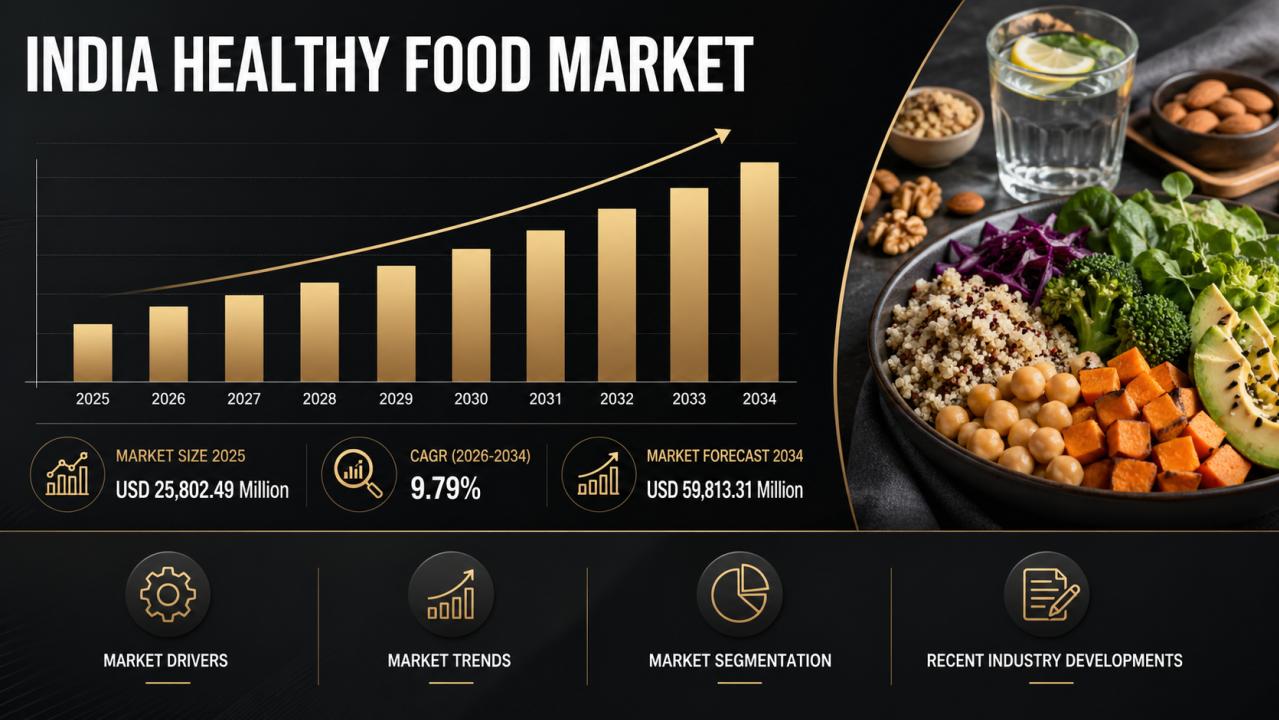
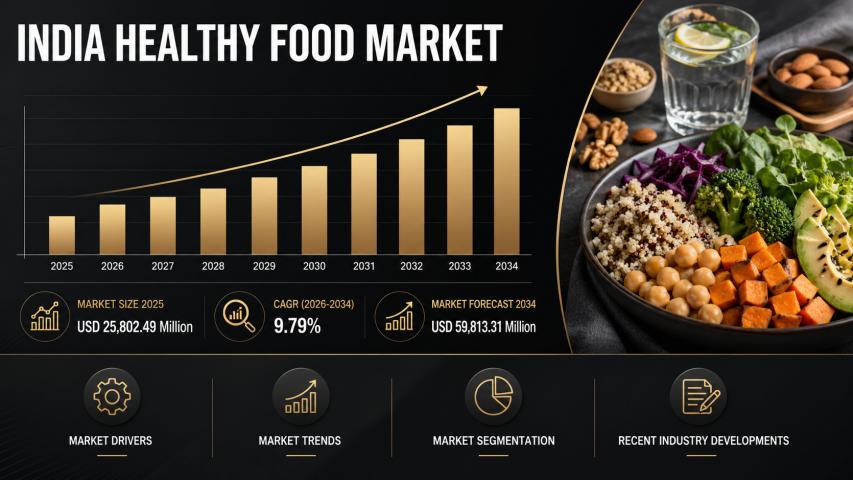
- Market Size in 2025: USD 25,802.49 Million
- Expected Size by 2034: USD 59,813.31 Million
- Compound Annual Growth Rate (CAGR): 9.79% (2026-2034)
- Leading Region: North India (33.8% Share)
- Leading Product Type: Organic Foods
- Leading Distribution Channel: Supermarkets & Hypermarkets (36.7% Share)
What is the Industry Overview?
The India healthy food market size was valued at USD 25,802.49 Million in 2025 and is projected to reach USD 59,813.31 Million by 2034, growing at a compound annual growth rate of 9.79% from 2026 to 2034. Robust market expansion is driven by escalating health consciousness, rising disposable incomes, rapid urbanization, and increasing awareness regarding the health benefits of nutritious food products. A strategic shift toward preventive healthcare, alongside rising life>
What are the Growth Drivers & Market Restraints?
What is driving the market?
- Rising Health Consciousness and Preventive Healthcare Awareness:
Urban consumers, particularly millennials and Gen Z, are increasingly adopting functional foods, dietary supplements, and fortified items to manage chronic conditions like diabetes, obesity, and cardiovascular diseases. This transition from reactive treatment to proactive preventive nutrition creates sustained long-term demand for clean-label, immunity-boosting, and gut-health solutions.
- Government Initiatives and Regulatory Support:
Regulatory frameworks actively foster market trust, such as the January 2025 revised standards under the National Programme for Organic Production that aligned organic agricultural products with European Union grades. Supportive government schemes including Paramparagat Krishi Vikas Yojana, Jaivik Bharat certifications, and stricter FSSAI labeling mandates ensure greater transparency and industry quality standards.
- Urbanization and Rising Disposable Incomes:
Rapid urban growth projected to encompass nearly 600 million city residents by 2036 combined with rising disposable incomes is driving consumer spending on premium health foods. Metropolitan areas including Mumbai, Bangalore, Delhi-NCR, Pune, Hyderabad, and Chennai lead retail demand for organic packaged items, beverages, dairy, and healthy snacks, reflecting a higher willingness to pay for premium nutritional products.
What are the main challenges?
- High Cost of Healthy Food Products:
Premium price points associated with organic and functional food items create a significant barrier to widespread adoption, particularly among price-sensitive consumer groups. This pricing gap restricts retail penetration in semi-urban and rural areas, where spending decisions consistently prioritize affordability over health benefits.
- Limited Consumer Trust in Labeling Transparency:
A lack of clear verification mechanisms and persistent suspicion regarding unverified health claims or organic certifications hamper market momentum. The proliferation of fake or low-quality products degrades overall consumer trust, creating reluctance to pay premium prices or make repeat purchases.
- Supply Chain and Distribution Challenges:
Inadequate supply chain infrastructure and weak cold chain logistics hinder product distribution, especially when serving remote and rural regions. The requirement to maintain strict organic standards during transit, combined with post-harvest losses, negatively impacts product freshness, inventory reliability, and nationwide accessibility.
➤ Request Sample Report (TOC & Charts)
Who are the Leading Companies?
The India healthy food market exhibits a moderately fragmented competitive structure characterized by both multinational corporations and domestic players competing across multiple product categories and pricing tiers. Market participants focus on continuous product innovation, securing organic certifications, forming strategic partnerships, and expanding direct-to-consumer and e-commerce distribution channels to strengthen market reach. Industry players also utilize strategic acquisitions to scale operations, as demonstrated by Tata Consumer Products acquiring Organic India in January 2024 to consolidate its Health and Wellness platform.
- Amul (National Cooperative Organics Limited)
- Organic India
- Tata Consumer Products
What is the Market Segmentation Breakdown?
By Product The market is segmented into Functional Foods, Organic Foods, BFY Foods, and Others.
- Leading Segment: Organic Foods dominated as the largest product segment in 2025. Segment growth is powered by expanding health consciousness, sustainability awareness, and rising concerns regarding chemical pesticides and fertilizers. Consumers increasingly demand ingredient transparency and chemical-free foods formulated without artificial additives or genetically modified organisms. Furthermore, corporate investments in agritech, QR-code-based traceability platforms, and supportive government programs like the National Programme for Organic Production and Paramparagat Krishi Vikas Yojana accelerate segment development.
By Distribution Channel The market is segmented into Supermarkets & Hypermarkets, Convenience Stores, Specialty Stores, and Online Retailers.
- Leading Segment: Supermarkets & Hypermarkets led the market with a 36.7% share in 2025. This leadership is supported by their ability to offer a broad assortment of certified organic, clean-label, and health-focused items under one roof. Consumers favor these modern retail formats for the convenience of label comparison, physical product inspection, and trusted shopping environments. The expansion of organized retail in high-footfall urban centers, coupled with strong supply chain networks, strategic in-store sampling, and health-focused private label offerings, sustains their market dominance.
By Region The market is segmented into North India, South India, East India, and West India.
- Leading Segment: North India represented the largest segment with a 33.8% market share in 2025. Dominance in the region is driven by higher disposable incomes, well-established retail infrastructure, and dense urban population centers across the Delhi-NCR region. Growing awareness of life>
Customization Note: If you require any specific information not covered within this report's scope, we will provide it as part of the customization.
Strategic Insight & Verdict
Through our analysis, we at IMARC Group observe that the India healthy food market is witnessing robust growth, driven by increasing health awareness, rising disposable incomes, rapid urbanization, and a growing shift toward preventive healthcare. Government support for organic farming, stricter food safety regulations, and rising demand for clean-label and functional food products are further strengthening market opportunities. Companies focusing on organic certifications, product innovation, transparent labeling, and omnichannel distribution are expected to strengthen their competitive position over the forecast period.