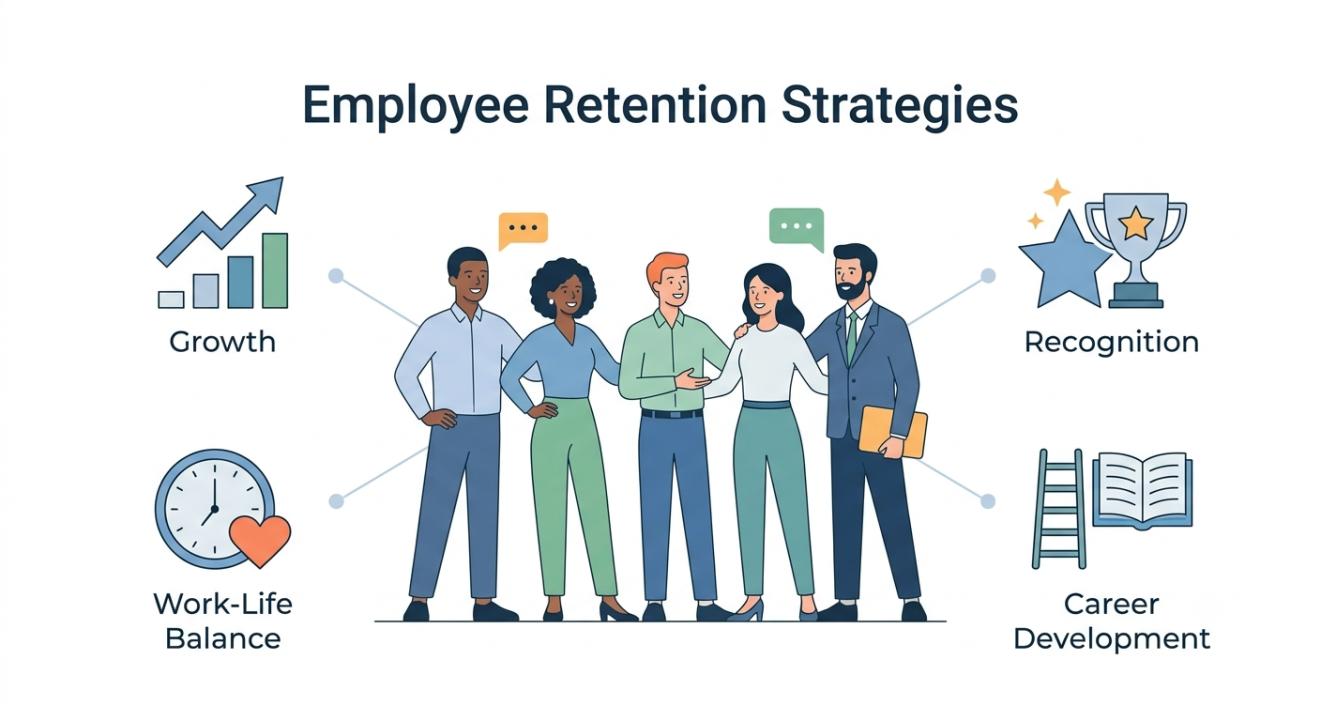
Half your best people are quietly looking for the door, and you may not know it until they've already accepted another offer. Gallup research consistently shows that a majority of employees are either not engaged or actively disengaged at work, and that the cost of replacing a single employee can run anywhere from half to twice their annual salary. If you're a manager or HR leader wondering why turnover keeps climbing despite competitive pay, the answer usually isn't money; it's everything surrounding it. The right employee retention strategies don't just patch the problem; they reshape the entire employee experience so people actually want to stay.
Why Most Retention Efforts Fall Short
Companies default to perks like free lunches, gym memberships, a foosball table when what employees actually want is to feel respected, heard, and like their work means something. Perks are visible. Culture, growth, and trust are harder to build, which is exactly why most organizations skip straight to what's easy.
The strategies below aren't quick fixes. They're structural changes that address why people leave in the first place.
1. Fix the Manager Problem First
Employees don't leave companies; they leave managers. This is the most-cited finding in workplace research, and it holds up because most organizations promote strong individual contributors into leadership roles without equipping them with the tools actually to lead.
Poor management shows up in subtle ways: unclear expectations, no recognition, micromanagement, favoritism, or simply never checking in. Any one of those can drive a high performer to start polishing their resume.
What to do: Invest in management training that goes beyond compliance modules. Teach your managers how to give feedback, have difficult conversations, and run effective one-on-ones. Then actually measure manager effectiveness through team surveys and hold people accountable for the results.
2. Build Genuine Career Growth Paths
One of the most common exit interview answers is some version of "I didn't see a future here." That's not just about promotions; it's about whether people feel like they're learning, advancing, and building toward something.
Growth doesn't always mean climbing a hierarchy. Lateral moves, skill development, stretch projects, and mentorship all signal that the organization is invested in someone's long-term trajectory.
What to do: Have direct, honest conversations with each employee about where they want to go. Create individual development plans with specific milestones. Give people access to learning resources, internal or external, and let them use work time to develop new skills.
3. Pay People What They're Actually Worth
Pay doesn't motivate in a vacuum, but underpaying someone is a reliable way to lose them. The moment a high performer discovers their market value is 20% higher than their current salary, you've started a countdown clock.
Compensation reviews that occur only during annual performance cycles are too slow. Markets move. A salary that felt fair 18 months ago may now be quietly creating resentment.
What to do: Benchmark salaries against current market data at least annually, more frequently in high-demand roles. Be proactive about adjusting pay before people ask. Consider pay transparency where it makes sense; it reduces the sense that salaries are arbitrary and unfair.
4. Make Flexibility Non-Negotiable
Remote and hybrid work removed any remaining pretense that everyone needs to be in the same building from 9 to 5 to be productive. Employees who've experienced flexibility aren't willing to give it up, and organizations that require rigid schedules without a compelling reason are voluntarily shrinking their talent pool.
Flexibility also isn't just about location. Schedule flexibility: the ability to handle a doctor's appointment or school pickup without drama matters enormously to employees with families or non-traditional lives.
What to do: Define what flexibility actually looks like for each role, and be honest about constraints. Give people as much autonomy over how, when, and where they work as the job genuinely allows. Avoid hybrid arrangements that are "flexible in name only."
5. Recognize People in Ways That Actually Land
Recognition is massively underused as a retention tool, mostly because it's done poorly. Generic "Employee of the Month" plaques and mass emails rarely make anyone feel seen.
Effective recognition is specific, timely, and tied to actual behavior. "Great job this quarter" means nothing. "The way you handled that difficult client call last week, and the way you kept the team calm through it, that was exactly what we needed" means everything.
What to do: Train managers to publicly and specifically recognize contributions. Create peer recognition channels. Consider small but meaningful spot bonuses for exceptional work. The goal is to make employees feel that good work gets noticed, not just tolerated.
6. Take Wellbeing Seriously — Beyond the Wellness App
Offering a meditation app subscription while routinely expecting employees to work 60-hour weeks is not a wellbeing strategy. It's a PR move. Employees see through it.
Burnout is one of the top drivers of voluntary turnover, and it builds slowly. By the time someone quits due to burnout, the signs are usually there months earlier: disengagement, missed deadlines, reduced communication.
What to do: Monitor workloads actively and address overload before it becomes chronic. Encourage managers to model healthy work habits: logging off on time, using vacation, not sending emails at 11 PM. Normalize conversations about mental health, and make sure any mental health benefits are genuinely accessible.
7. Create Psychological Safety on Teams
Employees who feel like they'll be punished for speaking up, asking questions, or admitting mistakes don't stay, or if they do, they check out. Psychological safety, a concept studied extensively by Google's Project Aristotle, is one of the strongest predictors of high team performance.
It's not about making everyone comfortable all the time. It's about creating an environment where people feel safe enough to take risks, challenge bad ideas, and bring their actual thinking to work.
What to do: Model vulnerability from the top leaders who admit mistakes, creating permission for others to do the same. Respond to dissent and bad news with curiosity rather than defensiveness. Recognize and reward people who raise concerns, not just those who deliver good news.
8. Improve the Onboarding Experience
The decision to stay or leave often begins to take shape within the first 90 days. Employees who have a disorganized, confusing, or isolating onboarding experience start wondering what they've gotten into long before they're even fully productive.
A strong onboarding experience isn't just about paperwork and system access. It's about helping someone quickly understand the culture, build relationships, and see how their work connects to the bigger picture.
What to do: Assign a buddy or mentor to every new hire. Create a structured 30-60-90 day plan with clear milestones. Check in frequently during the first few months and actively ask what isn't working. First impressions are hard to undo.
9. Make Exit Data Actually Useful
Most organizations collect exit interview data and file it away. The employees who leave often know exactly what's broken and they're finally willing to say it because they have nothing to lose. That's a valuable signal that's routinely wasted.
Exit interviews, done well, can surface patterns that performance reviews and engagement surveys miss. If three people in the same department cite the same manager in the same quarter, that's not a coincidence.
What to do: Standardize exit interviews with consistent questions. Analyze the data by team, manager, tenure, and role type, not just in aggregate. Act on patterns you find, and close the loop by communicating what changes were made. If nothing changes, the data collection is theater.
10. Ask People What Would Make Them Stay — Before They Leave
Stay interviews are one of the most underleveraged retention tools available. The idea is simple: instead of waiting for someone to resign and then asking why they're leaving, you ask proactively while they're still there what keeps them at the company and what might make them consider leaving.
The answers are usually actionable. People will tell you if they're feeling unchallenged, underpaid, or overlooked if you actually ask and actually listen.
What to do: Schedule short, informal stay conversations with employees at least once a year, more frequently for high performers. Ask questions like: "What's your favorite part of your work right now?" and "Is there anything that might pull you away from this role?" Then follow through on what you hear.
Putting It Together: Retention Is a System, Not a Program
No single strategy on this list will move the needle on its own. Retention is the result of dozens of daily decisions about how managers behave, how work is structured, whether contributions are noticed, and whether people feel they belong. The organizations that do this well treat retention as an ongoing discipline, not an annual initiative.
Start with the areas where you're losing the most people and work backward. Exit data, stay interviews, and engagement surveys will tell you where to focus. Then build systems, manage accountability, develop career infrastructure, and provide fair compensation that make people want to build their careers with you rather than somewhere else.
Frequently Asked Questions
What is the most effective employee retention strategy?
The single most impactful strategy is improving direct management quality. Research consistently shows that the manager-employee relationship is the strongest predictor of whether someone stays or leaves. Everything else pay, perks, flexibility becomes less effective when the immediate management experience is poor.
How do you retain employees without raising salaries?
Non-monetary retention factors include career development opportunities, flexible work arrangements, stronger recognition practices, improved management quality, and the creation of genuine psychological safety. Pay matters, but employees regularly cite growth and respect over compensation when explaining why they stay at a job long-term.
What causes high employee turnover?
The most common causes are poor management, lack of career growth, below-market compensation, burnout from excessive workloads, and a culture where employees feel unheard or undervalued. Often, multiple factors compound over time before someone actually resigns.
How do you measure employee retention?
Retention rate is typically calculated as (employees at the end of the period/employees at the start of the period) × 100. Track this by department, manager, tenure band, and role type to identify where turnover is concentrated. Exit interview data and engagement survey scores add qualitative context to the numbers.
When should you start focusing on employee retention?
Immediately and continuously. Retention efforts that only kick in when someone hands in their notice are too late. Proactive strategies like stay interviews, career development conversations, and manager coaching are far more effective than reactive ones. High performers are almost always being recruited externally, whether you know it or not.