Walk down almost any stretch of Sukhumvit Road, and you'll see the same word on shopfront after shopfront: "bespoke." It's on tourist-facing sandwich boards, luxury ateliers, and everything in between — which is precisely the problem. In Bangkok's tailoring scene, "bespoke" gets used so loosely that it's stopped functioning as a meaningful description. Here's what the terms are actually supposed to mean, and why the difference matters more than it sounds like it should.
Bespoke: Built From Nothing
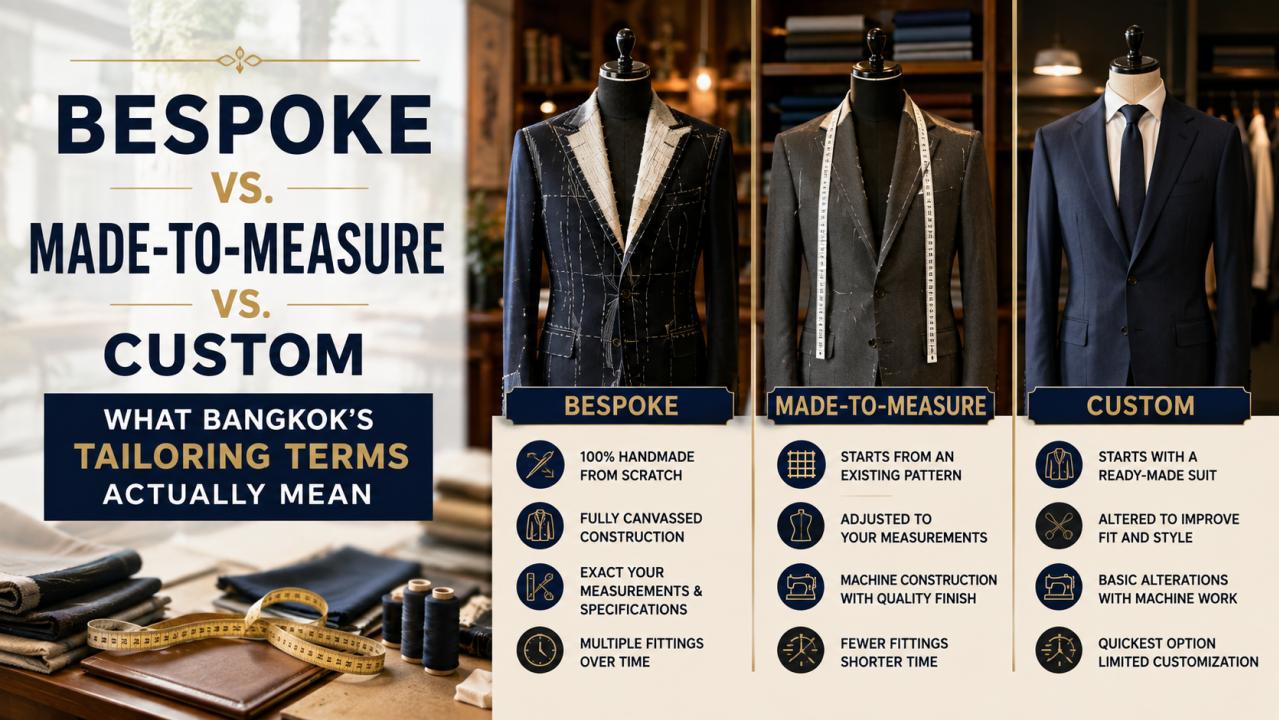
True bespoke tailoring starts with a blank sheet — literally. A bespoke tailor drafts an individual paper pattern for you, from scratch, based on your exact measurements, posture, and the way you carry your body. No existing template, no adjusted base size. That pattern is then cut and constructed specifically for you, usually with multiple fitting sessions along the way to refine shape, drape, and structure before the garment is finished.
This is also the most labor-intensive and time-consuming option, which is why genuinely bespoke suits in Bangkok typically involve at least two or three fittings spread across several days, not a same-day turnaround. It's also, generally, the most expensive tier — you're paying for a pattern that exists nowhere else and will never be reused for another customer.
Made-to-Measure: A Template, Adjusted
Made-to-measure (MTM) starts from a different point entirely: an existing standard pattern, which is then modified according to your measurements. Think of it as a middle ground between off-the-rack and full bespoke — you're getting a garment shaped around your body, but the underlying architecture of the pattern was designed for a general size range first, then altered, rather than built individually from the start.
This distinction matters practically. MTM garments are faster and cheaper to produce because the tailor isn't drafting a pattern from zero — and for many buyers, particularly those with a fairly standard body shape, the end result is genuinely close to bespoke in fit and appearance. Where MTM tends to fall short is on unusual proportions or specific postural quirks, since the base pattern can only be adjusted so far before the compromises start to show.
Custom Tailoring: The Catch-All Term
"Custom tailoring" is the loosest term of the three, and that's exactly why so many Bangkok shopfronts use it. Depending on the shop, "custom" might mean genuine bespoke, might mean made-to-measure, or might mean something closer to a limited set of pre-made templates with minor tweaks. The term itself doesn't guarantee anything about the underlying process — which is precisely why it shows up so often on tourist-facing signage. It sounds premium without committing to a specific standard.
Why This Actually Matters When You're Buying
None of this is academic. The construction method behind whichever term a shop uses directly affects three things you'll notice for years after you leave Bangkok:
Fit longevity. A bespoke pattern is built around your specific body, so as your body changes slightly over time, a skilled tailor working from your original pattern can adjust the garment accordingly. An MTM garment built from a generic base has less room for that kind of long-term refinement.
Structural quality. True bespoke construction typically uses full or half-canvas interiors — a layer of natural material inside the jacket that shapes itself to your body over time and improves with wear. Cheaper "custom" suits often use fused construction instead, where the canvas is glued rather than sewn in place; it looks fine on day one but tends to bubble or separate from the fabric after repeated wear and dry cleaning.
What you're actually paying for. Once you understand the difference, a wide price gap between two shops both advertising "custom suits" makes a lot more sense — one is likely doing genuine bespoke work with multiple fittings and canvas construction, while the other is producing a faster, simpler garment at a lower price point. Neither is inherently a scam; the problem is only when a shop charges bespoke prices for made-to-measure work.
How to Ask the Right Question
The most useful thing a visitor can do before committing to a shop is skip the marketing language entirely and ask directly: "Is this a full bespoke pattern, or an adjusted base pattern?" and "Is the construction canvassed or fused?" A tailor confident in their process will answer both questions specifically and without hesitation. Vague or deflective answers are the real red flag — far more than which word happens to be printed on the shop sign.
Once you know what questions to ask, it also helps to compare how different shops approach their services, construction, and pricing. A side-by-side look at some of Bangkok’s leading tailors can give you useful context before you sit down for a consultation.
Understanding these three terms won't make choosing a Bangkok tailor instant or effortless — there's still real variation in skill and quality within each category. But it does mean you'll be evaluating shops on what they're actually offering, rather than on which buzzword happened to catch your eye from the street.