Choosing bike insurance is an
important financial decision, particularly when you want protection beyond
mandatory third-party liability coverage. A comprehensive bike insurance policy
can cover a range of risks involving your own two-wheeler, along with
third-party liabilities, subject to the policy terms.
However, comparing comprehensive
bike insurance policies can be challenging when insurers offer
different premiums, coverage limits, deductibles, add-ons, and claim
conditions. The cheapest policy may not always provide the protection you need,
while the most expensive policy may include features that are unnecessary for
your circumstances.
Knowing what to compare can help you
select coverage based on value rather than price alone.
What
Is Comprehensive Bike Insurance?
Comprehensive bike insurance
generally combines third-party liability protection with coverage for damage to
your own bike arising from insured events. Depending on the policy, protection
may include accidents, theft, fire, natural calamities, and certain man-made
events.
The exact coverage differs between
policies, so it is essential to read the policy wording before purchasing.
A comprehensive policy does not mean
that every possible loss is automatically covered. Exclusions, deductibles,
coverage limits, conditions, and claim requirements continue to apply.
Why
Should You Compare Comprehensive Bike Insurance Policies?
Insurance policies can look similar
at first glance but differ considerably in their terms and benefits.
Comparing policies can help you:
- Identify coverage that matches your requirements
- Understand differences in premiums
- Evaluate useful add-ons
- Check deductibles and exclusions
- Understand the claim process
- Assess repair and service options
- Avoid paying for unnecessary features
The goal should be to find a balance
between adequate protection, affordability, and service quality.
1.
Compare the Coverage First
The first and most important factor
is the extent of coverage.
Check whether the policy covers
risks relevant to your bike, such as:
- Accidental damage
- Theft
- Fire
- Floods and other natural calamities
- Certain man-made events
- Third-party liability
Do not assume that two comprehensive
policies provide identical protection. Read the inclusions and conditions
carefully.
If you frequently ride in areas
prone to flooding, for example, understanding how the policy treats damage
caused by water or natural calamities can be particularly important.
2.
Look at the Insured Declared Value
The Insured Declared Value, or IDV,
is an important consideration when comparing comprehensive policies.
Broadly, IDV represents the insured
value of the vehicle for certain total-loss or theft claims, subject to the
policy terms and applicable deductions. It is generally linked to the vehicle's
age and value.
A policy with a very low IDV may
have a lower premium, but it could also mean lower potential settlement for an
eligible total-loss or theft claim.
Therefore, do not choose a policy
simply because its premium is lower. Check whether the IDV is reasonable for
your bike.
3.
Compare the Premium Carefully
Premium is naturally an important
consideration, but it should not be the only deciding factor.
When comparing premiums, check
whether the policies offer broadly comparable coverage. A lower premium could
reflect differences in IDV, deductibles, add-ons, coverage, or other policy
factors.
Instead of asking, “Which policy is
cheapest?”, consider asking, “Which policy provides the protection I need at a
reasonable cost?”
This approach can help you focus on
value rather than price alone.
4.
Evaluate Deductibles
A deductible is the portion of an
eligible claim that you are required to bear, according to the policy.
There may be a compulsory
deductible, while some policies may also allow you to choose a voluntary deductible.
A higher voluntary deductible can
sometimes reduce the premium. However, it also increases your financial
responsibility when you make a claim.
Before selecting a policy, make sure
you understand both the compulsory and voluntary deductible and assess whether
you can comfortably afford the applicable amount.
5.
Compare Add-On Covers
Add-ons can extend the protection
provided by a comprehensive bike insurance policy.
Depending on the insurer and policy,
available add-ons may include:
- Zero depreciation cover
- Roadside assistance
- Engine protection
- Consumables cover
- Return-to-invoice cover
- Personal accident-related extensions, where applicable
Not every rider needs every add-on.
For example, an owner of a relatively new bike may have different requirements
from someone riding an older two-wheeler.
Compare the additional premium with
the potential benefit and choose only covers that make sense for your usage and
risk profile.
6.
Check Policy Exclusions
Exclusions explain circumstances in
which the insurer may not provide coverage.
These can vary depending on the
policy but may relate to situations such as driving without a valid licence,
certain types of consequential losses, intentional damage, or using the vehicle
outside permitted conditions.
Understanding exclusions before
purchasing is critical.
A policy should not be judged solely
by the number of benefits advertised. Knowing the limitations of those benefits
is equally important.
7.
Examine the Claim Process
The real value of insurance becomes
apparent when you need to use it.
Before buying a policy, understand
how claims are reported, what documents may be required, whether inspection is
necessary, and how repairs are handled.
You should also understand the process
for theft and total-loss claims, as these can involve additional documentation
and verification.
A straightforward and clearly
explained claim process can make a significant difference during a stressful
situation.
8.
Consider Cashless Repair Facilities
If a policy provides access to a
network of cashless garages, check whether suitable repair facilities are
available in locations where you regularly ride or live.
The size of a network is not the
only consideration. The availability of relevant garages near you can be more
useful than a large network that is difficult for you to access.
Check the policy terms to understand
how cashless repairs work and whether any conditions or limits apply.
9.
Review No Claim Bonus Benefits
If you have not made eligible claims
during the previous policy period, you may qualify for a No Claim Bonus (NCB),
subject to applicable terms.
When comparing renewal options,
understand how your NCB is treated and what happens if you make a claim.
If you are switching insurers, check
the process for carrying forward your eligible NCB. Keeping accurate records of
your previous policy and claims history can help during renewal or purchase.
10.
Read the Policy Terms Before Buying
Once you have shortlisted policies,
do not make the final decision based solely on the comparison page or premium
quotation.
Read the policy wording and
understand:
- Coverage limits
- Exclusions
- Deductibles
- Claim conditions
- Add-on terms
- IDV
- Renewal conditions
- Required documents
Insurance is a contract, and the policy
wording defines the scope of protection.
Common
Mistakes to Avoid When Comparing Policies
Several mistakes can lead to
inadequate coverage:
Choosing only the lowest premium: A cheaper policy may have different coverage or a lower
IDV.
Ignoring exclusions: Not understanding exclusions can create unrealistic
expectations during a claim.
Buying unnecessary add-ons: Additional covers increase premiums, so select them based
on actual needs.
Choosing an unsuitable deductible: A high voluntary deductible may save money upfront but
increase your out-of-pocket cost during a claim.
Providing incorrect information: Always provide accurate vehicle and personal details when
purchasing insurance.
Waiting until the last moment to
renew: Late renewal can result in a break
in coverage and may require additional formalities depending on the
circumstances.
Conclusion
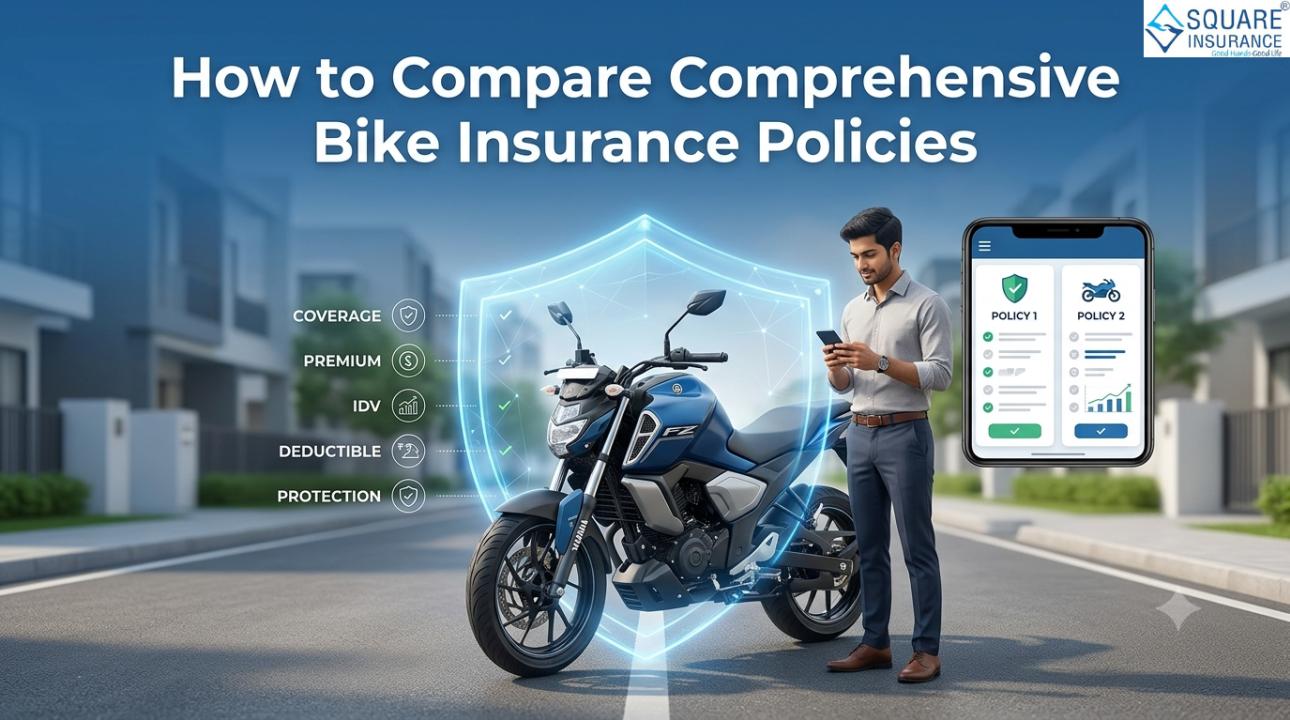
Comparing comprehensive bike
insurance policies requires more than checking premium prices. The right
comparison should consider coverage, IDV, deductibles, exclusions, add-ons,
claim procedures, repair facilities, and other policy conditions.
Your ideal policy should provide
meaningful protection without unnecessary costs. Take the time to understand
what each policy covers, what it excludes, and how claims are handled before
making a decision.
Square
Insurance can help bike owners evaluate their
insurance requirements and make a more informed choice. However, always review
the applicable policy wording, terms, conditions, inclusions, exclusions, and
other details before purchasing a policy.
Frequently
Asked Questions
1.
What should I compare when buying comprehensive bike insurance?
Compare coverage, premium, IDV,
deductibles, exclusions, add-ons, claim procedures, repair facilities, and
applicable NCB benefits. The policy offering the right balance of protection
and cost may be more suitable than the cheapest option.
2.
Is a lower bike insurance premium always better?
No. A lower premium may come with
differences in coverage, IDV, deductibles, or optional benefits. Compare
policies with similar coverage before deciding.
3.
What is IDV in comprehensive bike insurance?
IDV stands for Insured Declared
Value. It broadly represents the insured value of the bike for certain theft or
total-loss claims, subject to the policy terms and applicable deductions.
4.
Should I choose all available add-ons?
Not necessarily. Add-ons should be
selected according to your bike, riding habits, location, age of the vehicle,
and financial requirements. Unnecessary add-ons can increase the premium
without providing meaningful value for your situation.
5.
What is a deductible in bike insurance?
A deductible is the amount you are
required to bear towards an eligible claim, as specified in the policy.
Depending on the policy, it may include a compulsory deductible and an optional
voluntary deductible.
6.
Does comprehensive bike insurance cover theft?
Comprehensive policies generally
include protection against theft, subject to policy terms, conditions,
exclusions, and the claim process. Check the specific policy wording for
details.
7.
Can I compare bike insurance policies online?
Yes. Online comparisons can make it
easier to review premiums, coverage options, add-ons, and other policy
features. However, always read the final policy terms before purchasing.
8.
Why are policy exclusions important?
Exclusions identify circumstances or
losses that are not covered. Understanding them helps you set realistic
expectations about the protection provided by your bike insurance policy.
9.
How can I choose the right comprehensive bike insurance policy?
Start by assessing your bike's
value, usage, location, and risk exposure. Then compare coverage, IDV, premium,
deductibles, add-ons, exclusions, claim procedures, and service facilities
before selecting a policy.