In the modern business world, there is a constant need for communication. From corporate boardrooms to bustling retail floors, visual communication shapes how customers and employees receive information. Businesses have to provide accurate, clear, real-time information. For decades, liquid crystal displays dominated this field. If you take a look at any of today's modern cities, you will see these bright screens everywhere.
But there is a significant transformation taking place in the corporate world right now. Organizations are increasingly under pressure to decrease their carbon footprint and lower their operational costs. At the same time, screen fatigue makes consumers ignore traditional, flashing digital monitors. This shift has pushed a new technology into the spotlight. The use of an e-paper display for commercial signage is changing the way today's businesses communicate public data.
This extensive guide explains the essence of the distinction between these two visual technologies. Total cost analysis, energy metrics, functional limitations, and practical corporate use cases will be studied. By the end, your procurement and facilities teams can make a highly profitable, future-proof choice.
Understanding the Core Technologies
Your engineering and marketing staff needs to be aware of how these tools operate before implementing a substantial capital investment. The actual differences between these screens are what determines their performance and operational expenses in real life.
How E-Paper Works
Electronic paper mimics the appearance of ordinary ink on paper. It employs a reflective bistable technology, unlike standard monitors. The screen contains millions of tiny microcapsules filled with charged electrical pigments. An electric charge moves these pigments to the surface to create text and images.
Once the pigments move into position, they stay there without using any more electricity. Only power is used when content changes. This unique feature makes it a champion of digital signage energy efficiency. It can only be illuminated by the surrounding room light or natural light from the sun.
How Traditional LCD Works
Liquid crystal displays operate on an entirely opposite engineering principle. An LCD is based on a continuous strong light source, which typically is Light Emitting Diodes (LEDs) behind a matrix of liquid crystals. These crystals serve as tiny shutters that can be opened or closed to stop or allow light to pass through to create color pixels.
This means the screen continuously draws power from the grid for as long as it remains on. It emits bright light directly toward the viewer. This enables vibrant video playback but significantly increases continuous power demand on your infrastructure.
Direct Comparison: E-paper Display vs LCD
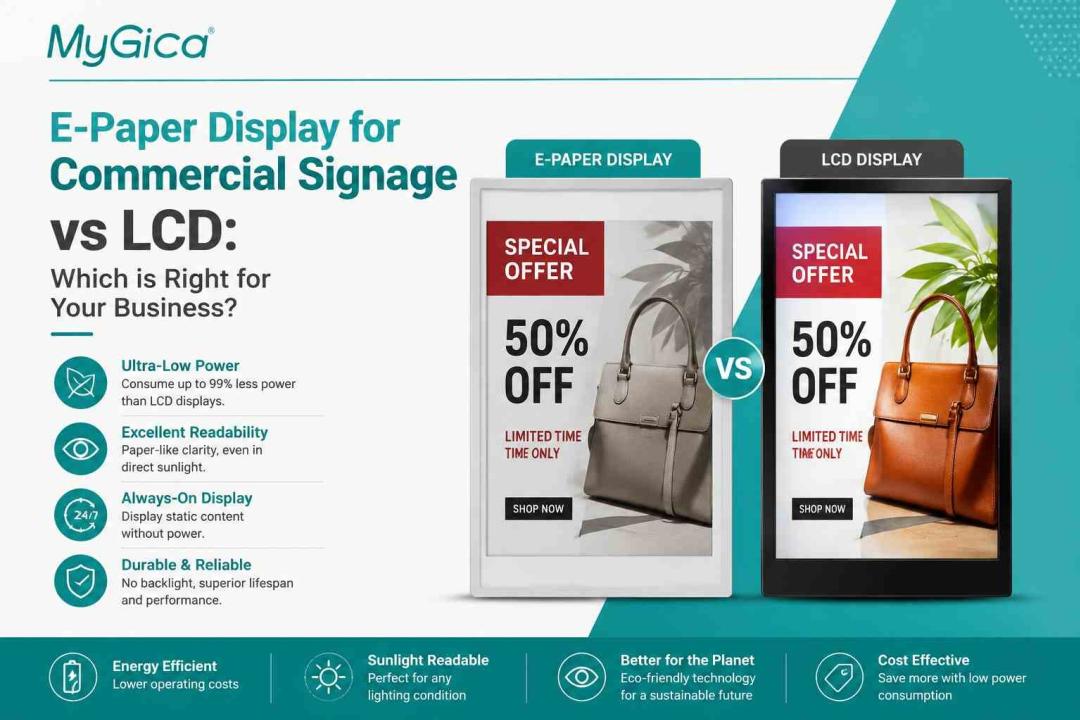
It is important to consider the entire lifecycle performance when choosing the next hardware layout. Let's compare e-paper displays and LCDs across key operational factors.
Feature / Metric | E-paper display | Traditional LCD Screen |
Power Consumption | Near zero; only draws power during content updates | High and continuous; requires constant backlight power |
Sunlight Readability | Excellent; becomes clearer in bright outdoor sunlight | Poor; suffers from heavy glare and screen washout |
Content Capabilities | Static images, text, grayscale, or muted color charts | Full-motion video, high refresh rates, vibrant colors |
Heat Generation | Zero heat emissions during standard operation | Significant heat requires cooling fans or ventilation |
Installation Flexibility | Ultra-lightweight; often runs on small internal batteries | Heavy; requires dedicated AC power cables and mounts |
Key Benefits of E Paper Display for Commercial Signage
E-paper displays for commercial signage offer distinctive business benefits over regular televisions. Let's explore the business metrics that are relevant to your executive leadership team.
1. Extreme Operational Cost Savings
The most unique aspect of this technology is its unmatched power savings. It consumes minimal energy, making it one of the most power-efficient display options available. The typical electronic ink sign can last for months, and sometimes years, on a small battery pack.
This can dramatically reduce utility costs for large retail networks or transit systems with thousands of public information points. Immediate reductions in monthly operating costs will be apparent in your finance department.
2. Flawless Visibility in Outdoor Environments
The traditional digital screens are ineffective when exposed directly to sunlight. The glare obscures images and renders it difficult for passing pedestrians to read text. An outdoor electronic paper display is the solution to this, naturally.
It reflects the light from the surroundings just like paper does; actually, it gets sharper and easier to read in stronger sunlight. This way, your public announcements, transit schedules, and advertisements remain clear 24/7 without having to use anti-glare glass coatings that are costly and difficult to retrofit.
3. Simplified Wireless Deployment
The process of installing a standard digital sign requires the expertise of a skilled electrician who needs to run costly power cables through walls or concrete. Electronic paper units completely avoid this expensive step. They are designed to be lightweight and require very little power, so they can easily be installed anywhere using adhesive strips or lightweight brackets.
Information is updated automatically through standard wireless networks, such as Wi-Fi, Bluetooth, or cellular bands. With its quick and easy installation, you can reduce business downtime and deploy digital signage deployments in a matter of hours, allowing your operation teams to scale.
When is LCD still the better corporate choice?
Electronic paper is very efficient, but it is not a solution that fits all marketing situations. There are certain high-impact communication channels where traditional monitors are still strong.
LCD is still required if your marketing approach heavily depends on fast-paced, full-motion video ads, high-definition product trailers, or touch menus. Electronic paper has slow refresh rates, making it unsuitable for video playback. In addition, if your signs are placed in a dark setting where no other lights are available, a backlit display eliminates the need for additional spotlights.
Real-World Corporate B2B Use Cases
Sustainable digital signage is being used by visionary companies throughout various industries in the world to replace old paper printouts and energy-consuming screens.
Smart Retail Environments: Hypermarkets use electronic shelf labels throughout their miles of shelves. The miniature paper-like tags enable the central pricing software to change thousands of item prices instantly without printing physical labels, eliminating manual pricing errors.
Public Transportation Hubs: Smart cities use an outdoor electronic paper display at each bus stop and train platform. These units can be powered by solar energy and provide real-time updates on arrivals, eliminating the need for disruptive underground electrical cabling.
Corporate Office Management: Small wireless panels outside conference rooms in corporate headquarters display the daily meeting schedule. They can be synced straight to office calendar applications, letting users know precisely what rooms are accessible and eliminating the need for complex power cabling.
Important Implementation Challenges to Consider
When considering your company's growth, an honest assessment involves considering technology trade-offs. For one, the upfront cost per square inch of electronic paper is higher than mass-produced consumer television screens. Your procurement officers should, however, weigh this upfront cost against the significant power savings over a 5-year lifecycle.
Secondly, the range of colors is growing but limited. Advanced multi-color electronic inks do exist, but they don't have the same intense, saturated color gamuts as top-tier entertainment panels. Clarifying whether your messaging demands cinema-quality color or simply high-contrast text and clean graphics is essential.
Conclusion
The key to selecting the right display technology is to match your business objectives to your requirements and limitations in your environment. For video-intensive marketing campaigns in controlled indoor environments, traditional liquid crystal displays are still the best choice. But if the goal is to create digital signage systems that are resilient and will massively reduce long-term costs, then electronic ink is the clear winner.
An e-paper display for commercial signage offers superior readability in bright conditions, eliminates complex wiring needs, and reduces energy costs to a minimum. With these energy-efficient displays integrated into your facilities, you not only optimize your company's efficiency but also achieve the sleek corporate sustainability goals you've set.
Do you want to upgrade your business network to state-of-the-art, extremely efficient visual systems? Call the product specialists at MyGica today to find out more about your project requirements, to get a quote for custom hardware, or to get to know about their cutting-edge commercial display solutions – tailored for modern enterprise performance.
FAQs
Can an electronic paper display show full-motion video?
No, electronic paper technology has low refresh rates that have been engineered to refresh static text or images, not play video fluidly.
Does an outdoor electronic paper display work in complete darkness?
Electronic paper works well in most lighting conditions, and commercial versions may have built-in front lights to ensure readability in low-light conditions.
How much energy do low power consumption displays actually save?
These displays use up to 90 per cent less power than conventional displays and only consume electricity when changing the displayed content.
Are electronic shelf labels difficult to update across multiple store locations?
Not at all – central content management software updates thousands of wireless tags at a time over your entire global retail network in seconds.