India Human Resource (HR) Technology Market: Industry
Report 2026–2034
The India
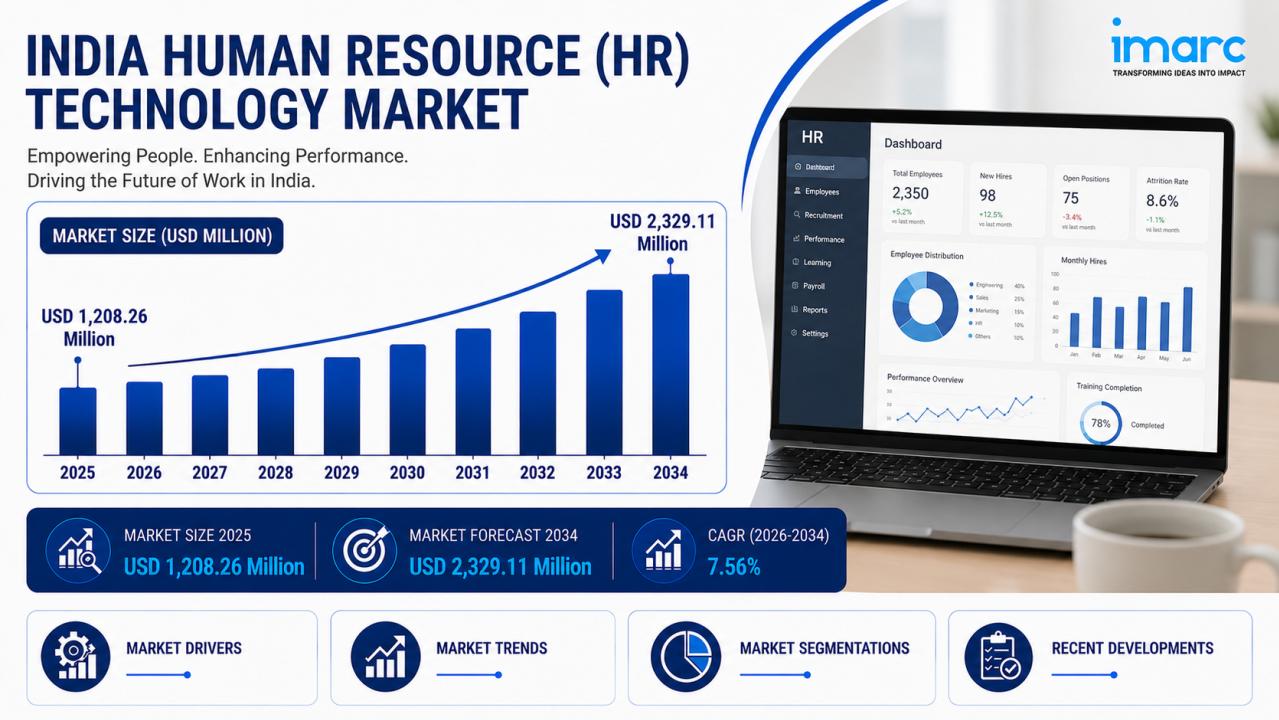
human resource (HR) technology market size increased from USD 1,208.26
Million in 2025 to USD 1,299.60 Million in 2026 and
is projected to reach USD 2,329.11 Million by 2034, exhibiting
a steady compound annual growth rate (CAGR) of 7.56% during
the 2026–2034 forecast period. The sector is experiencing a profound
structural evolution. Rapidly pivoting away from legacy, siloed administrative
software, Indian enterprises are aggressively adopting unified, AI-driven human
capital management (HCM) platforms. Driven by the normalization of hybrid
work models, the explosive growth of Global Capability Centers (GCCs), and an
intensifying war for top-tier talent, HR technology has transitioned from a
back-office utility into a highly strategic business necessity.
What Is the Size and Growth Forecast of the India Human
Resource (HR) Technology Market?
The market is exhibiting highly resilient, continuous
expansion, fundamentally anchored by massive corporate digitization and the
proliferation of affordable, cloud-based software-as-a-service (SaaS)
solutions.
- Market
Size in 2025: USD 1,208.26 Million.
- Market
Size in 2026: USD 1,299.60 Million.
- Market
Forecast in 2034: USD 2,329.11 Million.
- Compound
Annual Growth Rate (CAGR): 7.56% during the 2026–2034 forecast
period.
- Underpinning
Momentum: The rapid transition of Small and Medium Enterprises
(SMEs) toward automated payroll and compliance platforms, alongside
massive AI investments by enterprise IT leaders, guarantees a continuous,
high-volume domestic procurement pipeline.
What Are the Latest Emerging Trends in the India Human
Resource (HR) Technology Market?
- Deployment
of Agentic and Generative AI in Recruitment:
Moving past basic keyword-matching Applicant Tracking
Systems (ATS), companies are heavily deploying Agentic AI. These advanced
systems autonomously scrape professional networks, conduct initial
conversational assessments via chatbots, and evaluate cultural fit, drastically
slashing the time-to-hire while actively eliminating human cognitive bias
during early screening.
- Transition
to Skill-Based Workforce Architectures:
The market is actively shifting from static, degree-based
job profiles toward dynamic "skill ontologies." Next-generation HR
platforms are mapping the granular skills of the entire workforce in real-time,
allowing internal talent marketplaces to seamlessly match existing employees to
gig projects or lateral roles, heavily boosting internal mobility.
- Holistic
Employee Experience (EX) Platforms:
Core HRMS is no longer sufficient. To combat severe
post-pandemic burnout, organizations are heavily investing in comprehensive EX
platforms. These dashboards integrate continuous pulse surveys, peer-to-peer
recognition, and hyper-personalized wellness programs, shifting the focus from
mere transactional management to deep employee engagement.
- Integration
of Gig and Contract Workforce Management:
As India's gig economy scales into the corporate sector,
legacy HR tools that only accommodate full-time employees are failing. The
market is witnessing a surge in unified workforce platforms specifically
engineered to seamlessly onboard, track compliance, and execute automated
payouts for a blended workforce of freelancers, consultants, and full-time
staff.
- Hyper-Personalized
Learning and Development (L&D):
AI is revolutionizing corporate training. By analyzing an
employee's performance metrics and stated career goals, intelligent Learning
Management Systems (L&D modules) now autonomously curate hyper-personalized
upskilling paths, recommending specific micro-learning modules directly within
the daily workflow.
Grab a sample copy of this report: https://www.imarcgroup.com/india-human-resource-technology-market/requestsample
What Growth Factors Are Driving the India Human Resource
(HR) Technology Market?
- The
Unprecedented Expansion of Global Capability Centers (GCCs):
The massive influx of Fortune 500 companies establishing
high-end R&D, engineering, and IT hubs (GCCs) across India acts as a
primary catalyst. These centers require hyper-scalable, globally compliant, and
highly secure HR technology stacks to rapidly onboard and manage geographically
dispersed top-tier talent.
- Democratization
of SaaS among Indian MSMEs:
The explosion of affordable, cloud-based HR software models
(featuring flexible per-user/per-month pricing) has fundamentally unlocked the
massive Micro, Small, and Medium Enterprises (MSME) segment. Organizations with
limited IT budgets are rapidly adopting streamlined platforms to digitize core
payroll and statutory compliance functions.
- Intensifying
War for Talent and High Attrition Rates:
Faced with brutal attrition rates in sectors like IT and
BFSI, corporate leaders are shifting budgets toward HR technology as a
strategic retention tool. Advanced predictive analytics are being deployed to
flag flight-risk employees before they resign, enabling HR to execute targeted
interventions.
- Permanent
Normalization of Hybrid Work Models:
The structural shift toward hybrid and remote work
necessitates robust, cloud-native HR architectures. Companies absolutely
require digital-first platforms to manage virtual collaboration, track remote
performance KPIs without micromanaging, and administer contactless benefits
across decentralized teams.
- Strict
Statutory Compliance and Data Digitization:
India's highly complex and frequently updated labor laws
require meticulous compliance regarding provident funds (PF), tax deductions
(TDS), and state-specific regulations. Automated payroll and compliance modules
drastically eliminate the legal and financial risks associated with manual
spreadsheet-based errors.
What Are the Key Challenges Facing the India Human
Resource (HR) Technology Market?
- Navigating
Strict Data Privacy Regulations:
The implementation of India's Digital Personal Data
Protection (DPDP) Act has introduced intense regulatory scrutiny. HR platforms
process highly sensitive employee data (financial, medical, and biometric).
Ensuring total encryption, localized data residency, and strict consent
management poses a massive structural and financial challenge for legacy
software providers.
- Severe
Integration Silos:
Many Indian enterprises suffer from "tool
fatigue," utilizing disconnected platforms for payroll, learning, and
recruitment. The inability of these disparate systems to communicate fluidly
via APIs creates severely fragmented data sets, frustrating HR personnel and
destroying the ROI of advanced predictive analytics.
- Change
Management and Low User Adoption:
Despite heavy capital expenditure on premium HR tech, user
adoption frequently stalls due to clunky user interfaces or deep-rooted
cultural resistance within older, traditional manufacturing and public sector
organizations. If the software is not intuitively designed, employees simply
bypass the system.
Explore the Full Report with Charts, Table of Contents,
and List of Figures: https://www.imarcgroup.com/india-human-resource-technology-market
Deep-Dive Segment Insights:
The market is meticulously segmented to address specific
administrative workflows, distinct enterprise architectures, and major
commercial verticals.
By Application
- Recruitment
(25.0% in 2025): The leading segment. This massive volumetric
share is driven by the absolute necessity to automate candidate sourcing,
resume parsing, and interview scheduling to maintain a competitive edge in
high-attrition industries.
- Talent
Management & Performance Management: High-growth segments
increasingly utilized by enterprises to map competencies, execute
continuous 360-degree feedback, and manage leadership succession
pipelines.
- Payroll
Management: The foundational segment, critical for absolute
compliance with India’s complex statutory taxation and labor frameworks.
- Workforce
Management & Others: Focused on time-tracking, rostering, and
shift management, particularly vital for the retail, manufacturing, and
hospitality sectors.
By Type
- Inhouse
(66.0% in 2025): Commands the absolute majority. Large-scale
enterprises heavily prefer inhouse (proprietary or heavily customized
on-premise/private cloud) deployments to maintain absolute sovereignty and
security over highly sensitive employee data.
- Outsourced: Rapidly
growing as startups and SMEs increasingly outsource their entire HR and
payroll tech stacks to Managed Service Providers (MSPs) to minimize IT
overheads.
By End Use Industry
- Information
Technology (32.0% in 2025): The undisputed market driver. The
sheer scale of India's IT and ITES workforce demands cutting-edge HCM
platforms for massive, continuous onboarding, bench management, and global
compliance.
- BFSI
(Banking, Financial Services, and Insurance): Demands highly
secure, deeply compliant HR solutions to manage massive, geographically
dispersed branch networks.
- Health
Care, Public Sector, and TTH (Travel, Transportation, Hospitality): Comprise
the remaining share, with TTH adopting agile workforce management tools
for highly fluctuating shift workers.
By Company Size
- Less
than 1k Employees (41.0% in 2025): Small and medium enterprises
dominate the market volumetrically. This is driven entirely by the
proliferation of highly affordable, scalable, subscription-based cloud
solutions designed specifically for businesses with limited internal IT
budgets.
- 1k
- 5k Employees & Greater than 5k Employees: Represent the
premium, high-margin enterprise segments requiring deep API integrations
and custom AI analytics.
By Region
- North
India (30.0% in 2025): Commands the highest regional market
share. This dominance is heavily anchored by the massive
concentration of corporate headquarters, immense IT hubs, and dense public
sector operations throughout Delhi-NCR and its surrounding corridors.
- South
India: Represents the most highly digitized market, driven by the
colossal tech and startup ecosystems spanning Bengaluru, Hyderabad, and
Chennai.
- West
& Central and East India: Comprise the remaining market, with
West India strongly supported by the massive BFSI and corporate
conglomerate base in Mumbai and Pune.
Competitive Landscape & Key Player Positioning:
Covering an in-depth analysis of the competitive landscape,
market structure, key player positioning, competitive dashboards, top winning
strategies, and detailed profiles of all major industry participants you will
gain access to all these exclusive insights within the full research report.
Recent Developments:
- Early
2026 (Compliance Overhauls for DPDP Act): In response to the
strict enforcement of India's Digital Personal Data Protection (DPDP) Act,
major domestic platforms like Darwinbox and Keka initiated massive
architectural overhauls. They aggressively rolled out advanced
consent-management modules and localized data encryption protocols to
ensure enterprise clients avoided severe regulatory penalties.
- 2025–2026
(Widespread AI Integration by IT Titans): Major Indian IT
powerhouses, including Infosys, TCS, and Wipro, successfully and
aggressively integrated Generative AI into their proprietary recruiting
and workforce management procedures. These deployments demonstrated
significant, measurable reductions in time-to-hire while drastically
improving cultural fit evaluations across massive candidate pools.
- 2025
(Massive SME Cloud Adoption): The domestic market witnessed a
massive surge in cloud-based HR tech adoption by Small and Medium
Enterprises (SMEs). Driven by subscription-based pricing models, smaller
companies rapidly abandoned manual spreadsheets in favor of automated
payroll and statutory compliance platforms, drastically expanding the
market's addressable base.
Customization Note: If you require any specific
information not covered within this report's scope, we will provide it as part
of the customization.
Request Report Customization: https://www.imarcgroup.com/request?type=report&id=3618&flag=E
FAQs
Q1. What is the current valuation of the India human
resource (HR) technology market?
The India human resource (HR) technology market grew
from USD 1,208.26 Million in 2025 to USD 1,299.60
Million in 2026.
Q2. What is the projected growth rate for this sector?
The market is projected to reach USD 2,329.11
Million by 2034, exhibiting a robust compound annual growth rate (CAGR
of 7.56%) during the 2026–2034 forecast period.
Q3. Which application segment commands the highest market
share?
The Recruitment application leads the
market with a 25.0% share (2025), driven by the intense corporate
need to automate talent acquisition, streamline resume parsing, and reduce
overall time-to-hire in a highly competitive job market.
Q4. Which end-user industry and company size drive the
most demand?
The Information Technology sector dominates
with a 32.0% share (2025), while companies with Less than
1k Employees constitute the largest organizational segment at 41.0%
(2025), fueled by the rapid adoption of affordable cloud SaaS models.
Q5. What are the primary factors driving the market's
rapid growth?
Key growth catalysts include the massive expansion of Global Capability Centers (GCCs) in India, the necessity to manage permanent hybrid workforces, high employee attrition driving the need for predictive retention analytics, and the democratization of affordable, cloud-based HR solutions among MSMEs.