India Elevator And Escalator Market: Industry Report 2026–2034
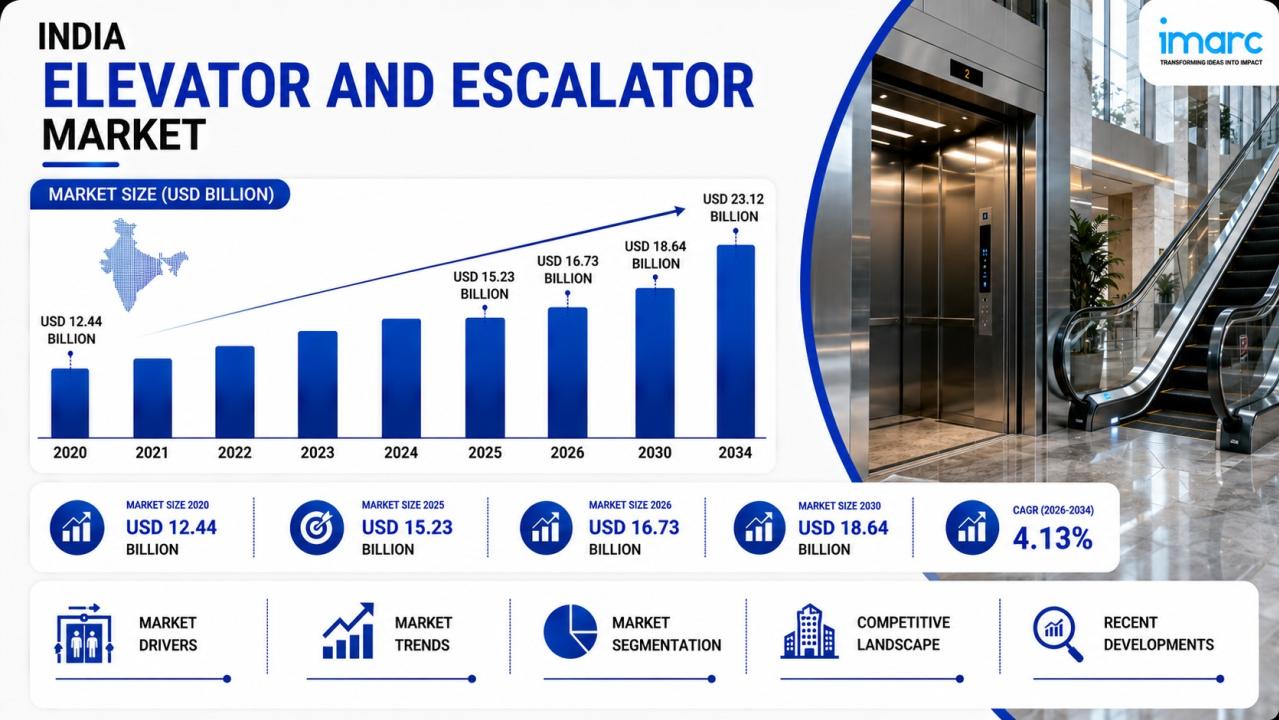
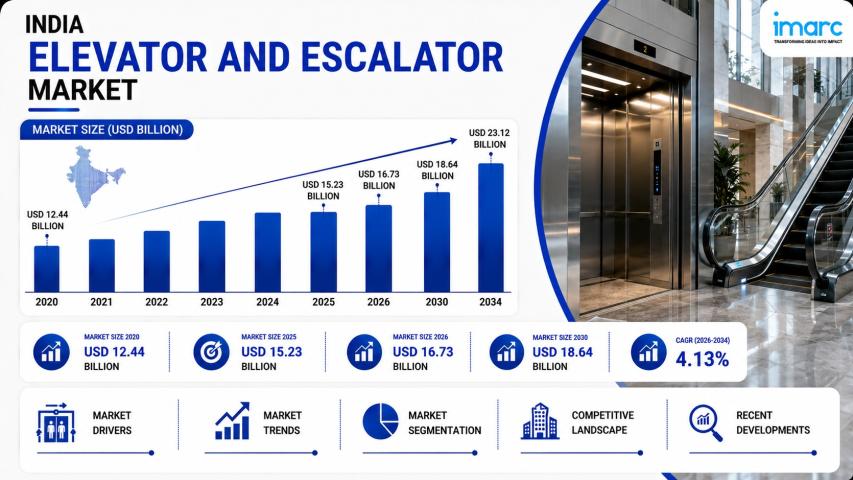
The India elevator and escalator industry size increased from USD 15.23 Billion in 2025 to USD 16.73 Billion in 2026 and is projected to reach USD 23.12 Billion by 2034, exhibiting a compound annual growth rate (CAGR of 4.13%) during the 2026–2034 forecast period. The industry is expanding steadily with India’s vertical urban growth. Driven by high-rise residential construction, metro rail expansion, commercial towers, and rising demand for safe, energy-efficient vertical transportation, elevators and escalators remain essential infrastructure across cities.
What Is the Size and Growth Forecast of the India Elevator And Escalator Market?
The market is exhibiting resilient, continuous expansion, fundamentally anchored by ongoing high-rise construction, metro projects, and the need for reliable vertical mobility in dense urban environments.
- Market Size in 2025: USD 15.23 Billion.
- Market Size in 2026: USD 16.73 Billion.
- Market Forecast in 2034: USD 23.12 Billion.
- Compound Annual Growth Rate (CAGR): 4.13% during the 2026–2034 forecast period.
- Underpinning Momentum: Strong residential high-rise pipeline, metro rail rollouts, commercial real estate growth, and increasing focus on modernization of aging lifts create steady demand for both new installations and service contracts across major cities.
What Are the Latest Emerging Trends in the India Elevator And Escalator Market?
- Growing Focus on Elevator Modernization:
Building owners are upgrading aging lifts with new controls, doors, and safety systems to meet stricter codes and improve energy efficiency. Modernization offers a cost-effective alternative to full replacement while enhancing passenger safety and ride quality in older residential and commercial buildings.
- Adoption of Machine-Room-Less and Energy-Efficient Models:
Machine-room-less elevators and regenerative drives are gaining preference for their space savings and lower power consumption. These solutions suit compact high-rises and help developers meet green building requirements while reducing long-term operating costs.
- Integration of IoT and Predictive Maintenance:
Connected elevators with sensors enable real-time monitoring and predictive servicing. This reduces downtime, improves safety compliance, and allows manufacturers to offer value-added digital service packages that strengthen long-term customer relationships.
- Rising Demand from Metro and Public Infrastructure:
Metro stations, airports, and large retail complexes continue to drive escalator installations. Each new station typically requires multiple units, creating concentrated high-volume orders for global and domestic suppliers.
- Emphasis on Safety Codes and Accessibility:
Updated Indian standards and state regulations are pushing higher safety features and accessibility options. Builders and facility managers increasingly specify elevators that comply with newer norms for emergency operations and inclusive design.
Request a Sample Copy of this Report: https://www.imarcgroup.com/india-elevator-escalator-market/requestsample
What Growth Factors Are Driving the India Elevator And Escalator Market?
- Rapid High-Rise Residential Construction:
Continuous vertical expansion in Mumbai, Bengaluru, Delhi-NCR, Hyderabad, and Pune generates bulk demand for elevators. Developers order multiple units per project during structural phases, making residential construction the primary volume driver.
- Metro Rail and Public Transit Expansion:
Ongoing metro projects across major cities require large numbers of escalators and elevators at stations. These infrastructure programs create predictable, high-value orders for both new installations and associated maintenance contracts.
- Commercial and Mixed-Use Real Estate Growth:
Office towers, IT parks, hotels, and retail complexes need reliable vertical transportation systems. Premium and mid-segment commercial projects continue to specify advanced elevators with higher speed and capacity features.
- Aging Installed Base and Modernization Needs:
A large stock of older elevators requires upgrades to meet current safety standards and improve efficiency. Modernization is emerging as a fast-growing service segment with recurring revenue potential for manufacturers.
- Stricter Safety Regulations and RERA Formalization:
Regulatory push for safer lifts and formal project execution under RERA encourages quality installations and timely completion, supporting demand for organized OEM products and professional service networks.
What Are the Key Challenges Facing the India Elevator And Escalator Market?
- High Initial Capital Cost for Developers:
Elevator packages represent a significant expense in multi-unit buildings. Budget pressures can lead to delayed orders or preference for lower-specification units, affecting premium product uptake in cost-sensitive projects.
- Project Delays and Real Estate Cyclicality:
Construction slowdowns or financing issues in the real estate sector can postpone elevator installations. This creates uneven order inflows and inventory challenges for manufacturers dependent on timely project progress.
- Skilled Installation and Service Talent Shortage:
Shortage of trained technicians for installation, commissioning, and maintenance can extend project timelines and impact service quality, particularly in rapidly growing tier-2 markets.
- Intense Price Competition in Mid-Segment:
Strong competition among global and domestic players in the volume mid-segment pressures margins. Differentiating on technology, energy efficiency, and service remains essential for sustaining profitability.
Explore the Full Report with Charts, Table of Contents, and List of Figures: https://www.imarcgroup.com/india-elevator-escalator-market
Deep-Dive Segment Insights
The market is meticulously segmented to address diverse building types, service needs, and regional construction patterns.
By Type
- Elevators (96.8% share in 2025): Dominate due to universal application in residential, commercial, healthcare, and hospitality buildings. Demand is anchored by high-rise construction across Mumbai, Bengaluru, Delhi-NCR, and Hyderabad.
- Escalators (3.2% in 2025): Concentrated in airports, metro networks, and large retail, with major demand from Bengaluru, Mumbai, Hyderabad, and Chennai metro projects.
By Service
- New Installation (58.5% share in 2025): Leads, reflecting India’s strong real estate pipeline and metro rollouts. Builders typically order elevators in bulk during structural completion.
- Maintenance and Repair (28.4%): Anchored by long-term annual maintenance contracts offering recurring revenue.
- Modernization (13.1%): Fastest-growing service line, driven by aging lift stock and stricter safety regulations.
By End Use
- Residential (67.8% share in 2025): Largest segment, supported by high-rise housing demand and RERA-led project formalization.
- Other end uses include commercial, infrastructure, and institutional applications.
By Region
- West India (32.5% share in 2025): Leads, driven by Mumbai and Pune high-rise pipeline, MMR metro expansion, and Gujarat industrial corridors.
- North India (27.6%): Supported by Delhi-NCR commercial hubs, Noida and Gurugram towers, and expanding metro rail.
- South India (24.3%): Fastest-growing, fueled by Bengaluru and Hyderabad IT parks, Chennai metro, and strong residential demand.
- East India (15.6%): Growth from Kolkata residential and retail expansion plus Bhubaneswar smart city projects.
Competitive Landscape & Key Player Positioning
The India elevator and escalator market combines global leaders with strong domestic challengers. KONE Corporation, Otis Elevator Company (I). Ltd., Schindler, and Johnsonlifts together account for most of the new installation revenue in 2025, leveraging large installed bases, strong brand recall, and pan-India service networks supporting premium and mid-segment projects.
Key players include:
- KONE Corporation – Leader with energy-efficient MRL portfolio and IoT services
- Otis Elevator Company (I). Ltd. – Leader with global scale and premium high-rise installations (Otis, Gen2, Gen3 Edge)
- Schindler – Leader with strong metro and airport escalator presence
- Johnsonlifts – Leader as the largest Indian OEM with deep distribution (Nextra, Sukranti, Enduronic)
- Mitsubishi Elevator India Pvt Ltd – Challenger focused on reliability and premium commercial projects
- Hitachi Lift India Pvt. Ltd. – Challenger with Japanese engineering strength in hospital and metro applications
Recent Developments
- 2025–2026: Industry focus intensified on elevator modernization as aging stock and new safety standards (including IS 17900) encourage upgrades for improved safety, energy efficiency, and accessibility in existing buildings.
- Ongoing: Major OEMs continued expanding local manufacturing and service networks to support high-rise and metro-related demand across key urban markets.
- 2025–2026: Connected elevator solutions with IoT-based predictive maintenance gained traction, enabling manufacturers to offer digital service packages and reduce equipment downtime for building owners.
- Infrastructure Momentum: Metro projects in multiple cities sustained strong escalator and elevator orders, reinforcing public transit as a reliable demand segment.
- Market Outlook: Residential high-rises and commercial towers remain the primary volume drivers, while modernization emerges as a key growth opportunity within the service portfolio.
Customization Note: If you require any specific information not covered within this report’s scope, we will provide it as part of the customization.
Request Report Customization: https://www.imarcgroup.com/request?type=report&id=31328&flag=E
Frequently Asked Questions (FAQs)
Q1. What is the current size of the India elevator and escalator market?
The India elevator and escalator market size reached USD 15.23 Billion in 2025 and increased to USD 16.73 Billion in 2026.
Q2. What is the projected market size by 2034 and the growth rate?
The market is projected to reach USD 23.12 Billion by 2034, growing at a compound annual growth rate (CAGR of 4.13%) during the 2026–2034 forecast period.
Q3. Which type holds the largest share?
Elevators dominate with a 96.8% share in 2025, driven by widespread use in residential and commercial high-rise buildings.
Q4. Which service segment leads the market?
New Installation accounts for the largest share at 58.5% in 2025, supported by the strong real estate and metro project pipeline.
Q5. Which region accounts for the highest market share?
West India leads with a 32.5% share in 2025, anchored by high-rise activity in Mumbai, Pune, and Gujarat.