How to Create a Food Delivery App in the USA: Features, Cost and Development Guide 2026
Thinking about launching a food delivery business in the United States? A well-designed mobile app can bring restaurants, customers, and delivery drivers together on one digital platform.
But building a Food Delivery App in the USA involves much more than creating a menu and adding an online payment button. You need to think about restaurant management, driver operations, real-time tracking, secure payments, customer experience, technology, monetization, and scalability.
In this guide, we will walk through the key things you need to know before developing a food delivery application in 2026, including essential features, development costs, technology choices, revenue models, and the development process.
If you are researching food delivery app development for a startup or an existing food business, this guide can help you understand what goes into the process.
Why Build a Food Delivery App in the USA?
Food delivery has become an important part of the modern restaurant industry. Customers want convenient ordering experiences, while restaurants want digital channels that help them reach and retain customers.
This creates opportunities for businesses to develop specialized delivery platforms.
Instead of building a general-purpose platform immediately, a startup could focus on a specific market segment such as:
Local restaurants
Healthy food
Organic meals
Specialty cuisines
Corporate food delivery
Late-night food
Campus food delivery
Premium restaurants
Meal subscription services
A focused concept can make it easier to understand the target audience and build features around their actual needs.
What Does a Food Delivery App Need?
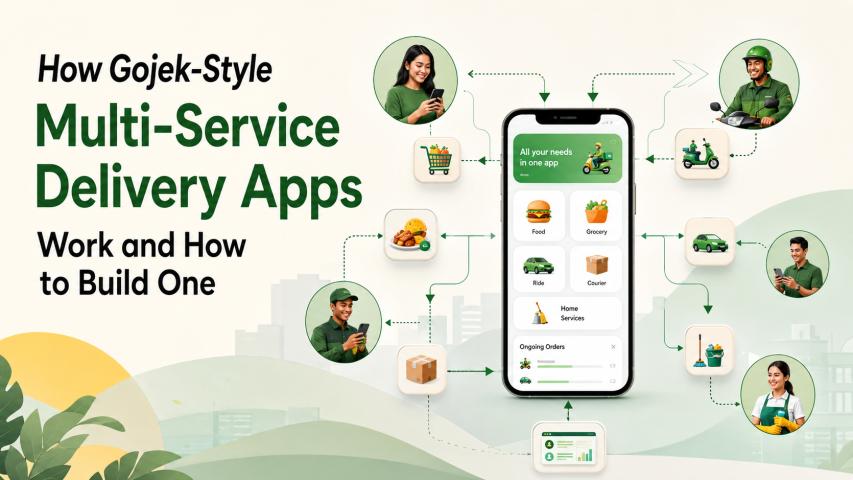
A complete delivery ecosystem generally includes four major components:
Customer App
The customer application allows users to discover restaurants, browse menus, place orders, make payments, track deliveries, and leave reviews.
Restaurant App or Dashboard
Restaurants need an interface for managing menus, accepting orders, updating preparation times, managing availability, and viewing sales information.
Driver App
Drivers need a simple application where they can receive delivery requests, navigate to restaurants, pick up orders, and complete deliveries.
Admin Panel
The admin dashboard gives the business control over users, restaurants, drivers, orders, payments, promotions, reports, and platform settings.
All four components need to communicate with each other properly.
Essential Features of a Food Delivery App
Let's look at the features that should be considered when planning your application.
1. Easy Registration
Customers should be able to create an account quickly using email, phone number, or supported social login options.
The goal should be simple onboarding without asking for unnecessary information.
2. Restaurant Search
Users should be able to search for restaurants by location, cuisine, price range, ratings, delivery time, and other useful filters.
A good search experience can save users from scrolling through hundreds of restaurants.
3. Restaurant Profiles
A restaurant page can include:
4. Digital Menu
Restaurants should be able to create organized digital menus with categories, images, descriptions, prices, and customization options.
Menu management should also be easy for restaurant staff to update.
5. Cart and Checkout
The checkout screen should clearly display:
A modern Food Delivery App in the USA can support multiple payment options through suitable payment providers.
The platform should follow appropriate security practices and avoid unnecessary storage of sensitive payment information.
7. Live Order Tracking
After placing an order, customers want to know what is happening.
The application can show stages such as:
Confirmed → Preparing → Ready → Picked Up → On the Way → Delivered
This makes the process easier to understand.
8. GPS Navigation
Location technology can help customers find nearby restaurants and allow drivers to navigate between restaurants and delivery addresses.
Drivers can use map-based navigation to improve their delivery workflow.
9. Push Notifications
Notifications can be used for:
10. Reviews and Ratings
Customers can rate restaurants and delivery experiences after completing an order.
Reviews can provide useful feedback for restaurants and help customers make informed choices.
AI Features for Food Delivery Apps in 2026
Artificial intelligence can add useful functionality when it is connected to a real customer or business need.
AI Food Recommendations
The application can recommend dishes based on previous orders, preferences, and browsing behavior.
Personalized Offers
AI and analytics can help businesses create more relevant promotions instead of sending identical discounts to every customer.
Smart Search
Users could search using natural language, such as:
“Find vegetarian restaurants near me with delivery under 30 minutes.”
The system can interpret the request and return relevant results based on available data.
AI Customer Support
An AI assistant can answer common questions about orders, delivery status, restaurant information, refunds, and account issues.
More complex problems can be transferred to human support.
Demand Prediction
Restaurants and platform operators can use analytics and machine learning to understand ordering patterns and anticipate periods of high demand.
Technology Stack
The technology stack will depend on the application's scale and requirements.
For mobile development, businesses can choose native technologies such as Swift for iOS and Kotlin for Android, or cross-platform frameworks such as Flutter and React Native.
For backend development, common choices include Node.js, Python, Java, and .NET.
Databases can include PostgreSQL, MySQL, MongoDB, or other technologies depending on the data requirements.
The application may also require integrations for:
The right technology should be selected based on the actual product requirements rather than simply choosing the most popular framework.
How Much Does It Cost to Build a Food Delivery App in the USA?
The cost depends on the complexity of the application.
A basic MVP with customer ordering functionality can have a significantly different budget from a complete ecosystem containing customer, restaurant, driver, and admin applications.
A general planning range could be:
Basic app: 25,000–50,000
Mid-level platform: 50,000–100,000
Advanced platform: 100,000–200,000+
These are broad estimates rather than fixed development prices.
How Can a Food Delivery App Make Money?
There are several ways to generate revenue.
Restaurant Commission
The platform can charge restaurants a commission on completed orders.
Delivery Charges
Customers can pay delivery fees based on the business's pricing structure.
Subscription Plans
A membership program can offer benefits such as reduced delivery charges or selected promotional benefits.
Sponsored Restaurant Placement
Restaurants can pay for promotional visibility within the platform, subject to the platform's policies.
Premium Services
The platform can introduce premium services for restaurants or customers based on its business model.
Combining several revenue streams can give a business more flexibility than relying on a single source.
How to Build the App Step by Step
Step 1: Research Your Market
Understand your target customers, restaurants, competitors, delivery areas, and pricing expectations.
Step 2: Define Your Business Model
Decide how the platform will earn money and what role restaurants and delivery drivers will play.
Step 3: Plan the MVP
Start with the core features required for launch.
Step 4: Design the UI/UX
Create wireframes and prototypes before development begins.
The interface should make ordering fast and straightforward.
Step 5: Develop the Platform
Develop the customer application, restaurant dashboard, driver application, backend, database, and admin panel.
Step 6: Integrate Third-Party Services
Connect payment gateways, maps, notifications, analytics, and other required services.
Step 7: Test the Application
Test ordering, payments, cancellations, refunds, tracking, notifications, restaurant workflows, and driver operations.
Step 8: Launch in a Specific Market
Instead of immediately targeting the entire US, consider starting in a specific city or service area.
This can make restaurant onboarding and delivery operations easier to manage during the initial stage.
Step 9: Gather User Feedback
Monitor reviews, support requests, analytics, and user behavior.
Use this information to improve the product.
Step 10: Scale
Once the platform has a stable foundation, expand into additional locations and introduce advanced features.
Final Thoughts
Building a Food Delivery App in the USA in 2026 can be an interesting opportunity for startups, restaurant groups, and businesses looking to create their own digital delivery ecosystem.
The best place to start is with a clear business idea and a practical MVP. Once the basic ordering, restaurant management, payment, and delivery workflows are working properly, advanced capabilities such as AI recommendations, smart search, personalized promotions, and predictive analytics can be introduced.
If you are researching food delivery app development, understanding the features, technology stack, development cost, monetization options, and operational requirements will help you plan the project more realistically.
For more practical guides about mobile app development, AI applications, business technology, development costs, and digital products, follow the channel for upcoming videos and tutorials.
👉 Watch the full video on YouTube and discover how to turn your food delivery app idea into a real-world digital platform.
https://youtu.be/aDDbdzDZneo?si=snFXJtGTzFh8V_zp