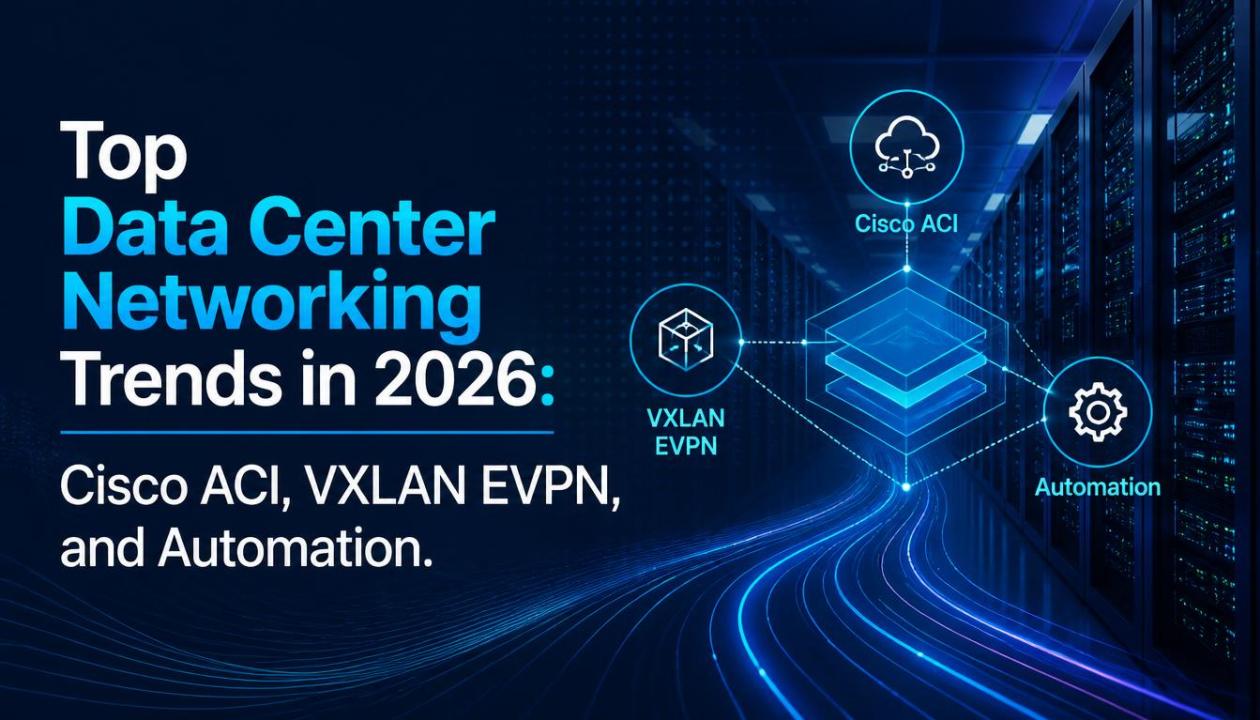
Data center networking continues to evolve as organizations adopt cloud computing, artificial intelligence, virtualization, and distributed applications. Modern infrastructure requires scalable connectivity, consistent security policies, and reliable performance to support growing workloads. Technologies such as Cisco Application Centric Infrastructure (ACI), VXLAN EVPN, and network automation are helping organizations build more flexible and manageable data center environments.
For professionals looking to understand these developments, CCNP Data Center Training can provide valuable knowledge of data center architecture, switching, virtualization, and operational troubleshooting. Understanding current networking trends helps learners and IT teams evaluate new technologies, improve network efficiency, and prepare for changing infrastructure requirements.
1. Cisco ACI for Policy-Based Data Center Networking
Cisco Application Centric Infrastructure (ACI) is a software-defined networking solution that uses centralized policy management to simplify data center operations. It enables administrators to define application connectivity requirements and apply policies across supported network infrastructure.
Key Benefits of Cisco ACI
Centralized network policy management.
Application-oriented segmentation.
Consistent configuration across supported infrastructure.
Integration with automation and orchestration tools.
Improved visibility into application connectivity.
Why Cisco ACI Matters in 2026
Organizations managing complex application environments need consistent policies across multiple network components. Cisco ACI helps administrators define application requirements and translate them into network policies.
ACI can be useful in environments where application dependencies, security segmentation, and operational consistency are important. However, successful deployment requires appropriate planning, compatible infrastructure, and staff familiar with its policy model.
2. VXLAN EVPN for Scalable Network Architecture
Virtual Extensible LAN (VXLAN) extends Layer 2 connectivity across Layer 3 networks using encapsulation. Ethernet VPN (EVPN) provides a control-plane mechanism for distributing reachability information.
Together, VXLAN EVPN support scalable data center fabrics with improved flexibility compared with traditional large Layer 2 designs.
Important Features of VXLAN EVPN
Scalable network segmentation through VXLAN network identifiers.
Layer 2 and Layer 3 connectivity across supported fabrics.
Control-plane learning through BGP EVPN.
Support for multi-tenant environments.
Flexible workload placement across network segments.
Benefits for Modern Data Centers
VXLAN EVPN is useful when organizations need to connect virtual machines, containers, and physical workloads across distributed infrastructure. Its architecture can reduce dependence on traditional Layer 2 extension techniques and support more structured routing designs.
Network engineers should understand VTEPs, BGP EVPN route types, underlay routing, and endpoint reachability to deploy and troubleshoot these environments effectively.
3. Network Automation and Programmability
Manual network configuration becomes increasingly difficult as data centers grow. Network automation helps teams reduce repetitive tasks, standardize configurations, and improve operational consistency.
Common Network Automation Tools
Automation workflows may use Python, Ansible, REST APIs, and infrastructure management platforms. These tools can support configuration deployment, compliance checks, inventory collection, and network validation.
Why Automation Is Important
Automation can reduce configuration errors and make changes more repeatable. It also helps teams maintain consistency across large environments.
Before implementing automated changes, organizations should establish testing procedures, access controls, version management, and rollback plans. Automation should improve operational reliability rather than simply increase the speed of configuration changes.
4. AI Workloads and High-Performance Networking
Artificial intelligence and machine learning workloads can place significant demands on data center networks. Distributed training and large-scale data processing require high bandwidth, low latency, and predictable connectivity between compute systems.
Networking Requirements for AI Infrastructure
Modern AI environments may use high-speed Ethernet, advanced congestion management, and specialized network adapters. Network designs must account for traffic patterns, oversubscription, packet loss, and workload placement.
Preparing Networks for AI Growth
Network teams should monitor utilization, latency, packet drops, and congestion. Capacity planning should consider both current workloads and expected expansion.
The appropriate design depends on workload requirements, hardware capabilities, application architecture, and budget rather than on bandwidth alone.
5. Data Center Security and Microsegmentation
Security remains a key consideration as applications and workloads become more distributed. Microsegmentation helps organizations define and enforce more granular communication policies between workloads.
Advantages of Microsegmentation
Limits unnecessary communication between systems.
Supports separation of application environments.
Helps reduce the potential impact of compromised workloads.
Improves alignment between network policies and security requirements.
Implementing Effective Segmentation
Organizations can use network access policies, virtual network segmentation, and supported security integrations to control traffic. Administrators should document application dependencies and test policy changes before deployment to avoid interrupting legitimate communication.
6. Hybrid Cloud and Multi-Cloud Connectivity
Many organizations operate workloads across on-premises data centers and public cloud platforms. This creates a need for reliable connectivity, consistent security controls, and clear operational visibility.
Challenges in Hybrid Environments
Common challenges include IP address management, routing consistency, access control, latency, and troubleshooting across different platforms.
Improving Hybrid Cloud Operations
Teams should standardize network documentation, establish consistent monitoring, and define clear routing and security policies. Automation can help coordinate repetitive tasks across supported environments.
A successful hybrid cloud strategy also requires evaluating application dependencies, connectivity costs, resilience requirements, and compliance obligations.
7. Network Observability and Proactive Troubleshooting
Traditional monitoring often focuses on device availability and interface statistics. Network observability adds context by correlating telemetry, performance metrics, logs, and traffic behavior.
Key Metrics to Monitor
Interface utilization and errors.
Latency and packet loss.
Routing adjacency changes.
VXLAN tunnel and endpoint reachability.
BGP EVPN session status.
Application connectivity and service performance.
Benefits of Proactive Monitoring
Proactive monitoring helps teams identify unusual behavior before it becomes a major service disruption. Combining telemetry with structured troubleshooting also makes it easier to determine whether an issue originates in the network, compute infrastructure, or application layer.
8. Sustainability and Energy-Efficient Networking
Energy efficiency is becoming an important consideration in data center planning. High-density computing, AI workloads, and increased network traffic can raise power and cooling requirements.
Strategies for Improving Efficiency
Organizations can evaluate equipment utilization, consolidate underused infrastructure, select appropriately sized hardware, and monitor power consumption.
Network upgrades should balance energy efficiency with capacity, resilience, performance, and lifecycle costs. Effective planning can help reduce waste without compromising essential services.
9. Developing Data Center Networking Skills
As data center architectures evolve, networking professionals benefit from understanding both foundational protocols and modern automation techniques.
Essential Skills for Network Engineers
Important skills include VLANs, routing, switching, BGP, VXLAN EVPN, data center security, troubleshooting, and programmability.
Hands-on labs can help learners understand how underlay routing, overlay networks, and centralized policies interact. Practical exercises involving configuration errors, routing failures, and endpoint reachability can strengthen troubleshooting abilities.
A structured CCNP Data Center course can help learners build knowledge of data center technologies and practice relevant configuration and troubleshooting scenarios. When selecting a course, review its curriculum, lab access, prerequisites, and alignment with current Cisco certification requirements.
Conclusion
Data center networking in 2026 is shaped by scalable architectures, software-defined networking, automation, AI infrastructure, and stronger security requirements. Cisco ACI and VXLAN EVPN provide approaches for managing application connectivity and building flexible network fabrics, while automation and observability help improve operational consistency. Hybrid cloud connectivity and energy efficiency also remain important considerations for organizations modernizing their infrastructure.
For networking professionals, staying current with these developments can support long-term career growth and technical development. A CCNP Data Center course can provide a structured way to explore modern data center technologies, develop practical troubleshooting skills, and understand how networking solutions support evolving business requirements.