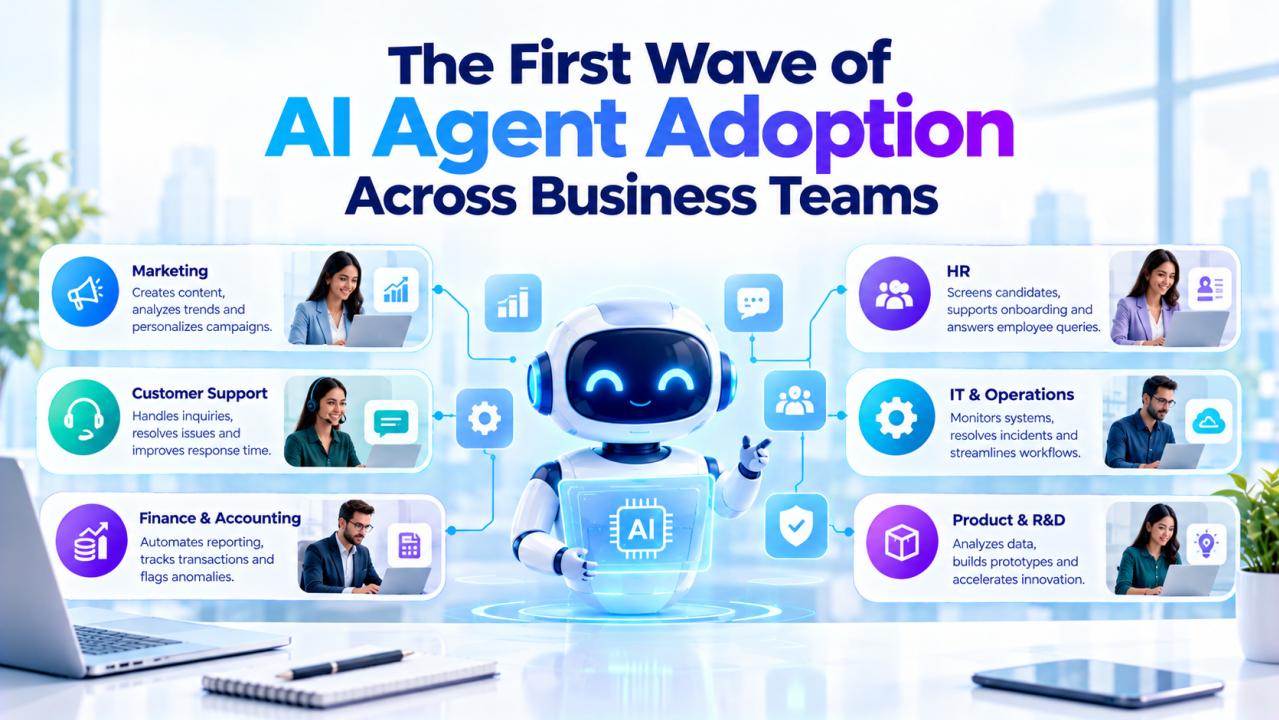
The First Wave of AI Agent Adoption Is on Business Teams
Artificial Intelligence (AI) is transitioning from answering questions and creating content to far more. An AI agent can interact with business applications, analyze data, and assist in decision-making with minimal human involvement. While these capabilities are being explored, the initial phase of adoption is now visible across teams dealing with repetitive tasks, vast amounts of information, and tasks that require timely responses.
Companies are finding effective ways to integrate AI agents into their workflows, ranging from customer support to marketing and software development. By understanding the starting point of the adoption, organisations can find relevant use cases and be ready to scale adoption across their organisation.
Why Businesses Are Adopting AI Agents
While traditional automation relies on rigid rules, AI agents are capable of understanding context, making decisions, and adjusting their behavior within specific parameters. They can be used with several tools and carry out a number of actions to achieve a certain goal, depending on their design.
AI agents are a topic of interest for businesses aiming to streamline production processes, cut down on manual labor, and empower workers to concentrate on more value-added tasks. Organisations exploring this space often turn to professional AI development services to build and integrate agents that align with their specific operational needs.
Factors that contribute to adoption of this include:
- Operational efficiency: The ability to automate tasks that take up time from employees.
- Improved decision-making: Knowledge of relevant information and organisation of information quickly.
- Increased responsiveness: Providing timely help to support customers and colleagues.
- Workflow coordination: Linking activities in several business applications.
But it is important to select the right tasks before trying to automate everything in your business.
1. Customer Support Teams Are the First to Go
One of the most practical places to start with an AI agent is customer support. There are repetitive questions, orders, appointment requests, and simple troubleshooting that are handled by support teams regularly.
An AI agent can fetch data from authorized databases, categorize user queries, propose solutions, and trigger authorized actions. If the problem is complicated and/or needs human intervention, the agent can hand it off to a support representative.
This can be beneficial for businesses during heavy enquiries, which means that workers can focus on more complex or delicate matters.
The main thing is to make sure that there are clear escalation procedures, that the quality of the responses is high, and that agents do not make claims that they cannot support.
2. Agents Are Utilized by Sales Teams to Conduct Research and Follow Up
Salespeople invest a lot of time into researching the customer base, adding prospects to the list, drafting meeting summaries, and following up with prospects. AI agents can help with these tasks by gathering and structuring pertinent data for sales agents.
For instance, if a prospect has engaged with an agent in the past, the agent might be able to recount the history of their previous interactions, draft a follow-up message, and suggest a course of action — all in a predefined fashion based on the agent's sales strategy. Effective AI agent development ensures these workflows are tailored precisely to how each sales team operates.
These features allow sales teams to save time on administrative tasks, but maintain the personal touch in sales relationships.
Sensitive communications, pricing commitments, and actions that impact customer relationships still require human approval.
3. Marketing Teams Can Speed Up Campaign Workflows
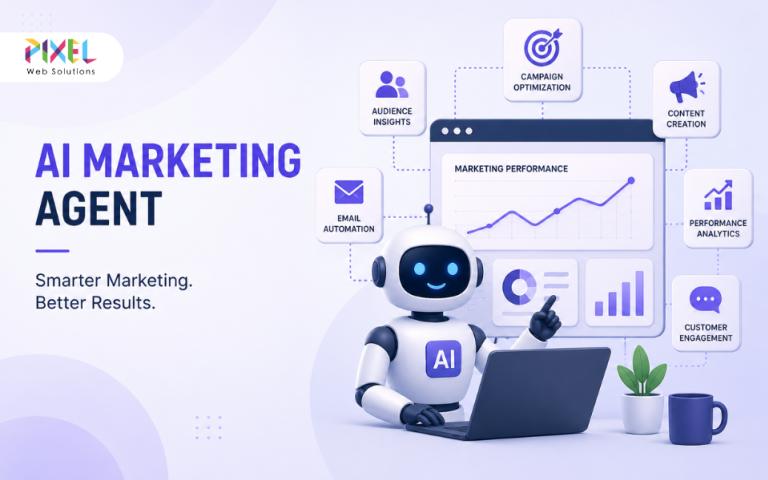
AI agents are being researched by marketing teams for their ability to assist in research, content planning, campaign management, and performance analysis. Coordinated agents can handle multiple aspects of a workflow instead of performing individual tasks.
A marketing agent could also review campaign performance and determine which content is not doing well, provide a synthesis of audience engagement, and propose changes for the next campaign. Teams leveraging AI app development services are better positioned to build agents that plug directly into their existing marketing platforms.
Other applications include:
- Summarizing and structuring customer feedback into useful themes.
- Creating content briefs for initial review.
- Tracking campaign performance against goals.
- Assisting with audience research and competitor analysis.
The human marketer must still check facts, brand consistency, and quality of published content.
4. IT and Software Development Teams Boost Productivity
The IT departments and software development teams are also investigating AI agent tools for technical workflows. Depending on the permissions and integrations, agents can look into the error logs, summarise the incidents, help review code, build test cases, and help with documentation.
Some systems can do multiple development processes — from the identification of a potential issue to suggesting a change in the code and running tests in a controlled environment.
These capabilities can help speed up the work but also add risks. Changes to the code, infrastructure changes, and deployment to production need to have proper testing, access control, and human supervision.
5. Finance and Operations — Automate Routines
Structured processes are handled by finance and operations teams that include invoices, reports, reconciliations, approvals, and internal requests. AI agents can also be used to analyze documents and identify inconsistencies, provide document summaries, and assign tasks to the correct employees.
For example, an agent can match up invoice information with purchase information and highlight discrepancies to be reviewed. Firms working with Artificial intelligence development services gain the technical expertise needed to deploy these agents securely within finance environments.
Businesses should separate the two concepts of making a recommendation and authorizing a financial transaction. When dealing with sensitive systems, approval controls, audit trails, and permission limits are crucial to ensure safe interactions with AI agents.
Challenges With the First Wave of Adoption
However, AI agents are not always 100% reliable. When data is inaccurate, instructions are confusing, too many permissions are granted, or integration is not strong, results can be inaccurate, or actions can be taken that were not intended.
Start with small, measurable use cases and take it slowly.
Important safeguards include:
- Establishing roles and boundaries of operations.
- Restricting access to sensitive systems and information.
- Monitoring and auditing of actions.
- Virtual testing of agents without deployment.
- Measuring accuracies, completion rates, costs, and employee impact.
These practices enable businesses to gauge the true impact of an AI agent beyond being just another technology under the hood.
Conclusion
The early phase of AI agent adoption is unfolding in business teams where repetitive tasks, information acquisition, and workflow management offer potential areas for improvement. Organisations can begin their journey of embracing agentic AI in a variety of practical ways, including through customer support, sales, marketing, IT, finance, and operations.
How well businesses integrate automation with accountability will dictate the next step of the process. Choosing specific use cases, creating robust protection measures, and quantifying results helps create a foundation for responsible AI agent use and sustainable productivity.