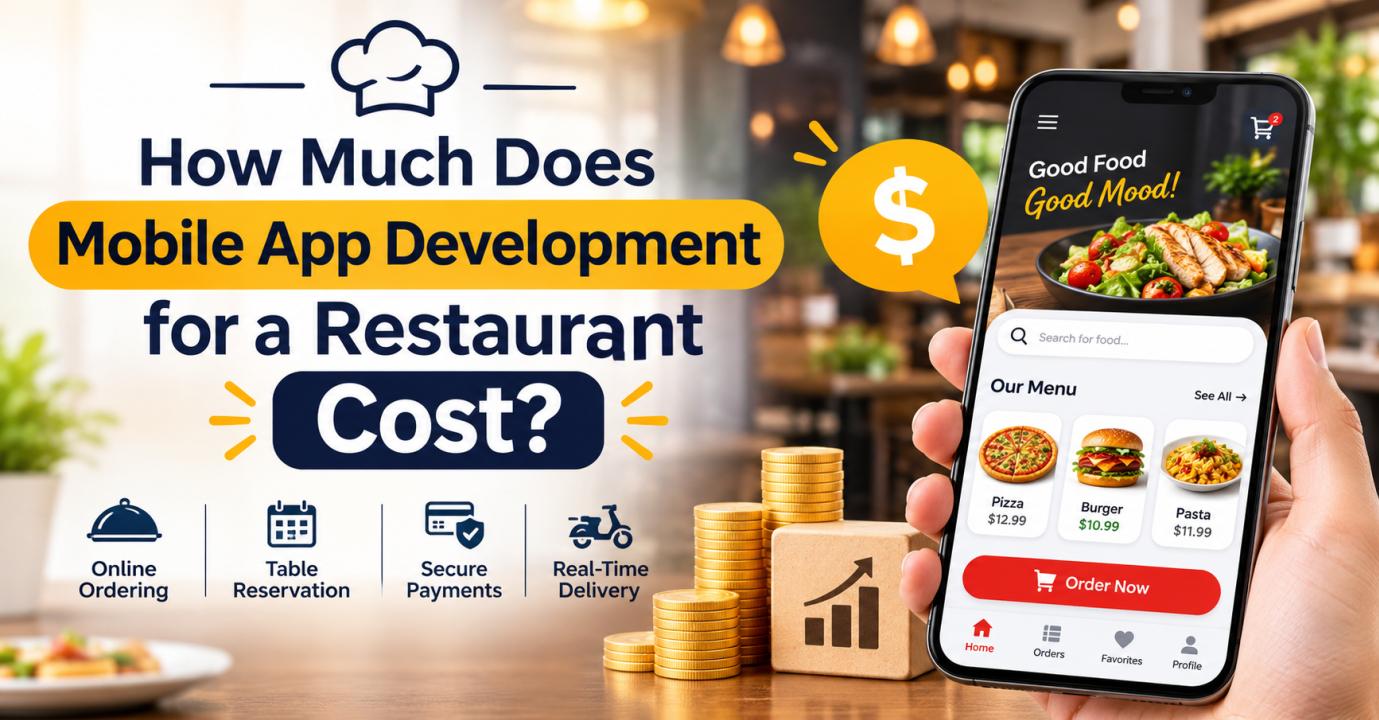

Application development is increasingly used in the field of user experience improvement, placing orders, and managing processes in the sphere of business. From ordering and reserving tables through the use of mobile applications to making payments and monitoring the order delivery process, mobile apps have proved themselves as extremely useful tools for modern businesses.
No matter if you own a small restaurant, a food chain, or even a cloud kitchen, creating an application for your business may be beneficial for you. However, the first question that usually comes to mind for such people is "How much does it cost to develop a restaurant mobile app?"
Well, it depends on many factors: application complexity, its features and design, tech stack, integration capabilities, and developers' experience. A simple application for your restaurant will not cost you too much money, but an advanced one with an AI recommendation system and other features will cost you quite a lot.
In this guide, we will discuss the cost of restaurant app development, important features, business benefits, and technology trends in the future.
What Is Restaurant App Development?
Restaurant app development is the process of designing, building, and launching a mobile application that helps restaurants manage food ordering, reservations, payments, deliveries, and customer interactions.
A restaurant application provides customers with a convenient way to browse menus, customize meals, place orders, make payments, and track deliveries. At the same time, restaurant owners can manage orders, monitor sales, update menus, and analyze customer preferences through an administrative dashboard.
A professional AI development company can help businesses build customized applications based on their operational requirements and target audience. Depending on the business model, the application can include customer-facing features, restaurant management tools, delivery partner panels, and backend administration.
Common types of restaurant applications include:
- Food Ordering Apps: Allow customers to browse menus, customize meals, and place orders directly through their smartphones.
- Table Reservation Apps: Help customers check availability, select dining times, and reserve tables.
- Restaurant Management Apps: Support restaurant owners in managing orders, staff, inventory, billing, and daily operations.
- Food Delivery Apps: Connect customers, restaurants, and delivery partners through a centralized platform.
- Multi-Restaurant Apps: Allow customers to explore and order food from multiple restaurants through one application.
Choosing the right application model is the first step toward estimating the overall restaurant app development cost.
Key Features of Restaurant App Development
The features included in a restaurant application directly influence its usability, functionality, and overall development budget. A basic application may only require menu browsing and online ordering, whereas an advanced platform may include delivery tracking, loyalty programs, analytics, and restaurant management tools.
Here are eight essential features to consider:
1. User Registration and Profile Management
Users should be able to create user profiles, log in, edit their details, save their shipping addresses, and view the history of their orders. The process of registration can be made easy with social login and OTP-based authentication.
2. Digital Menu Management
The digital menu helps customers browse the list of food products, see their pictures, know about their pricing, and choose their meal options. The restaurant staff should be able to modify the menu items, update their prices, add descriptions, and manage food availability without any technical help.
3. Online Food Ordering
Online ordering is the most vital aspect of restaurant applications. Users will be able to add the dishes to the cart, customizing the food orders, applying discount coupons, choosing between pick-up and delivery, and placing their orders via the app itself.
4. Secure Payment Gateway Integration
Integration with the secure digital payments, such as credit card, debit card, mobile wallet, and other payment options that are used in the locality, should be available in the restaurant app. Integration makes the payment process convenient for the customer.
5. Real-Time Order Tracking
Order tracking helps customers track the status of their orders from order confirmation through preparation and delivery. The integration of GPS and map features will help in tracking deliveries and the arrival times and location of the delivery partners.
6. Table Reservation and Booking
This feature enables customers to find out about table availability, choose their preferred time for dining, and make reservations through the app. This would enable better coordination by the restaurant's employees and avoid clashes in scheduling.
Advantages of Restaurant App Development
Investing in a restaurant mobile application offers several advantages beyond online food ordering. It helps businesses improve customer engagement, automate operations, and build stronger relationships with their customers.
1. Improved Customer Experience
Using a restaurant app enables consumers to access the menu, make customized orders, book a table, and pay for their meals without having to queue. A user-friendly interface and easy process of ordering lead to improved customer satisfaction.
2. Increased Online Orders and Revenue
Mobile applications offer yet another sales avenue to restaurants. The customers can order at any time, get exclusive deals, and order their favorite dishes. Ordering directly can help the restaurants establish a relationship with their customers without completely relying on third-party delivery platforms.
3. Better Restaurant Operations
Several activities such as ordering, making reservations, tracking payments, and updating menus can be automated using restaurant software applications. The use of POS and inventory systems may also contribute to automation and increased efficiency.
4. Customer Data and Personalization
Analysis of order patterns, customer preferences, purchase frequency, and feedback will assist restaurants in comprehending their audience. This will allow businesses to offer suitable meals, promote their business effectively, and formulate better marketing strategies.
5. Stronger Customer Loyalty
A dedicated app enables restaurants to use points, referral plans, member privileges, and discounts to reward their customers. These programs are designed to motivate people to come back to their restaurants.
Cost to Build a Restaurant App
The restaurant app development cost depends on the application type, features, design complexity, development platform, integrations, and technical requirements.
For example, a basic application with a digital menu and online ordering requires fewer development resources than an advanced solution with multiple restaurant locations, delivery partner applications, real-time tracking, and AI-powered recommendations.
Estimated Restaurant App Development Cost
The following figures are indicative planning estimates for custom development by a development team in India. Actual quotations will vary depending on project scope and technology requirements.
App Complexity | Estimated Development Cost | Timeline |
Basic Restaurant App | $5000-25000 | 2–3 months |
Advanced Restaurant App | $25000-50000 | 5–8 months |
Enterprise-Level Platform | $50.000-150.000+ | 8–12 months+ |
These are illustrative budget ranges, not fixed market prices or vendor quotations. Complex multi-vendor platforms can exceed the enterprise range.
Published 2026 development estimates also show substantial variation based on the number of applications, integrations, and development approach.
Roy Digital App Studio+3
Cost Breakdown by Development Components
Understanding individual development expenses helps businesses plan their budgets more effectively.
Development Component | Estimated Cost |
UI/UX Design | ₹40,000–₹1.5 lakh |
Frontend Development | ₹1–3 lakh |
Backend Development | ₹1.5–4 lakh |
Payment Gateway Integration | ₹25,000–₹80,000 |
Admin Dashboard | ₹50,000–₹2 lakh |
Quality Assurance and Testing | ₹40,000–₹1 lakh |
Deployment and Launch | ₹20,000–₹50,000 |
Note: These are indicative component-level estimates. The actual costs depend on the features and scope, and these amounts should not simply be added to the package estimates above.
Factors That Influence Restaurant App Development Cost
Several important factors determine the overall investment required to build a restaurant application.
1. Application Complexity: A basic ordering application requires fewer resources than a multi-feature platform with customer, restaurant, delivery, and admin modules. More complex workflows increase development time and cost.
2. Platform Selection: Developing separate native applications for Android and iOS may require additional resources. Cross-platform frameworks such as Flutter and React Native can help businesses manage development costs while supporting both platforms.
3. UI/UX Design: Custom interfaces, interactive menus, animations, and personalized user experiences require additional design and development effort. A well-planned interface can improve usability and customer engagement.
4. Third-Party Integrations: Payment gateways, GPS tracking, POS systems, CRM software, inventory management tools, and delivery APIs add integration and testing requirements to the project.
5. Development Team Expertise: The experience, location, and technical capabilities of the development team influence the overall budget. Working with an mobile app development company can help businesses select appropriate technologies and avoid unnecessary development expenses.
Additional Costs to Consider
The initial development budget is not the only expense associated with launching a restaurant application. Businesses should also plan for ongoing operational costs.
- Server and Cloud Hosting: Charges for storing application data and managing backend infrastructure.
- App Maintenance: Regular bug fixes, security updates, and compatibility improvements.
- Third-Party API Charges: Fees for maps, SMS, email, and other external services.
- Payment Processing Fees: Transaction charges applied by payment providers.
- Marketing and Promotion: Expenses for customer acquisition, advertising, and promotional campaigns.
For reliable long-term planning, businesses should account for maintenance and infrastructure expenses in addition to the initial development investment.
How to Reduce the Cost of Restaurant App Development
Businesses can control development expenses without compromising essential application quality by following these practices:
- Start with a Minimum Viable Product (MVP) containing essential ordering, menu, payment, and admin features.
- Choose cross-platform development when it fits the technical and business requirements.
- Prioritize features based on actual customer needs rather than adding unnecessary functionality.
- Use reliable third-party services for standard requirements instead of building every component from scratch.
- Plan the application architecture carefully to avoid expensive redevelopment as the business grows.
These approaches help control the cost to develop restaurant app development projects while maintaining flexibility for future improvements.
5. Future Trends of Restaurant App Development
The future of restaurant technology is moving toward automation, personalization, and data-driven operations. Emerging technologies are helping restaurants improve service quality, reduce operational challenges, and deliver more convenient digital experiences.
Here are six trends shaping the future of restaurant applications.
1. AI and Personalized Recommendations
AI can analyze customer preferences, previous orders, and purchasing behavior to recommend relevant dishes. Restaurants can use intelligent recommendation systems to personalize menus, suggest meal combinations, and create targeted promotional offers.
2. Contactless Ordering and QR Code Payments
With QR ordering, consumers can use codes placed at their table, view menus on digital form and make orders using their smartphones. This kind of ordering system minimizes manual order making and creates convenience for consumers.
3 Internet of Things (IoT) Integration
The IoT devices can link kitchen equipment, smart refrigerators, inventory systems, and restaurant management systems. The interconnected devices help the restaurant owner to keep track of inventory and the efficiency of the equipment.
4 Predictive Analytics and Demand Forecasting
Predictive analytics will assist restaurants in understanding consumer needs, discovering best-selling items, and predicting future sales. Through the analysis of past order information and seasonality, firms can optimize their stock management and minimize food wastage.
5. Cloud-Based Restaurant Management
The use of cloud technology in the hospitality industry enables the owner to have access to business information, tracking of orders, and management of various locations from one dashboard. The cloud computing technologies also facilitate real-time data synchronization, remote management, and flexibility in expanding business operations.
These innovations are driving the growth of food delivery app development, creating new opportunities for restaurants to improve customer experiences and modernize their operations.
Conclusion
Investing in mobile apps for your restaurant can be crucial when trying to make the right impact through your digital presence. There are various restaurant app development options to choose from, starting from simple food ordering apps up to AI-based ordering apps, POS integration, and delivery tracking software.
The total cost of development of a restaurant app varies from ₹3 lakh to ₹80 lakh, which depends on the complexity and features of the app, technologies used, and integration needs.
Working with a professional company that offers customized restaurant app development services can help transform your business idea into a scalable digital solution. With the right development strategy, restaurants can improve operational efficiency, attract more customers, and build a stronger position in the competitive food service industry.