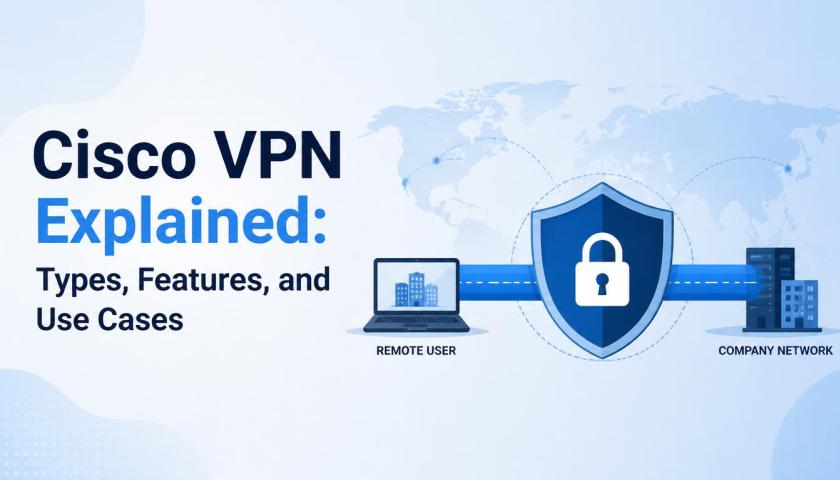
Secure communication between geographically separated branch offices is a critical component of modern IT infrastructure. One of the most effective solutions to achieve this is by implementing a Site-to-Site Virtual Private Network (VPN). This method provides encrypted tunnels over the internet, ensuring that internal data exchanges remain protected and reliable.
Professionals looking to master such implementations often pursue certifications like CCIE Security training, which provides advanced knowledge and practical experience in securing enterprise networks.
Understanding Site-to-Site VPN
A Site-to-Site VPN connects entire networks—such as a headquarters and its remote branch—via a secure and encrypted connection over the public internet. This setup allows employees at different locations to communicate and share resources as though they are on the same local network.
There are two common types of Site-to-Site VPNs:
Intranet VPN: Connects multiple locations within the same organization.
Extranet VPN: Connects the network of an organization with those of external partners or clients, while maintaining secure access controls.
Scenario Overview: Secure Connectivity Between Two Branches
Let’s walk through a real-world scenario where two office branches in different cities need a secure and seamless way to share files, access applications, and communicate over VoIP. The goal is to create a reliable and encrypted tunnel that supports ongoing business operations while minimizing security risks.
Step 1: Assessing Network Requirements
Before configuration, it’s important to define the business and technical requirements:
Enable secure site-to-site communication.
Ensure high availability with minimal latency.
Maintain consistent security policies across both locations.
Allow for scalability to support future branches or partners.
Step 2: Designing the VPN Architecture
Based on the requirements, an IPsec Site-to-Site VPN is selected. IPsec ensures encryption and authentication of the traffic between two sites.
The essential components include
VPN Gateways: Typically, routers or firewalls that support IPsec.
Static Public IPs: Required for the endpoints of the tunnel.
Pre-Shared Key (PSK): Used for mutual authentication.
IKE (Internet Key Exchange): Protocol for negotiating secure tunnel parameters.
Step 3: Configuration Process
Here’s a simplified breakdown of the implementation process:
ISAKMP/IKE Policy Setup
Define encryption method (e.g., AES-256), hashing (SHA-256), authentication (PSK), and key exchange settings.Crypto ACL (Access Control List)
Specify which internal subnets should be allowed to communicate over the VPN.Transform Set Configuration
Combine the selected encryption and hashing protocols into a usable policy.Crypto Map Creation and Application
Bind the VPN settings to the appropriate outbound interface.NAT Exemption
Ensure traffic destined for the VPN is not subject to NAT (Network Address Translation), which would disrupt tunnel formation.Testing and Validation
Use tools like ping, traceroute, and show crypto isakmp sa to verify that the VPN tunnel is up and data is flowing correctly.
Step 4: Operational Advantages
The deployment results in the following benefits:
Security: Data exchanged between sites is encrypted, making it highly resistant to interception or tampering.
Performance: With proper QoS (Quality of Service), voice and video communications remain stable.
Cost-Effectiveness: VPNs leverage the internet rather than expensive dedicated lines.
Centralized Management: IT teams can manage access policies and software updates from one location.
Step 5: Common Challenges and Solutions
Challenges:
Mismatched VPN Settings: Differences in PSKs or IPsec parameters can cause tunnel failures.
Latency or Packet Loss: Can affect real-time applications like VoIP.
Debugging Complexity: Diagnosing VPN issues may require deep understanding of logs and cryptographic behavior.
Best Practices:
Regularly audit VPN logs for anomalies.
Use strong encryption standards like AES-256 and SHA-2.
Keep firmware updated on gateway devices.
Employ redundant tunnels for high availability.
Why It Matters to IT Professionals
Hands-on experience with VPN deployment is highly valuable in today’s cybersecurity landscape. As businesses increasingly adopt hybrid work environments and remote access strategies, the ability to implement and maintain secure VPNs is in high demand.
Advanced certifications like CCIE Security training equip network engineers with real-world skills needed for designing, deploying, and troubleshooting complex security solutions, including multi-site VPN architectures.
Conclusion
A Site-to-Site VPN is a foundational tool for secure and efficient communication between distributed offices. With careful planning, robust configuration, and continuous monitoring, it can provide long-term security and connectivity benefits to any growing organization.
For IT professionals looking to specialize in enterprise security and infrastructure design, enrolling in CCIE Security training is an excellent step toward mastering these critical technologies and advancing in a competitive industry.