
Are you ready to take advantage of the booming mobile app market? Back in 2020, mobile apps were expected to generate a staggering $188.9 billion in global revenue, highlighting an enormous opportunity for businesses worldwide. But in a saturated market, how can your mobile app stand out from the competition?
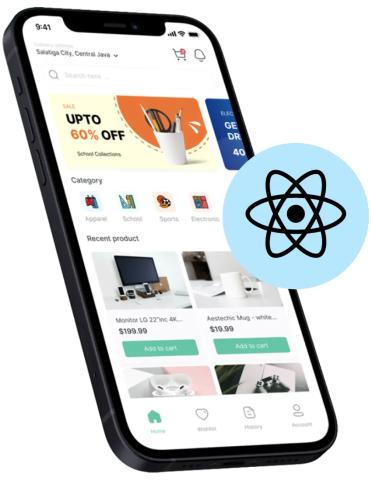
Enter React Native: a framework designed to streamline mobile app development across both iOS and Android platforms. In this comprehensive guide, we’ll break down what React Native is, explore its benefits, and help you decide whether it’s the right solution for your business.
Understanding React Native
React Native is an open-source framework that enables developers to create native mobile apps using JavaScript. Traditionally, building an app for iOS and Android required two separate codebases using Swift/Objective-C for iOS and Java/Kotlin for Android. React Native simplifies the process by allowing developers to write a single codebase that runs on both platforms.
While React Native might seem like a new invention, its roots trace back to Facebook, the social media giant that also created ReactJS. Initially used to improve their mobile app challenges, Facebook released React Native as an open-source project to the broader development community.
Comparing ReactJS vs. React Native, both share a similar syntax and core principles. However, ReactJS is geared toward web development, while React Native focuses exclusively on mobile applications. React Native allows developers to leverage their JavaScript skills to build fully functional mobile apps that compile down to native code.
Facebook’s Problem and React Native’s Solution
Facebook needed a way to manage its iOS and Android apps more efficiently. Maintaining two separate codebases caused duplicated work and inconsistencies between platforms. React Native provided the ideal solution by allowing a unified codebase that compiles into native app components for both platforms.
If you’ve ever used the Facebook or Airbnb mobile app, you’ve already experienced React Native in action.
Market Popularity and React Native’s Growth
React Native’s popularity continues to rise due to its ability to build high-quality mobile apps with lower costs. Among the top 500 apps in the U.S., over 14.85% are built using React Native, making it the third most popular framework behind Kotlin and Android Architecture Components.
React Native Developers for Hire are in high demand, and this growing adoption rate reflects just how well the framework performs in real-world applications.
Why Choose React Native for Your App?
Initially, React Native faced criticism regarding its ability to deliver "true" native performance. However, it has proven itself capable of producing smooth and responsive user experiences while simplifying code maintenance and organisation.
The framework uses native UI components, ensuring a high level of performance across both platforms. This makes it an ideal choice for companies aiming to build visually rich and feature-packed apps without doubling their workload or cost.
Proven by Industry Giants
Big names like Facebook, Instagram, Walmart, Tesla, Skype, and Discord have chosen React Native to power their mobile apps. This strong track record makes React Native an appealing choice for businesses seeking scalability and speed.
Unified Codebase = Greater Efficiency
React Native allows developers to write a single codebase for both iOS and Android, significantly reducing development time. This is especially advantageous for startups and small to medium-sized businesses with limited development budgets.
Unlike ReactJS, which is used for creating responsive web applications, React Native focuses solely on mobile. Still, both frameworks complement each other well, especially when developers share frontend logic and components.
Use Skills You Already Have
Another major benefit is that many companies already have JavaScript or ReactJS developers on staff. Transitioning them to mobile development with React Native is relatively straightforward. This reduces the learning curve and makes hiring easier.
React Native Developers for Hire often come with experience in related technologies, making them versatile and easier to onboard than developers skilled in niche languages like Swift or Kotlin.
Constantly Evolving
React Native is under continuous development, both by Facebook and a global community of contributors. New updates, features, and plugins are added regularly. This community-driven model helps solve common challenges more quickly and offers reusable components to accelerate development.
As an example, Bartosz Kazuła needed a speedometer component for one of his projects. Rather than build it from scratch, he found an open-source library ready to use, saving time and effort.
Even tech giants like Microsoft have invested in React Native, developing their fork called React Native for Windows, allowing developers to create apps for Windows devices and Xbox.
Bonus: Save Time with a Web App
If your team is already using ReactJS for web development, portions of the frontend code—such as logic and UI structure—can be reused for your mobile app. This cross-code compatibility leads to even more time and cost savings.
Case Study: Bloomberg’s Success with React Native
Bloomberg, a major player in financial news, turned to React Native to overhaul their consumer mobile app. Previously, separate teams worked on iOS and Android versions, causing delays and inefficiencies.
With React Native, the team unified their codebase, completed development in just five months (half the expected time), and introduced features like live TV, event feeds, and article bookmarking. The app also allows for deep personalisation, including custom news feeds and real-time portfolio tracking.
React Native’s automatic code refresh feature enabled fast updates, making development and testing more efficient.
Things to Watch Out For
Despite its many strengths, React Native is not a silver bullet. Here are a few caveats:
Not 100% Native
Some system-level features—like syncing user accounts across the device or advanced background tasks—might require native code. React Native apps aren’t as deeply integrated into the OS as purely native apps.
Mix and Match
You don’t have to rely solely on React Native. It’s flexible enough to allow integration with native Swift or Java modules for advanced features that need closer OS interaction.
React Is a Requirement
To use React Native, you’ll need to understand React. This may not be ideal for teams familiar with other frameworks like Angular or Vue. However, React’s component-based structure makes it easy to learn.
Performance Considerations
Heavy or poorly written JavaScript can slow down your app. While this isn’t unique to React Native, it’s something to consider if your app will handle complex calculations. Choosing skilled React Native Developers for Hire can help mitigate performance issues.
As developer Tim Mensch noted, “Badly written JavaScript is slightly more likely to be slow than badly written native code. I prefer to hire strong developers.”
Is React Native Right for You?
So, should you use React Native for your mobile project? Here are some things to consider:
Faster Development: One codebase for two platforms means quicker turnaround.
Lower Costs: Reduce the need for multiple teams and specialised skill sets.
Quality User Experience: Responsive UI with a native feel.
Access to Talent: Easier to find React Native Developers for Hire due to the widespread use of JavaScript.
Community Support: Thousands of open-source components and frequent updates.
Cross-Platform Compatibility: Share business logic between mobile and web apps.
Final Thoughts
React Native is a powerful tool for building efficient, cost-effective, and user-friendly mobile apps. Its ability to leverage a single codebase for multiple platforms makes it especially valuable for businesses looking to scale quickly.
If you’re considering mobile development and want flexibility, speed, and a large talent pool of React Native Developers for Hire, React Native is the smart way forward.
Whether you're a startup looking for rapid deployment or an established enterprise aiming to streamline your development process, React Native has proven it can deliver results. With a growing ecosystem, strong community backing, and real-world success stories, now is the perfect time to tap into what this framework has to offer.
Looking to get started? Make sure you find the right React Native developer who understands your business goals and can turn your ideas into a high-performance mobile application. The mobile future is here—are you ready to build it?