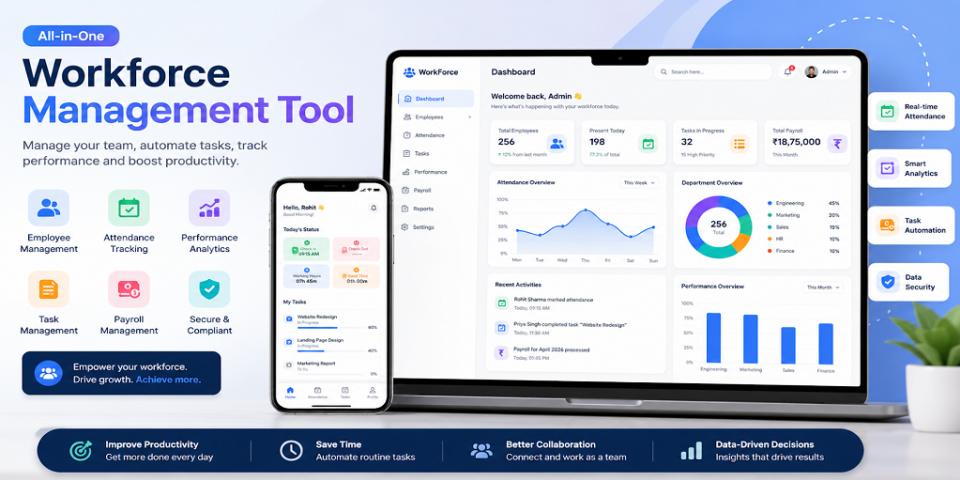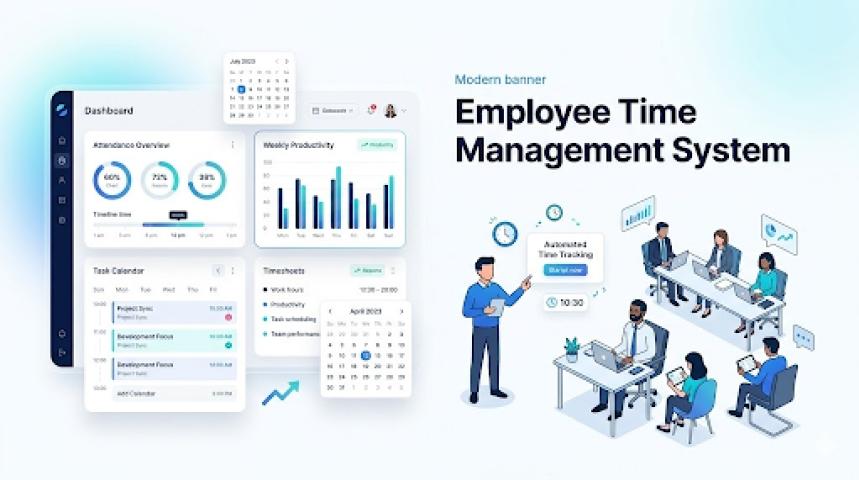

The Workforce Management (WFM) Software Marketis evolving swiftly due to rising demands for productivity, compliance, and workforce optimization. In 2023, the global WFM market stood at approximately USD 9.4 billion and is projected to reach USD 27.8 billion by 2033, growing at a CAGR of around 11.7%.
Request Sample Report:
https://straitsresearch.com/report/workforce-management-software-market/request-sample
Regional Trends (2021–2033)
-
North America leads the market, accounting for approximately 37% share in 2023. High adoption rates are driven by enterprise reliance on advanced scheduling, analytics, and compliance tools.
-
Europe ranks second with nearly 25% share, led by the UK, Germany, and France, focusing on managing complex labor laws and hybrid work schedules.
-
Asia-Pacific is the fastest-growing region, projected to grow at ~13.5% CAGR. Rapid digital transformation and workforce flexible scheduling in India, China, Australia, and Southeast Asia are key drivers.
-
Latin America, Middle East & Africa, and Other Regions show steady growth due to increasing enterprise modernization and retail expansion.
Market Segmentation (2021–2033)
Explore full segmentation:
https://straitsresearch.com/report/workforce-management-software-market
By Deployment Mode
-
On-Premise: Traditional deployments for industries with strict data regulations, such as government and finance, constituting approximately 30% of the market.
-
Cloud: Leading deployment mode with roughly 70% share in 2023, favored for scalability, automatic updates, multi-location support, and flexible adoption across SMEs and large enterprises.
By Functionality
-
Workforce Scheduling & Analytics: The largest segment (~30% of total revenue), covering shift planning, predictive forecasting, and labor cost modeling.
-
Time & Attendance Management: Critical for payroll accuracy and audit compliance, holding ~22% share and driven by biometric and mobile tracking.
-
Performance and Goal Management: Growing steadily (~15% CAGR) as organizations align work outputs with strategic objectives.
-
Absence & Leave Management: Important for compliance and employee well-being, capturing ~12% share in 2023.
-
Others: Include talent management, employee engagement, labor expense tracking, and mobile support.
By End‑User Industry
-
BFSI (Banking, Financial Services & Insurance): Leading vertical, driven by compliance and large frontline teams.
-
Consumer Goods & Retail: High adoption due to hourly staffing, dynamic scheduling, and multi-location operations.
-
Automotive: Supports shop-floor scheduling, certifications, and production cycles.
-
Energy & Utilities: Focus on safety, shift handover tracking, and compliance management.
-
Healthcare: Requires robust scheduling, credentials tracking, and on-call coordination.
-
Manufacturing: Employs scheduling, attendance, and labor cost tracking in complex production environments.
-
Others: Include sectors like hospitality, logistics, government, and education adopting WFM solutions.
By Enterprise Size
-
SMEs: Represent ~45% of installations, opting for prepackaged cloud tools with rapid implementation.
-
Large Enterprises: Comprise ~55%, often integrating workforce software with HRIS, ERP, CRM, and planning tools.
Top Players
Leading vendors in the Workforce Management Software market:
-
Active Operations Management International LLP
-
NICE Systems Ltd
-
Oracle Corporation
-
Infor Group
-
WorkForce Software LLC
-
Kronos Incorporated (part of UKG)
-
Reflexis Systems Inc. (also part of Zebra Technologies)
-
SISQUAL
-
Workday Inc.
-
Blue Yonder Group Inc.
These companies offer comprehensive WFM solutions with cloud-based suites, mobile apps, AI-enhanced forecasting, compliance engines, and real-time shift management.
Market Drivers
-
Hybrid Work Models
The growth of remote and hybrid workforces has increased demand for agile time-tracking, coordination, and scheduling tools. -
Compliance Requirements
Global labor laws (e.g., FLSA, GDPR, Working Time Directives) and overtime regulations drive adoption of compliant WFM systems. -
Operational Efficiency
Organizations focusing on labor cost reduction and employee productivity invest in scheduling optimization and attendance accuracy. -
Technology Integration
Seamless integration between WFM, HR, payroll, ERP, and scheduling systems enhances data-driven decisions and unified reporting. -
Employee Experience
Self-service portals, shift-swapping, mobile clock-in/out, and predictive scheduling help boost engagement and retention.
Market Challenges
-
Legacy System Limitations
Traditional on-premise platforms may struggle with modernization, especially in data integration and UI scalability. -
Privacy and Security Concerns
Workforce data involves sensitive personal information, requiring robust data protection, encryption, and compliance practices. -
Adoption Resistance
Workforce automation can spark pushback from employees fearing surveillance or loss of flexibility, requiring thoughtful change management. -
Complex Architectures
Integrating WFM with HR, payroll, ERP, and planning tools can be expensive and time-consuming. -
Cost Constraints
While cloud solutions reduce upfront costs, subscription models may still burden SMEs with limited budgets.
FAQs
Q1: How much will the Workforce Management Software market be worth by 2033?
A: It is projected to reach USD 27.8 billion, up from USD 9.4 billion in 2023, growing at a CAGR of 11.7%.
Q2: Which deployment model is most prevalent?
A:Cloud-based WFM solutions lead, accounting for approximately 70% of the 2023 market.
Q3: Which functionality dominates the market?
A:Workforce Scheduling and Analytics hold the largest share (~30%), followed by Time & Attendance Management (~22%).
Q4: Which industries have the highest adoption?
A: BFSI, Retail, Healthcare, Manufacturing, and Energy & Utilities are leading verticals for WFM software.
Q5: Who are the main market providers?
A: Key vendors include Oracle, Kronos (UKG), Workday, NICE, Infor, WorkForce Software, Reflexis, SISQUAL, and Blue Yonder.
Conclusion
The Workforce Management Software market is well-positioned for high growth through 2033, driven by the dual needs of managing hybrid workforces and compliance mandates. Cloud-based platforms with advanced scheduling, analytics, and mobile-first design continue to attract both SMEs and large enterprises. Top-tier vendors like Kronos, Oracle, and Workday are spearheading innovation with AI and integration-first approaches. Addressing challenges around security, adoption, and legacy system integration will define market leadership. As businesses strive for operational excellence and workforce agility, WFM solutions will remain central to strategic workforce planning and productivity.