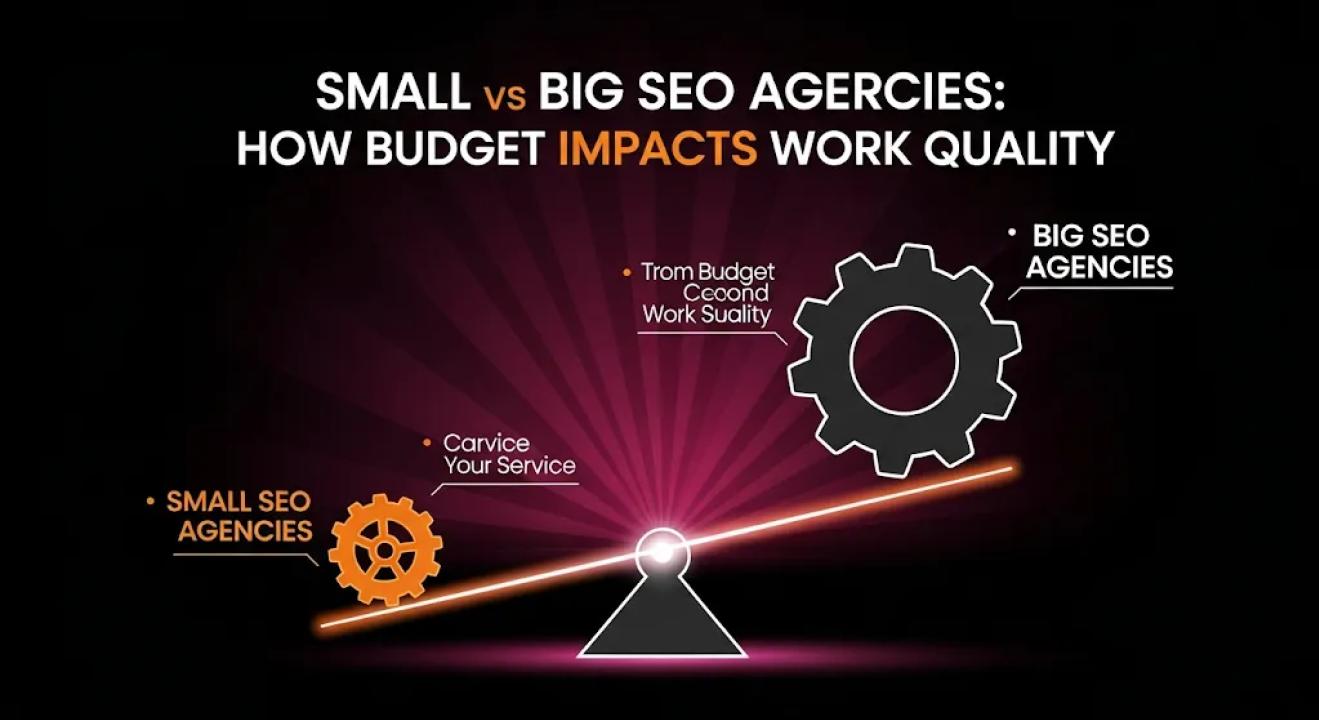
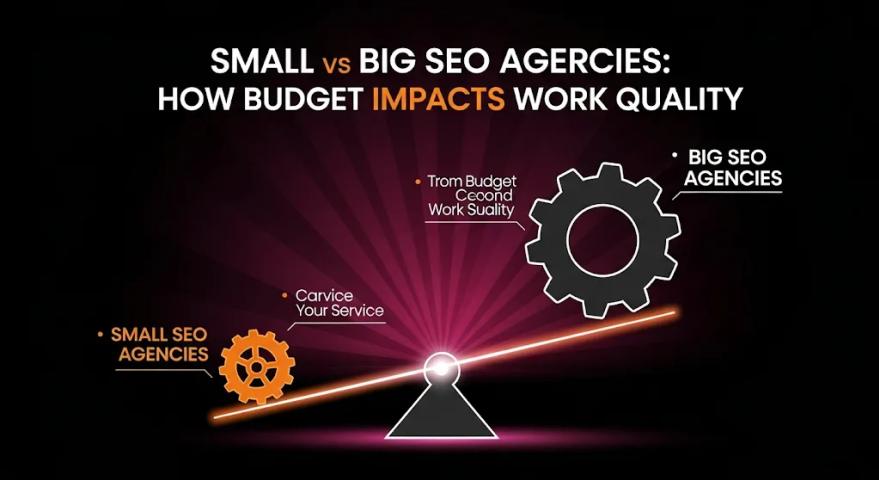
When businesses invest in SEO, one of the first questions they face is how much to spend — and with whom. Some gravitate toward smaller agencies with modest retainers, while others lean on established firms with premium pricing. But does a higher budget automatically translate into higher-quality SEO?
The answer is less straightforward than many assume. SEO success depends on context: the maturity of the business, the complexity of the industry, and the alignment between strategy and execution. Budgets do shape the scope of work, yet the relationship between cost and quality is rarely linear.
A too-formal framing puts it simply:
“Budget defines capacity. Strategy defines outcome. Without strategy, even the largest budget dissolves into inefficiency.”
What Separates a Small SEO Agency from a Big One?
The differences are not just about headcount. Small SEO agencies tend to operate with lean teams, wearing multiple hats. They thrive on agility, often experimenting quickly and adapting to client needs. Communication lines are shorter, and decisions move faster.
Large agencies, by contrast, offer specialization. A single account may involve technical SEO analysts, content strategists, paid media managers, and project leads. Processes are standardized, reporting is polished, and workflows are built for scale.
Both models carry strengths. The agility of a small team can feel refreshing, while the structured sophistication of a larger SEO agency offers reassurance. The question is whether the business needs rapid adaptability or institutional stability.
Is Higher Cost Always a Sign of Better SEO Execution?
It’s tempting to assume that cost signals quality. In some cases, this holds true — larger budgets grant access to broader expertise, enterprise tools, and experienced teams. But high cost without accountability can lead to bloated retainers with minimal impact.
Conversely, lower-cost agencies sometimes deliver exceptional value by focusing resources on what matters most: intent-driven content, technical fixes, and smart targeting. Yet limitations in manpower and bandwidth may eventually surface.
The lesson here is subtle but critical: price reflects capacity, not certainty. Better execution depends on whether the agency aligns its approach to the business’s goals.
Pros and Limitations of Hiring a Small SEO Agency
Small agencies often excel at personalization. Business owners may interact directly with the strategist or analyst working on their campaigns. This fosters collaboration and transparency. Budgets stretch further, as less overhead means more hands-on work.
However, small agencies may lack the infrastructure to handle complex, multi-market projects. Scaling campaigns across dozens of regions, running simultaneous technical audits, or producing content at volume can strain their resources.
For businesses seeking intimacy, flexibility, and lean execution, small agencies are compelling. But those requiring enterprise-level orchestration may outgrow them.
Pros and Limitations of Hiring a Big SEO Firm
Large SEO firms carry undeniable advantages. Dedicated specialists bring depth, and enterprise tools enable comprehensive reporting. Their experience spans industries, providing insights smaller agencies may not have encountered.
On the other hand, the very scale that provides structure can introduce rigidity. Smaller accounts may feel deprioritized compared to larger clients. Processes, while standardized, can sometimes slow innovation. Communication may also become layered, business owners speak with account managers rather than the strategists themselves.
For companies requiring scale, risk management, and technical sophistication, larger firms are well suited. But businesses prioritizing speed and creative flexibility may feel constrained.
Budget Breakdown: Where Does Your Money Go in Each Case?
Understanding how budgets are allocated clarifies expectations.
Small Agencies: More of the budget goes directly into execution, content creation, on-page optimization, and outreach. Overhead costs are minimal.
Large Firms: Budgets are distributed across layered teams, project management, reporting infrastructure, and often, premium analytics tools. Execution may form a smaller slice of the spend.
Neither allocation is inherently wrong. The key is alignment: businesses paying for enterprise-level support should actually need it, while those requiring tactical execution should not subsidize unnecessary overhead.
Which Type of SEO Agency Offers Better Personalization and Flexibility?
Small agencies are naturally closer to their clients. Customization comes easily, and strategies shift quickly in response to market changes. Campaigns feel personal, not templated.
Large firms, however, can struggle with personalization at scale. Standard frameworks are applied to ensure consistency, which may limit flexibility. That said, some larger firms overcome this with dedicated vertical teams or hybrid account structures.
So personalization is not exclusive to small agencies, but it comes more organically there. Larger firms must work harder to deliver it.
When Does It Make Sense to Choose One Over the Other?
The decision isn’t binary; it’s contextual.
A local business with modest goals may thrive with a small, hands-on agency that understands community dynamics.
An enterprise with global ambitions may require the structured processes of a larger firm to manage scale.
Startups aiming for rapid visibility may value flexibility, while established brands may prize risk management and governance.
There is also a middle path. Some mid-sized agencies combine agility with scale, offering the best of both worlds. For example, a digital marketing company like STADO in India positions themselves between boutique personalization and large-agency execution power, serving local businesses while also managing nationwide campaigns.
Conclusion
Budget shapes possibilities, but strategy determines outcomes. A small SEO agency can outperform a large firm if its approach is tailored and focused. Likewise, a big firm can deliver transformative results if its scale is matched to the client’s ambition.
Businesses must resist the urge to equate cost with certainty. The real metric is not spend, but alignment: does the agency understand the market, the goals, and the levers that drive growth?
In the end, SEO is less about agency size and more about strategic clarity. Budgets matter, but they are multipliers, not guarantees. Choose with care, measure with discipline, and success follows.