The global capsule hotel market is witnessing steady growth as more travelers seek affordable, convenient, and unique lodging options. Capsule hotels, also known as pod hotels or sleeping cabins, offer compact, basic accommodations with essential amenities like single or double beds, lockers, charging ports, and shared bathrooms. The market's growth is driven by rising global travel demand, cost-effectiveness, and the growing popularity of solo and short-stay travelers.
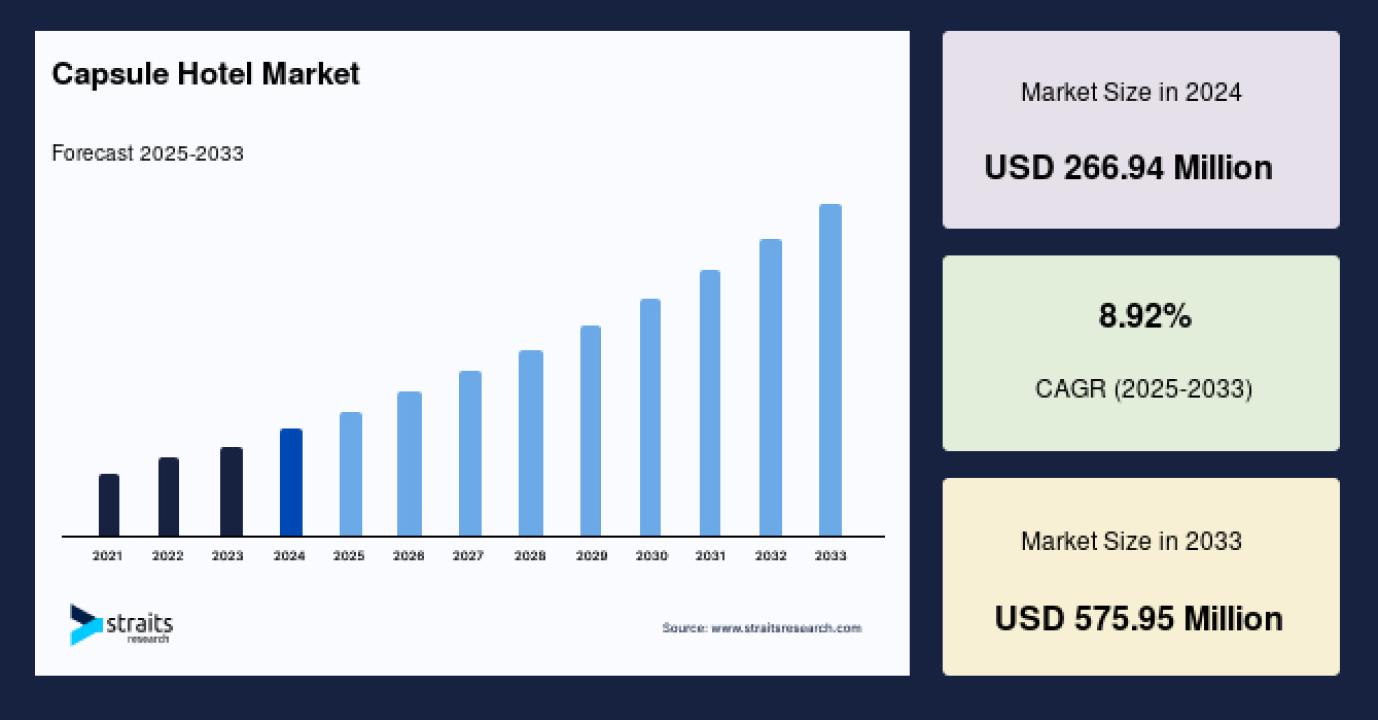
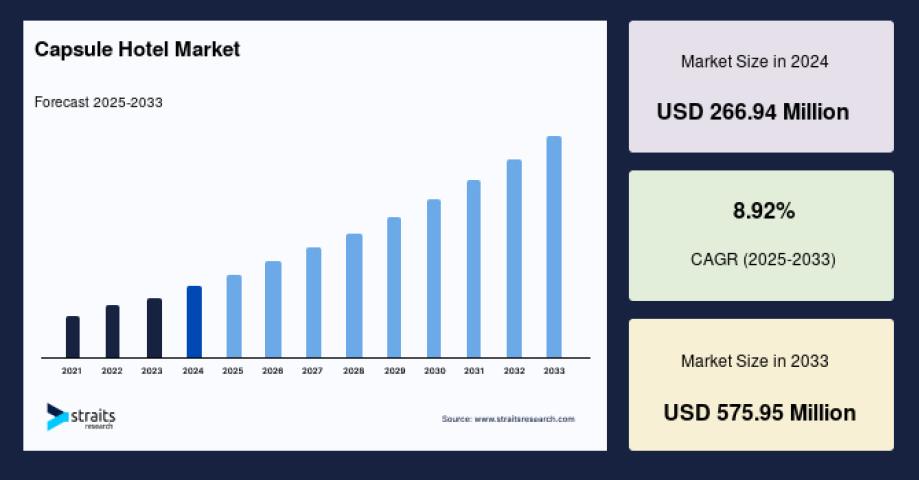
Market Size 2024 – USD 266.94 million
Market Size 2025 – USD 290.75 million
Market Size 2033 – USD 575.95 million
CAGR (2025-2033) – 8.92%
For detailed market data and insights, download a free sample: Request Sample – https://straitsresearch.com/report/capsule-hotel-market/request-sample
Market Drivers
One major driver is the affordability of capsule hotels compared to conventional hotels and lodges. These hotels offer hourly stays and are frequently situated near transport hubs like airports and train stations, catering to travelers needing short-term rest during layovers or delays. The rapid expansion of global tourism, including the rising influx of business travelers and solo tourists, fuels demand for budget-friendly lodging.
The growth of the tourism sector, especially in Asia-Pacific and emerging markets, also boosts demand. Many travelers especially younger generations like millennials and Gen Z prefer capsule hotels as economical yet comfortable accommodations for short trips or solo travel. Additionally, the increasing availability of capsule hotels in untapped markets presents significant opportunities for expansion.
Market Challenges
The capsule hotel market faces challenges such as security concerns owing to its shared space nature, and cultural acceptance barriers in some regions. Terrorism and political unrest in specific countries have negatively impacted international travel, influencing the capsule hotel demand. Moreover, competition from alternative affordable lodging options like hostels and budget hotels remains significant. The relatively early stage of capsule hotels in developed regions like North America and Europe also restrains growth compared to Asia-Pacific.
Market Segmentation
By Traveler Type
Solo Travelers: The dominant segment due to the ability to tailor experiences, spacious privacy, and affordability. Capsules efficiently use space with individual cabins meeting solo travelers’ needs.
Group Travelers: Increasingly opting for pods with double beds and amenities like Wi-Fi and lockers. Groups seek affordable options for leisure, cultural trips, and socializing.
By Booking Mode
Offline Booking: Currently leading the market, including airport and railway station counters, travel agents, and physical reservation centers.
Online Booking: Growing rapidly owing to internet proliferation and smartphone usage, allowing travelers to compare prices, avail discounts, and book conveniently.
By Age Group
Generation Y (Millennials): The largest user base due to their travel frequency, budget-consciousness, and preference for short, culturally enriching trips.
Generation Z: The second largest segment, highly cost-conscious and digitally engaged, fueling online booking growth and demand for essential amenities.
By Region
Asia-Pacific: The largest market, driven by countries like Japan, India, China, Malaysia, and Singapore. High-income growth and cultural curiosity fuel adoption.
North America: Fastest-growing, supported by rising awareness, increasing disposable income, and digital media-driven travel choices.
LAMEA (Latin America, Middle East, Africa): Emerging with rapid growth due to affluent populations, travel enthusiasm, and expanding airport capsule hotel deployments.
To purchase the full report, visit: Buy Now this report – https://straitsresearch.com/buy-now/capsule-hotel-market
Top Players Analysis
Leading players driving innovation and expansion include:
First Cabin Inc. – One of Japan’s pioneer capsule hotel brands with international expansions.
Capsule Hotels Global – Operator with multiple properties globally focusing on convenience near transport hubs.
The Pod Sydney – Australian player targeting urban millennials with modern capsule designs.
CityHub – European innovator with tech-enabled, social capsule experiences.
Book and Bed – Japan-based hybrid capsule-hostel known for the unique book-themed ambiance.
Nine Hours – Japan’s minimalistic capsule hotel chain emphasizing efficient design and service.
Yotel – International brand blending capsule concepts with futuristic automation.
Metro Capsule Hotel – Focuses on business travelers with premium amenities.
Zen Capsule Hotel – Expanding presence in Southeast Asia targeting solo and young travelers.
Zzzone Capsule Hotel – Known for affordable pods catering to budget-conscious tourists.
These players employ strategies like digital marketing, location expansion, and customizing offerings to different traveler segments to capitalize on rising market demand.
Conclusion and About Us
The capsule hotel market is poised for significant growth as affordability and convenience drive adoption globally. Expanding tourism along with evolving traveler preferences especially among millennials and solo travelers support continued demand. While challenges like security and regional market maturity persist, innovative concepts and untapped geographies provide sizable opportunities. Asia-Pacific’s dominant share and North America’s rapid growth will shape market dynamics in the coming decade.
Straits Research is a market intelligence company providing global business information reports and services. Our exclusive blend of quantitative forecasting and trends analysis provides forward-looking insight for thousands of decision-makers. Straits Research Pvt. Ltd. provides actionable market research data, especially designed and presented for decision making and ROI.
FAQs
What is the capsule hotel market size in 2024?
USD 266.94 million.
What is the expected market size in 2033?
USD 575.95 million.
What CAGR is forecasted from 2025 to 2033?
8.92%.
Which region has the largest capsule hotel market?
Asia-Pacific.
Who are the dominant traveler types for capsule hotels?
Solo travelers, due to tailored, affordable lodging.
What is the fastest-growing booking mode?
Online booking, driven by increased internet and smartphone penetration.