The sports optic market has emerged as a significant segment of the global sports equipment industry, driven by the rising demand for precision, accuracy, and enhanced viewing experiences. Sports optics such as binoculars, telescopes, riflescopes, and rangefinders play a critical role in outdoor activities including hunting, shooting sports, golf, archery, astronomy, and wildlife observation.
Technological innovations, including lightweight designs, sharper imaging, and durable construction, have boosted adoption among both professionals and recreational enthusiasts. The market’s steady growth reflects the evolving needs of adventure seekers, sports participants, and conservationists.
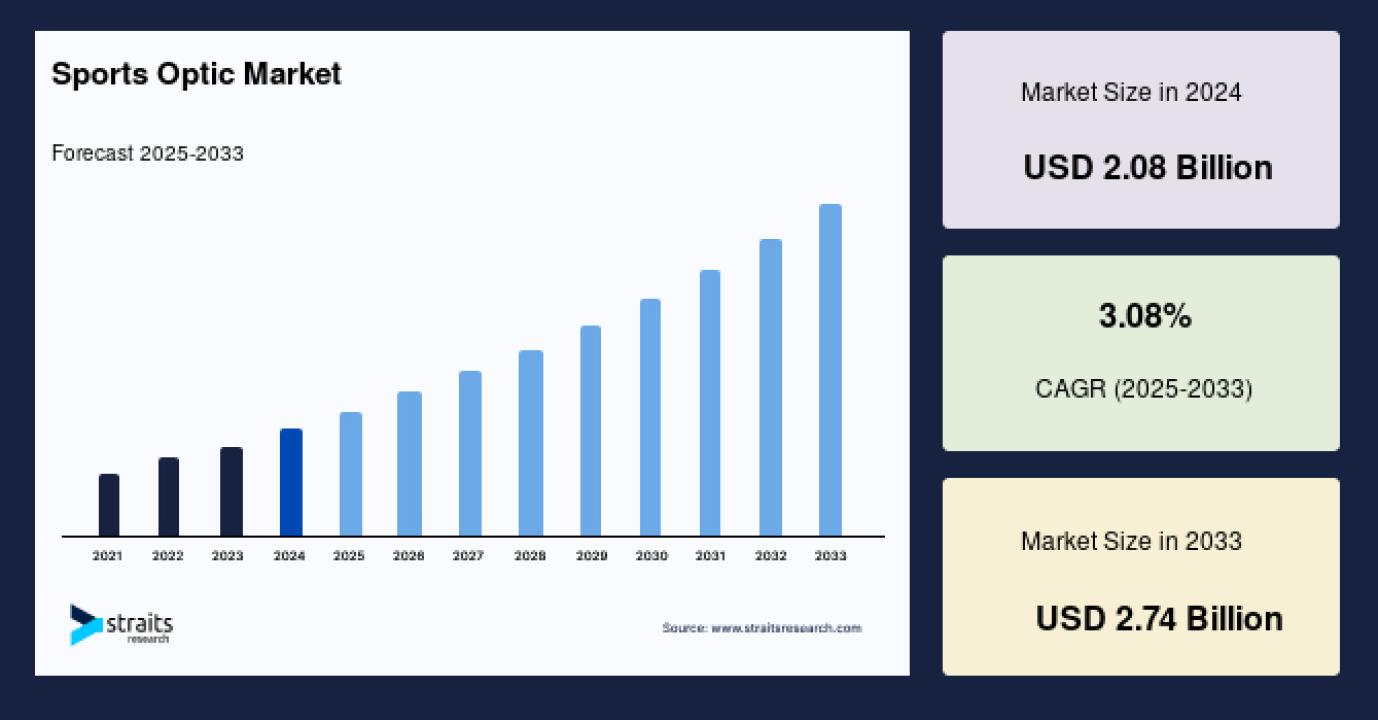
According to Straits Research, the global sports optic market was valued at USD 2.08 billion in 2024 and is projected to increase from USD 2.15 billion in 2025 to USD 2.74 billion by 2033, registering a modest CAGR of 3.08% (2025–2033).
📄 Get Sample Report for In-Depth Insights and Forecasts: https://straitsresearch.com/report/sports-optic-market/request-sample
Market Drivers
Several factors are fueling growth in the global sports optic market:
Popularity of Outdoor Recreational Activities – Rising participation in hunting, birdwatching, and wildlife tourism is driving demand for precision-based optical products.
Integration of Digital Technology – Advanced features such as range-finding, night vision, and GPS compatibility are making sports optics more versatile and appealing.
Increasing Disposable Income – Consumers in developing economies are investing in premium sports optics, enhancing market penetration.
Support from Sports and Conservation Groups – Wildlife conservation organizations and sports federations rely on advanced optics for monitoring, safety, and event management.
Market Challenges
Despite its growth trajectory, the market faces challenges:
High Product Costs: Premium optics with advanced features remain expensive, limiting access for cost-sensitive consumers.
Counterfeit Products: The availability of low-quality imitations erodes consumer trust and undermines established brands.
Regulatory Restrictions: Strict hunting laws in several regions constrain demand for riflescopes.
Competition from Alternatives: Devices like drones and digital cameras serve as substitutes in some applications.
Nevertheless, expanding e-commerce channels, product innovations, and growing brand awareness are expected to mitigate these challenges over time.
Market Segmentation
The sports optic market is segmented into product types, prism types, distribution channels, and regions:
1. By Product
Binoculars: Popular for wildlife observation, birdwatching, and live sports events.
Riflescopes: Increasingly used in hunting and shooting competitions.
Telescopes: Favored by astronomy enthusiasts and stargazers.
Rangefinders: Gaining popularity in sports such as golf and archery.
2. By Prism Type
Roof Prism: Compact, lightweight, and ideal for portability.
Porro Prism: Offers wider field of view and enhanced depth perception.
3. By Distribution Channel
Online: Fastest-growing segment, driven by global e-commerce expansion.
Offline: Remains vital through specialty stores and retail outlets.
4. By Geography
North America: Leading market, supported by hunting culture and strong demand for riflescopes.
Europe: Growth driven by wildlife tourism and adventure sports.
Asia-Pacific: The fastest-growing region due to adventure tourism and rising disposable incomes in China, India, Japan, and South Korea.
Latin America, Middle East & Africa: Gradual growth with increased interest in outdoor recreational activities.
Key Players Analysis
The market is highly competitive, with global brands focusing on innovation, advanced features, and distribution networks to strengthen their presence. Major players include:
Nikon Corporation – Renowned for precision optics across binoculars and riflescopes.
Leica Camera AG – Specializes in premium optics with cutting-edge performance.
Carl Zeiss AG – A global leader in hunting and birdwatching optics.
Vortex Optics – Popular for affordable, rugged binoculars and riflescopes.
Swarovski Optik – Focused on premium products for nature lovers and sports users.
Bushnell Corporation – Widely recognized for cost-effective optics.
Leupold & Stevens, Inc. – Known for riflescopes and gear for hunting sports.
Celestron, LLC – Strong presence in telescopes and astronomy optics.
Trijicon, Inc. – Military-grade optics adapted for sports shooting.
ATN Corporation – Leader in digital imaging and night vision optics.
These companies invest heavily in R&D, durability improvements, and digital integration to meet rising consumer expectations.
Conclusion
The sports optic market continues to expand steadily, powered by rising outdoor sports participation, growing interest in wildlife observation, and the demand for advanced, durable optical devices. Technological integration including GPS compatibility, digital imaging, and night vision has made sports optics indispensable across multiple applications.
While high costs and regulatory challenges persist, the market outlook remains positive. With consumer demand for adventure sports and wildlife activities on the rise, the global sports optic industry is set to achieve consistent growth, offering opportunities for both established players and emerging brands.
FAQs
1. What is the current size of the global sports optic market?
The market was valued at USD 2.08 billion in 2024.
2. What is the projected size of the market by 2033?
The market is forecasted to reach USD 2.74 billion by 2033.
3. What is the CAGR of the sports optic market (2025–2033)?
The market is expected to grow at a CAGR of 3.08%.
4. Which products dominate the market?
Binoculars and riflescopes are the leading product categories, with growing demand for rangefinders in golf and archery.
5. Who are the major players in this market?
Key companies include Nikon, Leica, Carl Zeiss, Vortex Optics, Swarovski, Bushnell, Leupold & Stevens, Celestron, Trijicon, and ATN Corporation.