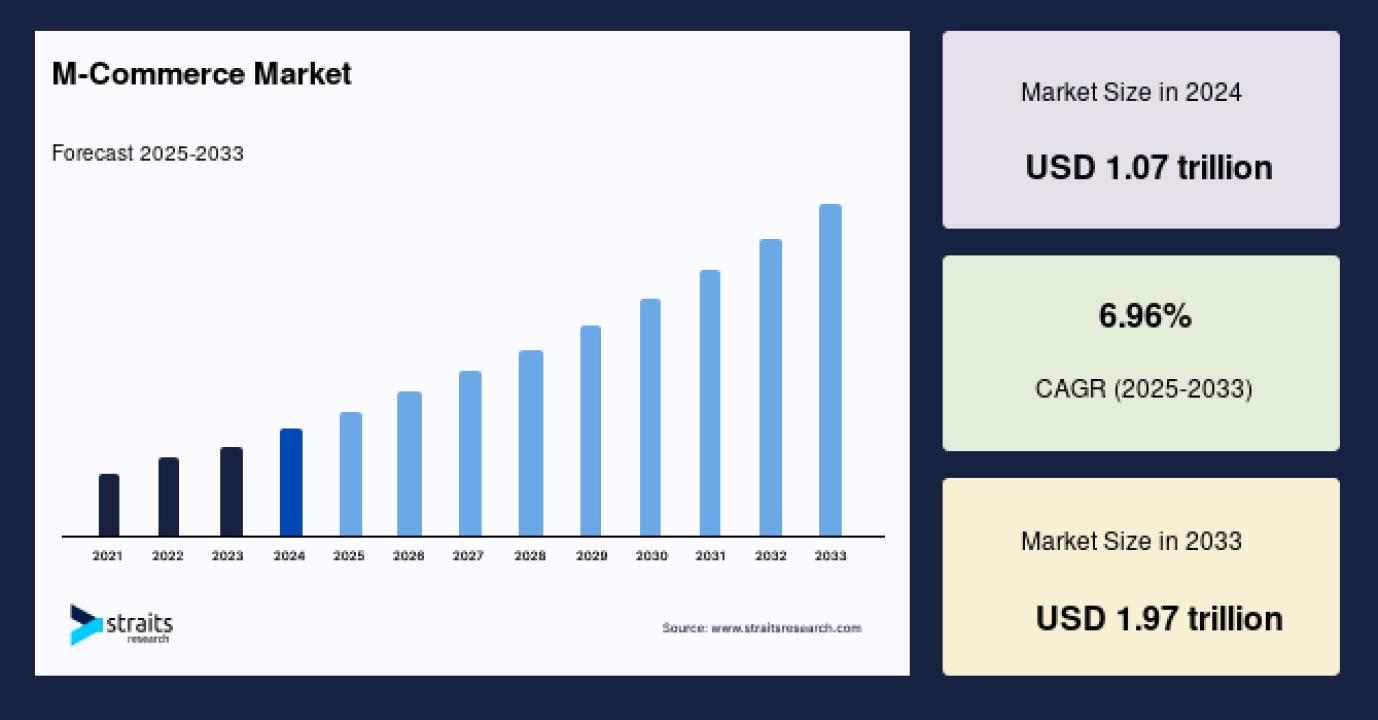

The m-commerce (mobile commerce) market is catapulting global digital economies to new heights, leveraging smartphones, fast internet, AI-driven personalization, and secure mobile payments. Consumers are adopting mobile-based transactions across retail, travel, entertainment, and financial services, thanks to seamless user experiences and rapid digital innovation. Modern m-commerce solutions are built on robust platforms that integrate dynamic pricing, augmented reality, personalized recommendations, and one-click checkout, radically reshaping the way businesses operate and engage customers. Download free sample: Request Sample- https://straitsresearch.com/report/m-commerce-market/request-sample.
Market Size 2024 – USD 1.07 trillion.
Market Size 2025 – USD 1.14 trillion.
Market Size 2033 – USD 1.97 trillion.
CAGR 2025–2033 – 6.96%.
Market Overview
M-commerce empowers users to make purchases, pay bills, and interact with brands all from the convenience of smartphones and tablets. The market’s exponential growth is propelled by the proliferation of affordable mobile devices, improved internet infrastructure, and shifting consumer preferences that prioritize speed and convenience. AI-powered personalization, real-time recommendations, and secure payment solutions like NFC and mobile wallets are fueling consumer loyalty and transaction growth.
Market Drivers
Widespread access to smartphones (over 2.5 billion users) and enhanced data connectivity, even in emerging markets, are significantly increasing mobile transaction volumes.
Innovations in mobile app technology, such as AR-based product visualization (e.g., IKEA, Sephora) and AI-driven product recommendations (Amazon), enhance the overall shopping experience.
Secure mobile payment platforms, including NFC-enabled transactions with Apple Pay, Google Pay, and contactless banking apps, drive higher engagement and repeat purchases.
The integration of chatbots and voice search capabilities accelerates purchase decisions and streamlines support interactions.
Expansion in underdeveloped regions Asia, Africa, Latin America is fueled by rising urbanization, disposable incomes, and smartphone adoption, generating untapped markets for growth.
Market Challenges
Persistent concerns over data privacy and cybersecurity, including phishing, payment fraud, and malware attacks, inhibit user trust and adoption.
Infrastructural limitations and lower internet penetration in certain regions constrain growth, particularly in less developed markets.
Competition is intense resulting in the need for constant innovation, improving app features, reducing transaction friction, and ensuring compliance with multiple regulatory standards.
Some users still hesitate to trust mobile platforms with large transactions due to the risk of security breaches and unoptimized interfaces.
Market Segmentation
By Transaction Type:
M-Retailing: Dominates the market, with consumers shopping, browsing, and making purchases directly via mobile apps and sites. Personalization and loyalty programs further incentivize usage.
M-Ticketing/Booking: Encompasses ticket purchases for travel, movies, events, and services.
M-Billing: Supports mobile-based payments for utilities and regular services.
By Payment Mode:
Near Field Communication (NFC): Leads market revenue, enabling fast, secure, contactless payments via simple taps highly popular in retail and transit.
Mobile Wallets & In-App Payments: Support one-click checkouts across commerce platforms.
Other Modes: QR codes, direct carrier billing, peer-to-peer mobile payments.
By Application:
Retail: The top segment thanks to app-based commerce, real-time deals, and location-driven marketing.
BFSI: Mobile banking, bill pay, insurance, and investment apps drive secure, rapid transactions.
Travel, Hospitality, Media & Entertainment: Mobile booking, streaming, and real-time services boost user retention.
Healthcare, Airlines, and Others: Mobile health monitoring, appointment scheduling, upgrades, and add-ons.
By Region:
North America: The dominant region, with early tech adoption and strong presence of giants like Amazon, Walmart, and PayPal driving mobile commerce innovation.
Europe: Fastest-growing market, with nations like Germany, France, and Spain leveraging mobile payments in both retail and automotive sectors.
Asia-Pacific, Africa, Latin America: Rapid market evolution due to urbanization, smartphone access, and localized content offerings, marking lucrative opportunities for growth leaders.
Buy Now this report - https://straitsresearch.com/buy-now/m-commerce-market.
Top Players Analysis
Amazon (U.S.): Global leader in mobile retail and AI-driven commerce.
PayPal (U.S.): Pioneer in secure mobile wallet and peer-to-peer payment solutions.
AiBUY: Innovator in AI-integrated shoppable videos and live commerce experiences.
Google (U.S.): Significant in payment technology, app store innovation, and mobile advertising.
Apple (U.S.): Apple Pay revolutionized secure, contactless transactions.
Walmart (U.S.): Mobile-first marketplace and omnichannel integration.
Visa & Mastercard: Payment network giants implementing robust mobile payment security.
Ericsson: Innovator in mobile commerce network infrastructure.
Gemalto (Netherlands): Specializes in mobile security and transaction solutions.
SAP, Flipkart, Shopify, Rakuten, and others actively expand specialized platforms, financing, cross-border commerce, and localized offers.
Conclusion
The m-commerce market is rapidly modernizing global retail and service sectors, with smartphone adoption, faster connectivity, and intelligent mobile platforms defining future trends. Leaders must continually invest in AI, payment security, intuitive UX, and locally relevant innovations to stay competitive.
About Us:
Straits Research is a market intelligence company providing global business information reports and services. Our exclusive blend of quantitative forecasting and trends analysis provides forward-looking insight for thousands of decision-makers. Straits Research Pvt. Ltd. provides actionable market research data, especially designed and presented for decision making and ROI line.