The construction industry is entering a new era with the integration of 3D printing technology, redefining how buildings and infrastructure are designed and executed. By offering faster, cost-effective, and sustainable solutions, 3D printing in construction is set to become one of the most disruptive forces shaping the built environment.
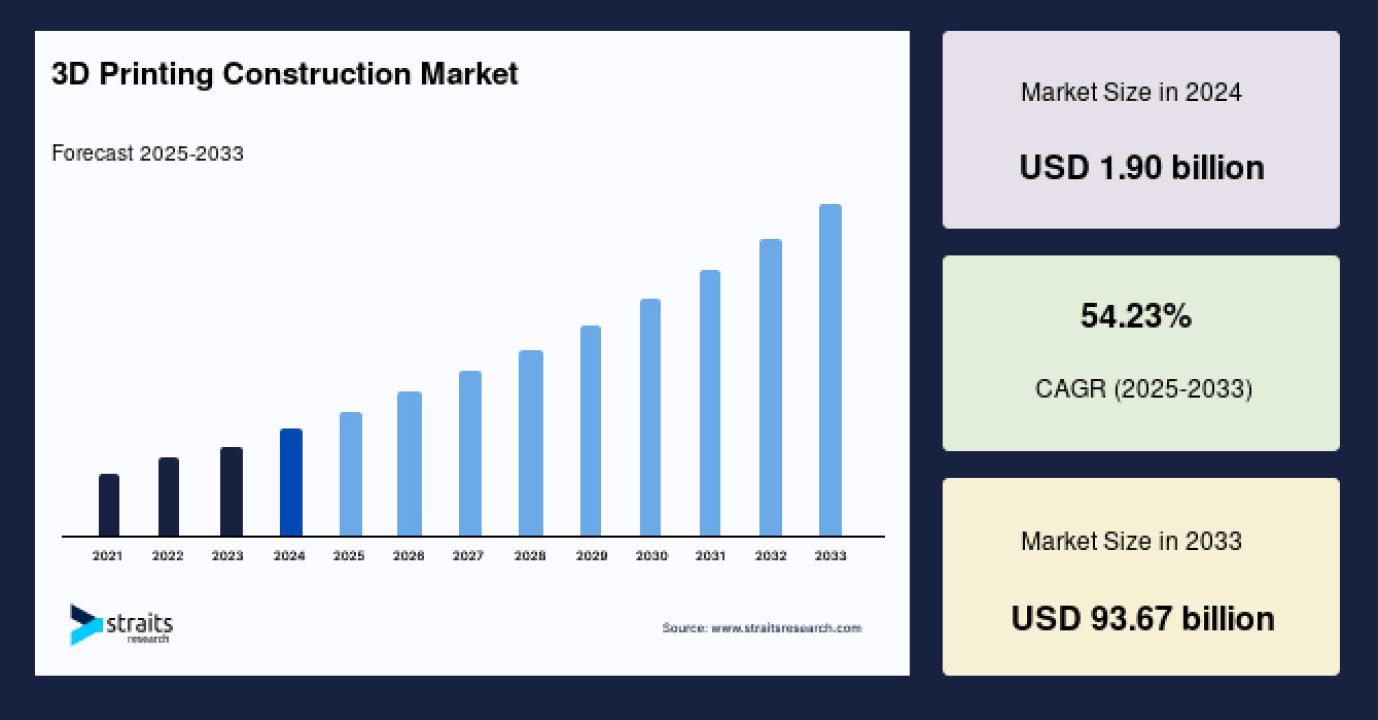
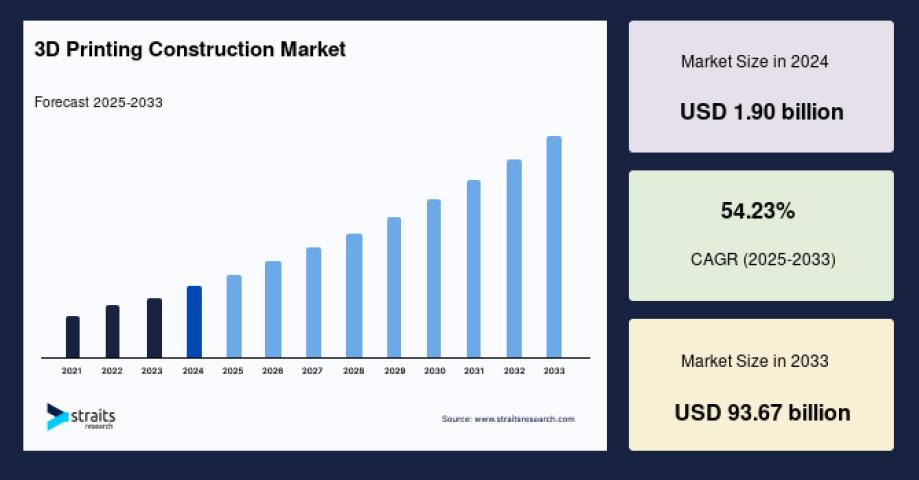
According to Straits Research, the global 3D Printing Construction Market is valued at USD 1.90 billion in 2024, projected to reach USD 2.93 billion in 2025, and an astonishing USD 93.67 billion by 2033, growing at a CAGR of 54.23% (2025–2033).
👉 Get a Free Sample Report Here
Key Market Drivers
Several powerful trends are fueling the exponential growth of this market:
Affordable Housing Demand – 3D printing supports rapid, low-cost housing development to meet global shortages.
Sustainability Goals – Reduced material wastage and eco-friendly materials align with green building initiatives.
Rapid Urbanization – Growing cities require faster and scalable construction methods.
Labor Shortages – Automation mitigates dependency on skilled labor while accelerating project timelines.
Technological Advancements – Breakthroughs in robotics, materials, and large-scale printers are pushing adoption forward.
Market Challenges
Despite its massive growth prospects, the industry faces hurdles such as:
High Initial Costs for equipment and materials.
Regulatory Barriers, as many building codes are not yet tailored for 3D-printed structures.
Skilled Workforce Gaps in operating advanced 3D construction systems.
Material Limitations, with ongoing research needed for broader applicability.
👉 Buy the Full Report for Comprehensive Insights
Market Segmentation
Straits Research segments the market across multiple dimensions:
By Construction Method – Extrusion, Powder Bonding, Others
By Material Type – Concrete, Composites, Metals, Others
By End-Use Industry – Residential, Commercial, Infrastructure, Industrial
By Region – North America, Europe, Asia-Pacific, Latin America, Middle East & Africa
Currently, extrusion technology dominates the sector, particularly for walls, foundations, and structural components. The residential segment shows the fastest growth, driven by affordable housing initiatives.
Leading Companies in the Market
The competitive landscape is dynamic, with major players focusing on innovation, collaborations, and large-scale deployment. Key companies include:
ICON Technology, Inc.
COBOD International A/S
Apis Cor Inc.
Winsun (Yingchuang Building Technique Co. Ltd.)
CyBe Construction B.V.
XtreeE SAS
Sika AG
MX3D B.V.
WASP S.r.l.
Mighty Buildings, Inc.
These firms are heavily investing in robotic systems, eco-friendly materials, and pioneering projects that push 3D printing construction into mainstream adoption.
Conclusion
The 3D Printing Construction Market is on track for exponential growth, projected to hit USD 93.67 billion by 2033. Its ability to cut costs, accelerate project timelines, and address global housing shortages makes it a pivotal force in the future of construction. While regulatory hurdles and upfront costs remain challenges, continuous innovation and large-scale adoption will ensure rapid transformation in the coming decade.