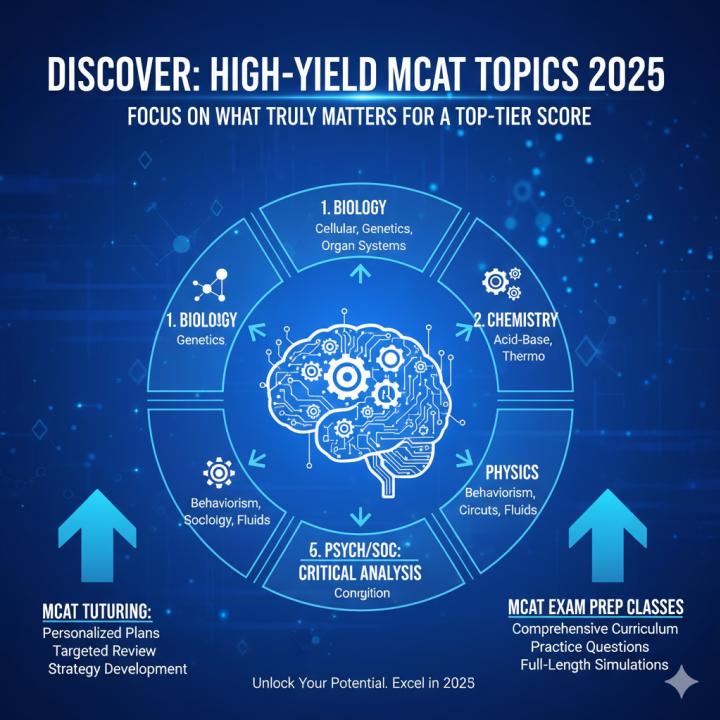
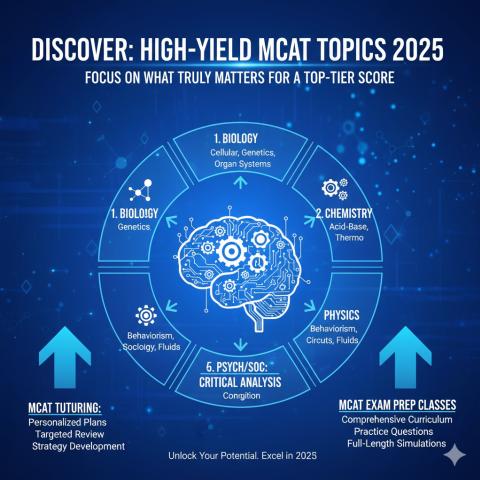
The MCAT remains one of the most challenging exams for aspiring medical students. Each year, thousands of test-takers spend months mastering complex topics, yet many later admit they focused too much on low-yield material. Understanding high-yield MCAT topics—those that appear most frequently and carry significant weight—can drastically improve efficiency, confidence, and scores.
In 2025, with updated exam formats and changing emphasis areas, mastering the right content is more critical than ever. Strategic learners are turning to MCAT tutoring and MCAT exam preparation classes to help them pinpoint and strengthen these high-yield areas.
Understanding the Structure of the MCAT in 2025
Recent Updates to the MCAT Format
The 2025 MCAT maintains its traditional four-section format:
- Chemical and Physical Foundations of Biological Systems (Chem/Phys)
- Critical Analysis and Reasoning Skills (CARS)
- Biological and Biochemical Foundations of Living Systems (Bio/Biochem)
- Psychological, Social, and Biological Foundations of Behavior (Psych/Soc)
However, subtle shifts have occurred. Recent exams emphasize experimental design, data interpretation, and integrative reasoning. Understanding these changes ensures that your study plan aligns with current expectations.
Section Breakdown: What Each Area Tests
Each section assesses different competencies:
- Chem/Phys: Physics, general and organic chemistry, and biochemistry.
- CARS: Reading comprehension and logical analysis.
- Bio/Biochem: Molecular biology, genetics, and cell processes.
- Psych/Soc: Behavioral sciences and research-based social principles.
Knowing where to focus effort—especially in topics repeatedly tested—is where the concept of “high-yield” becomes essential.
The Concept of “High-Yield” Topics Explained
What Makes a Topic High-Yield?
A “high-yield” topic appears frequently across test forms and requires conceptual mastery, not rote memorization. Think of:
Amino acid structure and properties
Enzyme kinetics and inhibition
Newtonian mechanics
Hormonal regulation and homeostasis
These topics form the backbone of multiple question sets.
Common Mistakes Students Make While Choosing Topics
Students often fall into the trap of:
- Spending weeks on obscure chemistry mechanisms
- Ignoring core biological pathways
- Over-prioritizing memorization instead of understanding principles
Professional guidance through MCAT tutoring helps eliminate these inefficiencies early in the prep cycle.
High-Yield MCAT Topics for 2025: Complete Overview
Biology and Biochemistry Must-Know Concepts
- Enzyme kinetics, Michaelis-Menten graphs
- DNA replication, transcription, and translation
- Hormonal regulation (insulin, glucagon, cortisol)
- Cellular respiration and metabolic pathways
Organic Chemistry and General Chemistry Highlights
- Acid-base reactions and titration curves
- Functional group recognition
- Thermodynamics and kinetics fundamentals
Physics and Math Essentials
- Kinematics, forces, and energy conservation
- Circuits, Ohm’s Law, and capacitors
- Data interpretation and basic statistics
Psychology and Sociology Key Theories
- Freud, Piaget, Erikson developmental stages
- Social identity theory, conformity, and bias
- Research methodology and ethics
CARS: High-Yield Strategies
CARS demands critical reading, not memorization.
Focus on:
- Author’s tone and purpose
- Elimination of distractors
- Consistent daily reading practice
What Students Wish They’d Studied More
Overlooked Topics That Frequently Appear
Many students regret underestimating:
- Experimental design and data analysis
- Metabolism integration (glycolysis + TCA + ETC)
- Neurotransmitter pathways
Misunderstood Concepts That Lower Scores
Common issues include misunderstanding enzyme inhibition, misreading graphs, and under-practicing psychology experiments.
Balancing Time Between Low-Yield and High-Yield Areas
A common regret: spending too much time mastering low-yield chapters. The best strategy is to allocate 70% of your time to high-yield content and the rest to review weak spots.
The Role of MCAT Tutoring in Maximizing High-Yield Learning
Personalized Study Plans Through Professional Tutors
MCAT tutoring offers customized plans that pinpoint your unique weaknesses and guide you toward high-yield mastery. Tutors provide:
- Personalized diagnostic tests
- Structured timelines
- Feedback on reasoning strategies
Benefits of MCAT Exam Preparation Classes vs. Self-Study
MCAT exam preparation classes create accountability and structured pacing. Group learning fosters competition and shared insights, while guided sessions cover test trends that students might miss alone.
Strategic Tips for Effective MCAT Exam Preparation
Building a Study Schedule Around High-Yield Topics
Start by mapping topics by frequency, then build a weekly cycle of review, practice, and recall.
Active Recall, Spaced Repetition, and Practice Tests
Tools like Anki and UWorld help reinforce content through repetition and application.
Managing Burnout and Motivation During Prep
Short, consistent study bursts with rewards improve retention and prevent fatigue.
Tools, Resources, and Study Materials for 2025
Category | Recommended Resources |
Official Practice | AAMC Practice Tests |
Review Books | Kaplan, Princeton Review |
Online Tools | MCATKING, UWorld, Jack Westin |
Tutoring | MCATKING, Altius, private tutors |
Common Pitfalls to Avoid in MCAT Preparation
- Cramming too close to the exam date
- Ignoring CARS until the final month
- Neglecting timed practice under exam conditions
FAQs About MCAT Tutoring and Exam Preparation Classes
Q1: How early should I start MCAT tutoring?
Ideally, 6–8 months before your test date for personalized pacing.
Q2: Are MCAT exam preparation classes worth the cost?
Yes, especially for students who need structure and external motivation.
Q3: How do tutors identify high-yield topics for each student?
Through diagnostic assessments and past MCAT trend analysis.
Q4: Can I combine tutoring with self-study?
Absolutely. Many students use tutoring to guide their self-study efficiently.
Q5: What’s the average improvement after taking MCAT classes?
Students often report a 7–10 point increase with consistent effort.
Q6: Do online classes offer the same benefits as in-person prep?
Modern platforms provide equally interactive sessions with flexible scheduling.
Conclusion: Mastering the 2025 MCAT Through Smart Preparation
Success in the 2025 MCAT isn’t about studying everything—it’s about studying smart. Focusing on high-yield topics, integrating feedback from MCAT tutoring, and enrolling in MCAT exam preparation classes can make all the difference.
A well-guided, high-yield approach not only saves time but ensures you walk into test day confident, prepared, and ready to outperform.